
Sentence Rewriter: How to Keep Meaning Intact
Use a sentence rewriter without losing facts, names, or tone. See what synonym swaps, paraphrase, and Unicode cleanup each change.
The popular advice to swap a few words and make a sentence sound more human misses the point. A sentence rewriter should produce different wording without changing what the author claims. Smoother prose, cleaner Unicode and a lower detector score aren't interchangeable outcomes.
The useful question is what needs changing: vocabulary, structure, hidden characters or a statistical token-choice pattern. Each calls for a different operation, and none provides an authorship verdict.
Table of Contents
- What a Sentence Rewriter Must Keep
- How to Rewrite One Sentence Step by Step
- Hidden Characters Versus Watermark Rewrites
- Check Facts Names and Tone Side by Side
- Fix Drift With Tighter Prompts
- Read the Result Before You Copy It
What a Sentence Rewriter Must Keep
Before choosing a tool, identify what must survive: numbers, dates, proper nouns, quotations, modality and tone. A reader should recover the same proposition from the rewrite, including who did what and how certain the author was.
Preservation comes before polish. Replacing may with will isn't a style improvement. Moving a qualification away from the claim it limits can also change meaning without introducing any obviously incorrect word.
What each rewrite method changes
| Method | What changes | What must stay | Typical failure |
|---|---|---|---|
| Synonym swap | A few content words | Facts, syntax, and rhythm | Still reads like the source |
| Clause reorder or voice shift | Order, emphasis, active or passive | Numbers, names, modality, tone | A modifier attaches to the wrong noun |
| Constrained prompt | Wording inside stated limits | Underlined facts and claim strength | The model adds, drops, or softens a claim |
| Full-sentence paraphrase | Lexis and sentence structure | The underlying proposition | Fluent text that is no longer the same claim |
| Hidden-character cleanup | Invisible or non-printing code points only | Every visible word | Treated as if it rewrote a statistical pattern |
A synonym swap suits a repeated word, not a sentence whose logic is tangled. Clause movement can improve emphasis, but the editor must check which noun each modifier describes. A constrained prompt is the practical default when wording needs work but factual boundaries are fixed.
Full-sentence paraphrase rebuilds the expression rather than decorating the original syntax. The 2007 WMT paper on English-to-English decoding demonstrated full-sentence paraphrasing through a statistical machine-translation system, establishing a foundation beyond isolated word substitution. More freedom to regenerate a sentence also means more opportunities to alter its claim.
Choose the smallest useful change
If the wording is already right and the problem is pasted formatting, a plain-text converter is a better starting point than regeneration. Converting formatting isn't an editorial reason to replace accurate words.
For a complementary review workflow, Voice Control Pro explains how to check AI rewrites for factual accuracy. That check belongs before acceptance, not after publication.
Practical rule: Use the least invasive operation that fixes the actual defect.
Before processing a draft, an editor can classify a candidate sentence using the table. Does it need a different word, a different structure, explicit rewriting constraints or only character cleanup? If the editor can't name the defect, generating alternatives is likely to create unnecessary review work.
How to Rewrite One Sentence Step by Step
Consider this hypothetical sentence:
The trial enrolled 128 patients and may reduce readmissions.
A bad rewrite would be: The study cured 128 people and will cut readmissions. Enrollment became a cure, patients became people, and possibility became certainty. The sentence sounds confident because it now claims something different.
The workflow below keeps the same example small enough to inspect.
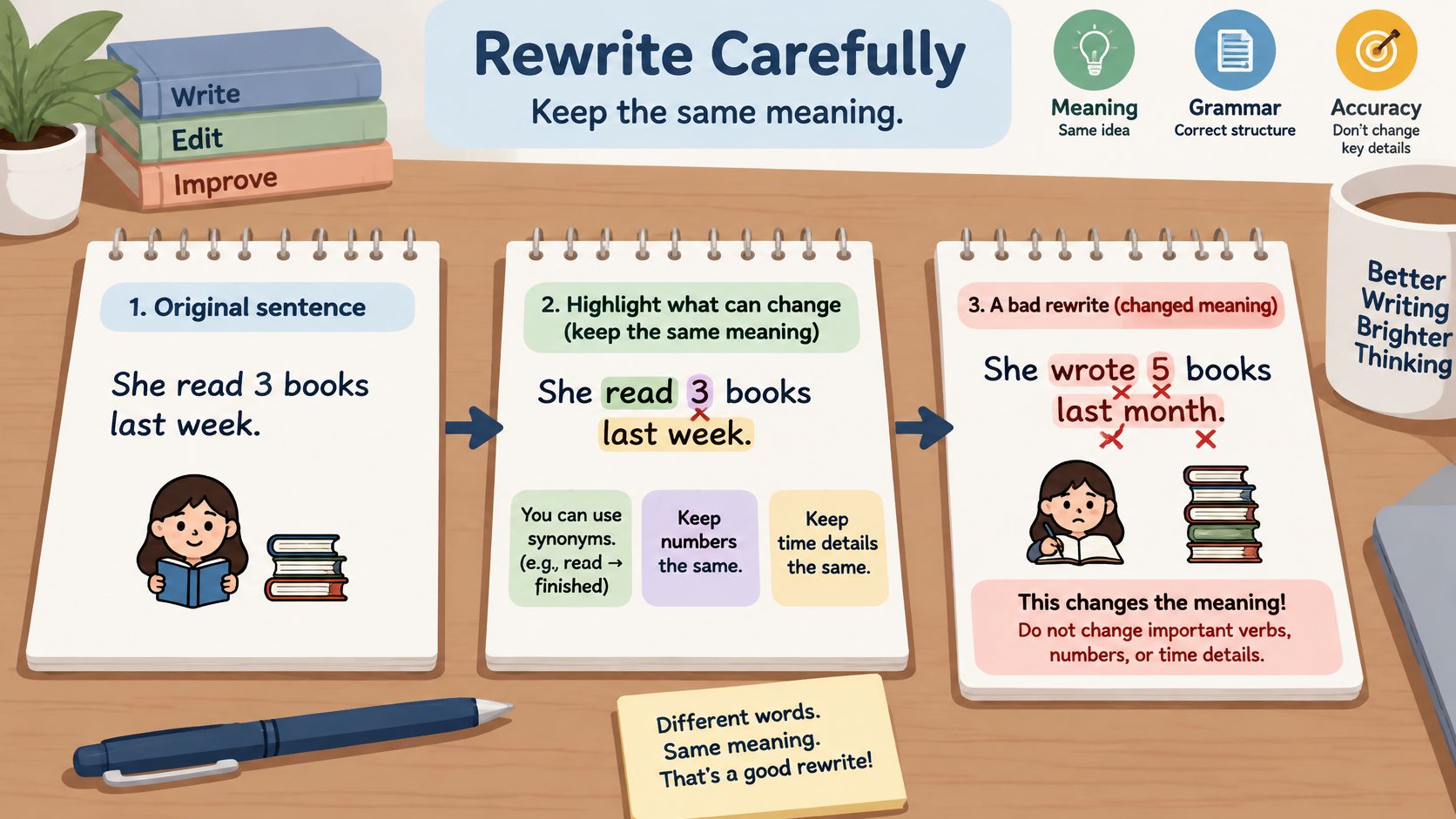
Establish the boundaries before generating
Isolate the sentence and mark protected content.
In the hypothetical original, underline 128 patients, enrolled, may and reduce readmissions. Also mark any names, dates or direct quotations when they appear.Protect relationships as well as strings. Keeping 128 somewhere in the output doesn't help if the rewrite changes it from an enrollment count into a recovery count. For developers, checking exact strings is useful, but it can't replace checking what those strings describe.
Write the editing job in a single line.
A suitable instruction is: Clearer syntax for a clinician; same claim strength; no new facts. This separates the desired improvement from the content that isn't available for revision.An instruction such as make this stronger is unsuitable here. Stronger can mean more readable, more persuasive or more certain, and the model may choose the wrong interpretation.
Draft by hand before requesting a full paraphrase.
A plausible first attempt is: Readmissions may fall after a trial that enrolled 128 patients. It preserves the sample size and hedge, but after introduces a temporal relationship that the original didn't explicitly state.That makes it provisional, not automatically faithful. A closer alternative is: The trial, which enrolled 128 patients, may reduce readmissions. The clause structure changes while the original relationship remains intact.
Give a model explicit constraints if assistance is useful.
A practical prompt is: Rewrite for clearer syntax. Keep the underlined items verbatim, including may. Preserve the distinction between enrollment and outcomes. Change structure without adding a cause, result or time relationship.Keep the source sentence alongside the prompt. Asking for a rewrite from a summary of the original creates another opportunity to lose a qualification before generation even begins.
Inspect the output before expanding the task
Paste the candidate into Simple Unmark, the publisher's own text cleaner.
The workflow uses a single box with nothing to set up, and the browser scans for hidden characters as text is entered. The rewrite aims to preserve meaning, facts, names and tone.Character feedback and semantic review serve different purposes. A clean character scan doesn't establish that enrolled survived as enrollment or that may retained its uncertainty.
Read the cleaned sentence aloud, compare it with the marked original, and only then copy it.
Reject a new outcome, an unexplained change of actor or a stronger conclusion. Reading aloud helps expose awkward syntax, but the visual comparison catches factual substitutions that sound perfectly natural.Don't expand the workflow to a paragraph until this sentence passes. Paragraph rewriting adds references, transitions and relationships between claims, so unresolved sentence-level errors become harder to locate.
Hidden Characters Versus Watermark Rewrites
Hidden-character cleanup removes code points. Unicode normalization standardizes character representations. Statistical watermark rewriting changes wording. These aren't stronger and weaker versions of the same operation.
A text-processing pipeline should expose them as separate choices. Otherwise, an editor may pay for an unnecessary rewrite, or a developer may describe a formatting utility as something it cannot do.
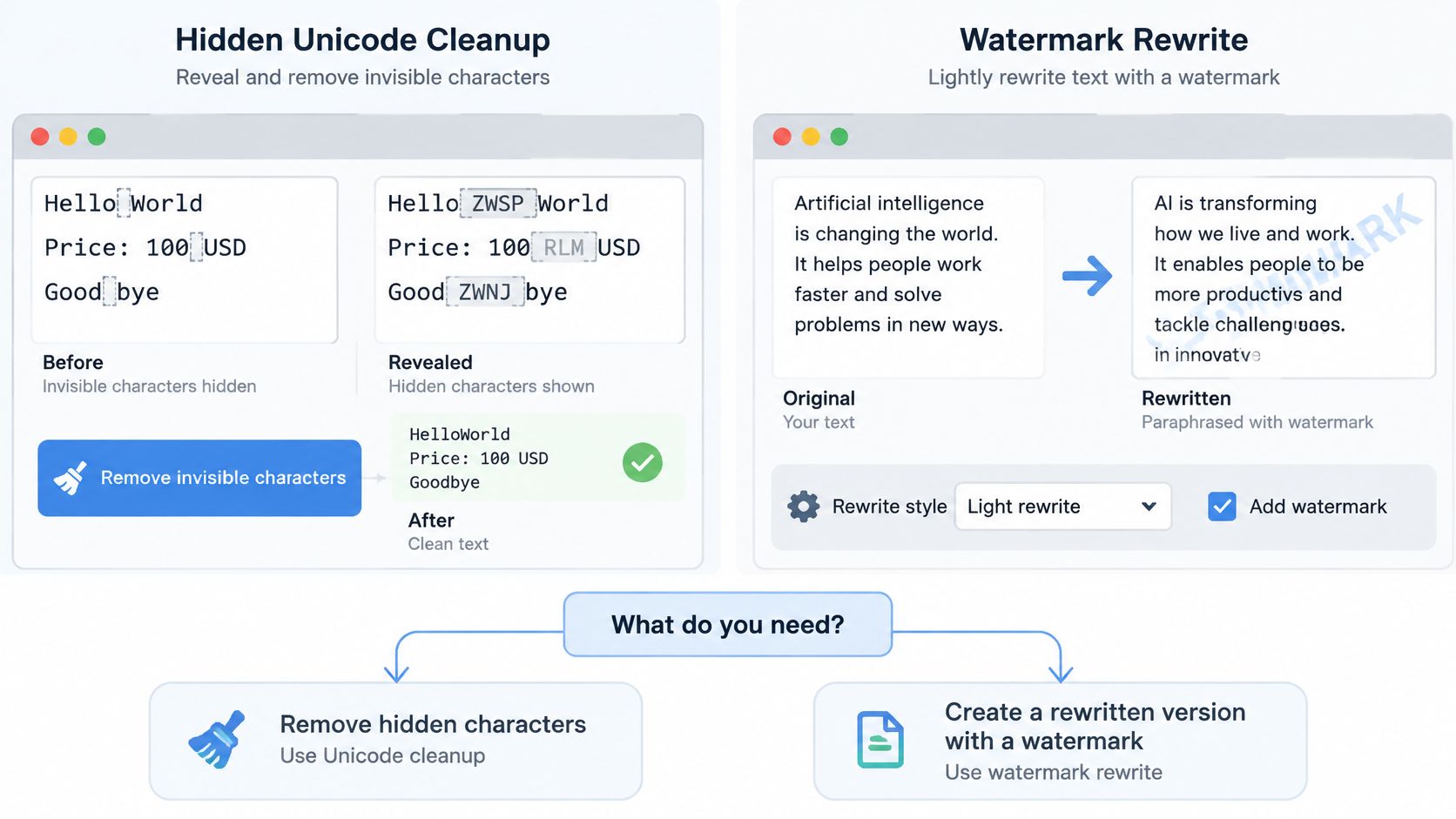
Hidden Unicode characters to check
The Unicode Consortium's invisible-character FAQ identifies the following code points among invisible or default-ignorable characters. Their presence doesn't prove AI authorship.
| Character | Code point | Typical effect |
|---|---|---|
| Zero-width space | U+200B | Can interrupt search matching or copied text without appearing |
| Zero-width non-joiner | U+200C | Stops adjacent glyphs joining in some scripts |
| Zero-width joiner | U+200D | Joins glyphs and can alter tokenization |
| Left-to-right mark | U+200E | Influences bidirectional text ordering |
| Soft hyphen | U+00AD | Usually displays a hyphen only at a line break |
| Word joiner | U+2060 | Prevents a line break without printing |
| Zero-width no-break space | U+FEFF | Can arrive through paste or byte-order marks |
Some of these characters perform legitimate linguistic or layout work. Removing joiners indiscriminately can damage multilingual text even when an English-only preview looks unchanged. An inspector should show the code point and surrounding context so the editor can judge whether removal is appropriate.
Standard Unicode normalization is a separate operation. For example, NFC can compose an accented letter from a base character and combining mark where a canonical composition exists. It doesn't serve as a general-purpose search for zero-width characters.
A watermark can exist without hidden characters
The text-watermarking paper on rewording vulnerabilities describes statistical signals based on token choices and their vulnerability to paraphrasing. A keyed generation rule can influence which words a model selects without inserting an invisible marker.
Deleting zero-width marks, normalizing Unicode, converting rich text to plain text or removing line breaks doesn't itself replace those word choices. Those operations therefore can't establish removal of a token-choice watermark.
Simple Unmark's combined cleaning process removes hidden characters and rewrites wording to break up statistical patterns. It cannot measure the remaining provider watermark signal or guarantee removal, permanent undetectability or a particular AI detector score. Its rewrite is text-only and needs human review.
The distinction is developed further in the hidden Unicode versus statistical watermarks guide. A provider-labelled page also isn't evidence that every output from that provider is watermarked; that claim must not be assumed for ChatGPT.
Choose character hygiene for unwanted code points, normalization for representation consistency, and reviewed paraphrase for wording changes. None supplies a detector verdict.
Check Facts Names and Tone Side by Side
Place the original and candidate in adjacent columns. Compare claims rather than judging which version sounds more professional, and mark each preserved item explicitly.
A rewrite passes only when the author can account for its changes. A familiar-looking paragraph isn't enough: readers often overlook a substituted verb when the surrounding wording remains recognizable.
Side-by-side preservation checks
| Check | Keep from the source | Fail if the rewrite |
|---|---|---|
| Numbers and units | Exact digits and units | Rounds, converts, or drops a figure |
| Names | Spelling of people, products, and places | Uses a nickname or swaps an entity |
| Dates | The same calendar point | Replaces a date with a relative time |
| Modality | must, may, might, and other hedges | Strengthens or softens the claim |
| Quotations | Verbatim words or a clear paraphrase label | Presents a paraphrase as a quotation |
| Tone | Formal, blunt, warm, or technical register | Flips register or adds sales language |
In the hypothetical trial sentence, 130 patients fails even though it looks like harmless rounding. A replacement such as participants also deserves inspection: the source may use patients deliberately to identify the population.
Names and dates need equally literal checking. A nickname may identify a different person, and next year becomes ambiguous when text is republished. Keep the original calendar reference unless the author deliberately updates it.
Review the qualifications around the facts
Citations and hedges belong in the same pass. One trial suggests cannot become evidence shows merely because the second phrase reads more cleanly. Nor should a citation move to the end of a sentence that now contains additional, unsupported claims.
A smoother sentence is not a faithful sentence.
Quotation marks require special care. A paraphrase can accurately convey an idea while still being unsuitable as a direct quotation; either restore the exact words or clearly present the passage as paraphrase. Tone also carries intent, so a blunt operational warning shouldn't emerge as promotional copy.
Detector output can't substitute for this review. A 2026 study published in AI and Ethics reported that 75–85% of human-authored texts were classified as AI-generated after polishing, with 15–25% receiving high-confidence AI classifications.
That finding is a warning about authorship assessment, not a technique for manipulating it. Students, editors, researchers and non-native English writers can use legitimate editing assistance without a detector becoming reliable evidence of either authorship or factual preservation.
For academic, legal, employment and publishing work, a responsible human should approve substantive changes. Preserve the original, retain a reviewable record of edits, and disclose assistance according to the applicable policy.
The pass rule is concrete: every underlined item from the drafting stage remains identical or has been deliberately and visibly changed by the author. An unexplained difference means the candidate returns for correction.
Fix Drift With Tighter Prompts
Constraints work better when they name the specific failure to avoid. These prompts keep the editing task narrow rather than asking a model to improve everything at once.
Prompts that set a clear boundary
- Clarity: Rewrite this one sentence for a general reader. Keep every number, name, date, and modal verb. Do not add causes or outcomes. This limits explanation that sounds helpful but introduces unsupported reasoning.
- Compression: Shorten to one clause without changing claim strength. This targets length, but the result still needs checking for dropped qualifications or lost facts.
- Audience: Retell for clinicians; keep the hedge and the sample size. This allows appropriate terminology without treating specialist readers as permission to strengthen the conclusion.
These are working instructions, not guarantees. If the compression request can't preserve the enrollment detail and possible outcome together clearly, abandon the clause limit. Fidelity matters more than satisfying a stylistic constraint.
Repair the claim before the rhythm
In the trial example, a candidate containing will eliminate readmissions fails in separate ways. May became will, and reduce became eliminate. Fixing only the modal would leave an unsupported claim of complete prevention.
Restore the modal first, then the outcome verb, then any noun that became more specific. Only after those repairs should the editor adjust rhythm or sentence length. This order prevents cosmetic revisions from hiding a substantive error.
Keep direct quotations and citation strings outside the rewritten span. Give the model only the prose that may change, while retaining enough context to resolve pronouns and technical terms. Where possible, keep a single claim in each sentence so the model doesn't merge findings with different qualifications.
A second translation pass is a poor repair method for text with fragile numerical details. It generates another candidate rather than explaining what went wrong in the existing one, and it adds another comparison task.
More aggressive paraphrase has a cost
The Google SynthID guide states that confidence can fall substantially after thorough rewriting or translation, while watermarking is less effective for factual responses because there is less freedom to change token choices without reducing accuracy. That constraint matters: tightly specified facts leave fewer safe alternatives than open-ended descriptive prose.
For dated provider claims, consult Simple Unmark's methodology and provider-status guide, record the review date, and recheck the provider documentation before relying on the claim. A provider-specific capability shouldn't be presented as permanently current or generalized to unrelated models.
Passage length, watermark scheme, detector threshold, language and degree of rewriting all affect the trade-off. SynthID detection also isn't a universal test of AI authorship. A reduced signal doesn't establish who wrote a sentence or whether its facts survived editing.
Stop when the sentence is clear and still true, not when a score looks reassuring.
If constraints repeatedly fail, use the manual candidate or retain the original. Repeated regeneration isn't a reason to lower the acceptance standard.
Read the Result Before You Copy It
The final choice depends on the defect, not the tool's name. Correct visible wording shouldn't be regenerated just because pasted text contains formatting debris.
Choose the appropriate path
- Character-only problems: Simple Unmark's free invisible-character inspector is unlimited and runs locally without signup or uploads. Free line-break removal and plain-text conversion also run locally, require no credits, and don't rewrite wording or verify statistical watermark removal.
- Wording problems: The text-only rewrite workflow requires a side-by-side content check before copying. Simple Unmark accepts text only, not image, video or audio files.
Guests get 3 cleans of up to 100 words each. Accounts receive 10 starter credits and can clean up to 5,000 words or 60,000 characters per clean. Private costs 0.1 credit per started 100 words, with partial blocks rounded up; Confidential costs 2x the Private rate.
Credits start at $5, never expire, and there's no subscription. Choose the privacy mode before every rewrite rather than assuming that all processing stays in the browser.
Make the privacy and approval decisions explicitly
Private sends text through Simple Unmark's app/workload and DeepInfra. Confidential bypasses the web backend using browser-to-workload encryption, but DeepInfra still sees the text to perform rewriting. Confidential AI is coming soon; encryption must not be described as hiding submitted text from the AI provider.
The service mustn't be used for fraud, impersonation, plagiarism, evasion of academic or workplace rules, or infringement. Rewording doesn't remove attribution obligations or grant permission to reuse someone else's material.
A peer-reviewed study in the International Journal of Educational Technology in Higher Education found AI-text detection technologies weren't highly reliable and were vulnerable to adversarial techniques. No detector score counts as clearance to publish, submit or attribute a passage.
Human review remains required. Read the sentence once more, confirm that it still makes the original claim, and copy only the version that passes. If the comparison leaves an unresolved difference, stop.
Simple Unmark offers local character-cleanup utilities and text-only rewriting for different editing needs. Visit Simple Unmark to choose the appropriate operation, then compare the result with the original before copying it.
- sentence rewriter
- paraphrase method
- unicode cleanup
- tone preservation
- watermark rewrite
Related articles
Rewrite Text Online Free: 8 Tools and Their Limits
Compare free rewriting workflows, current input limits and privacy. Test a short sample and check facts, tone and qualifications before accepting it.
How to Rewrite AI Content: A Practical Review Workflow
Improve an AI-assisted draft with clearer structure, specific wording and factual checks. Inspect hidden characters and compare the final text with its source.
AI Content Rewriters: What Changes and What to Check
Understand how rewriters change wording and structure, why facts need checking, and how character cleanup differs from statistical watermark rewriting.