
AI Content Rewriter: How It Works and What to Expect
An AI content rewriter changes wording and sentence structure to keep meaning intact. Learn how it works, what it can and can't do, and how it differs
You paste an AI draft into your document, and something feels off right away. The tone is flat, a few lines look oddly spaced, and a detector flag makes the whole piece harder to trust. That's usually where an AI content rewriter enters the picture, not as a magic fix, but as a way to clean up two different problems that people keep mixing together: token-pattern watermarking and invisible Unicode artifacts.
A basic spell-checker won't solve either one. It can fix typos and punctuation, but it won't touch the statistical pattern left by AI generation, and it won't reliably expose hidden characters that break copying or search. If you want the practical version of what rewriting can and can't do, start with the two-layer model below and keep that distinction in mind while you read. For a quick primer on removal workflows, see how to rewrite content.
Table of Contents
- Why People Reach for an AI Content Rewriter
- How AI Watermarking Works
- What an AI Content Rewriter Can Change
- Rewriting vs Basic Editing vs Watermark-Only Tools
- Invisible Unicode and Text Cleanup
- A Realistic Cleaning Workflow
- What Rewriting Cannot Promise
- Quick Checklist Before You Clean a Passage
Why People Reach for an AI Content Rewriter
The usual starting point is messy. Someone pastes text from ChatGPT, Gemini, or Claude into a draft, then notices strange spacing, a voice that sounds a bit too smooth, or a watermark warning that raises questions. At that moment, the problem isn't just wording, it's whether the text is carrying a detectable AI pattern or hidden formatting junk.
Practical rule: if the issue is only a typo, use an editor. If the issue is the way the text was generated or pasted, you need a rewrite or cleanup step.
That's why people reach for an AI content rewriter instead of a formatting tool. The rewriter works on the structure of the passage, not just the surface. It can change phrasing, sentence rhythm, and word choice while keeping the meaning intact, which matters when the goal is to make output more natural or less pattern-heavy.
A spell-checker can't do that. It doesn't know whether a phrase was shaped by generation patterns, and it won't show you whether invisible Unicode marks are sitting between words. This article keeps those two layers separate so you can tell whether you need a rewrite, a cleanup, or both. For a product-oriented overview of removal workflows, Simple Unmark has a guided page on how to remove AI watermarks from text.
How AI Watermarking Works
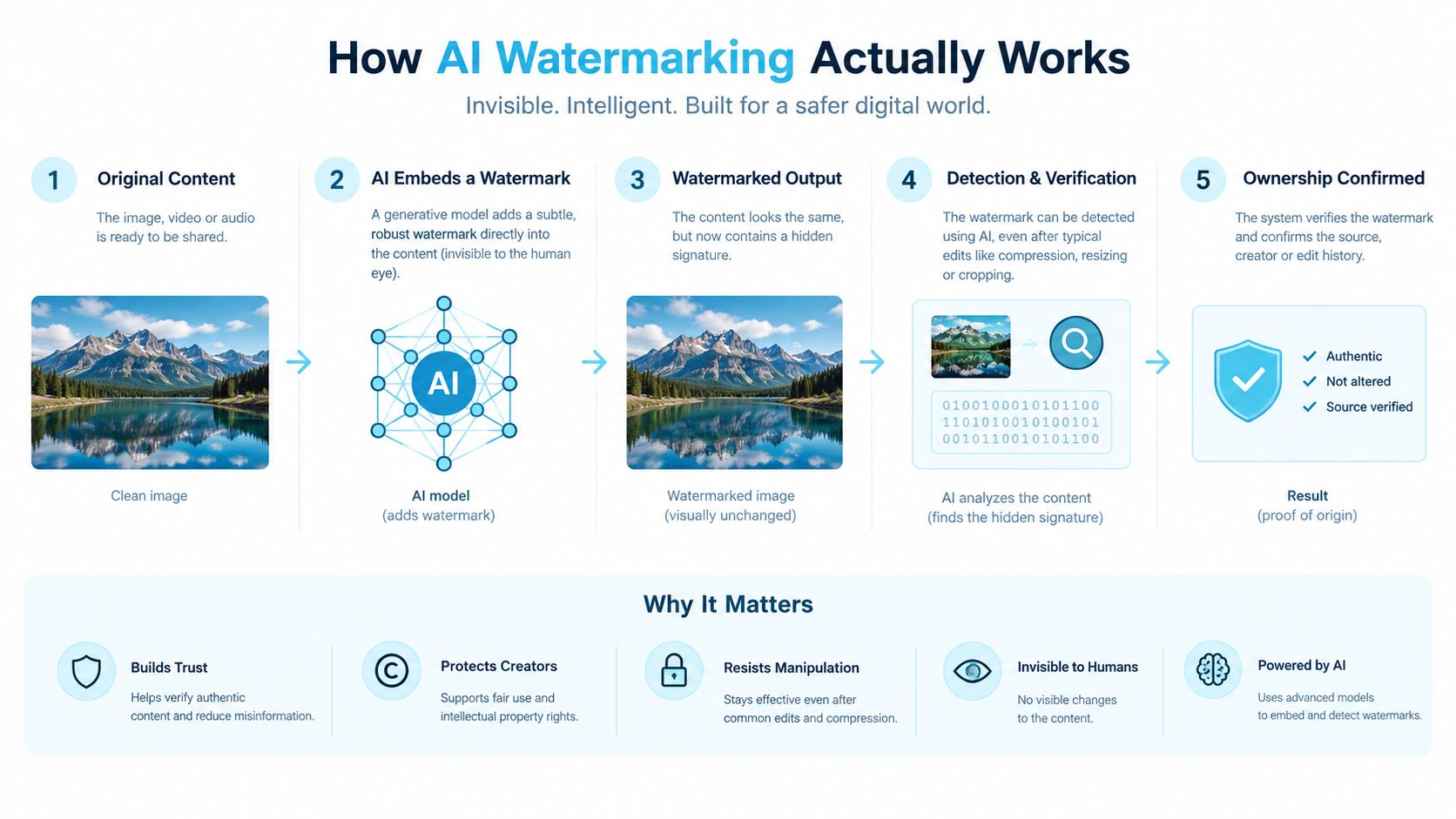
Watermarking starts while the model is choosing the next token. Each choice leaves a small statistical footprint, so the text can later be checked for a pattern that is hard to see by reading alone. That is the core idea behind probabilistic watermarking.
The research path reaches back further than many readers expect. Work on document watermarking dates to 1997. For large-language-model output, a statistical method was proposed in November 2022, using a keyed cryptographic pseudorandom function to steer token selection, and a 2023 paper helped spread the red-list or soft red-list framing, where some token choices are gently favored or discouraged so the output carries a detectable trace. Google later introduced SynthID-Text in 2024 as a production-oriented system for AI-generated text. Text watermarking overview
Why this matters after generation
Timing matters because the mark is built into generation itself. Google's description of SynthID-Text says token-selection logits are modified after Top-K and Top-P sampling through a pseudorandom function, which nudges the next token choices without visibly changing text quality. Google also says stronger rewrites or translation can lower detector confidence, while mild paraphrasing may leave evidence in place. SynthID-Text safeguards
That is why a rewriter is different from a basic editor. If the watermark lives in token-choice patterns, then changing the phrasing can change the pattern. The system is still probabilistic, though, so it is not a universal ownership stamp. Detection depends on passage length, language, detector threshold, and what happens to the text after generation. One widely cited study reported 98.4% detection with zero false positives for responses of about 200 tokens under its tested conditions, which shows strong performance in a controlled setup without promising the same result everywhere.
What an AI Content Rewriter Can Change
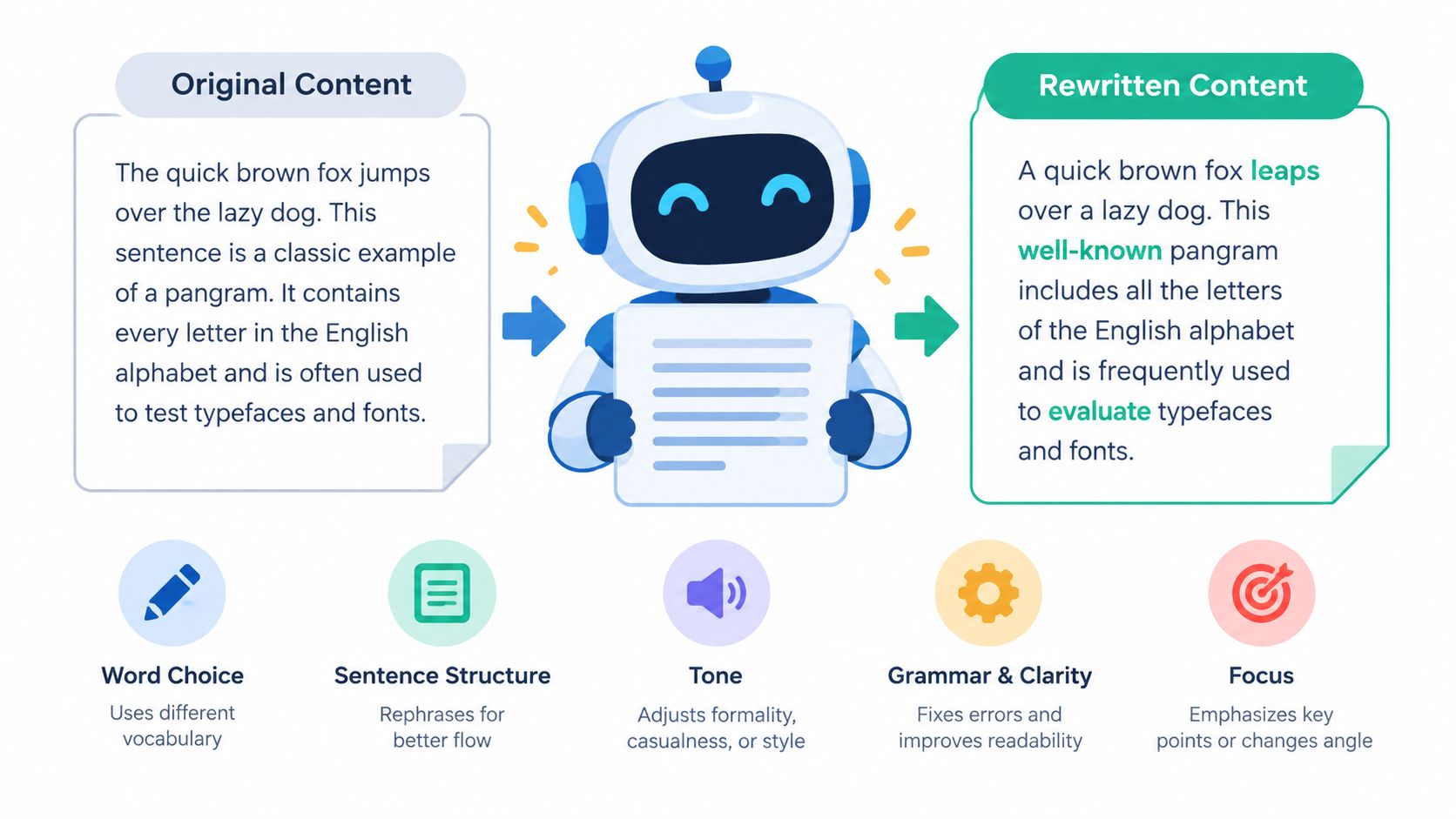
A rewriter does not erase meaning. It changes the route the sentence takes to get there. A watermark detector is looking for token-choice patterns, not just the topic of the passage. If you keep the facts but alter sentence structure and wording, the statistical signal can weaken while the message stays intact.
What paraphrasing does to detection
Meaning-preserving paraphrase is the hardest test for watermarking. In one study summarized in the Robustness study summary, SynthID's true-positive rate fell from 0.998 on clean watermarked text to 0.498 after moderate paraphrasing. The same study reported that one ChatGPT paraphrase pass reduced every tested watermarking method to below 30% detection. It also found that, for texts initially detected, meaning-preserving paraphrase removed detection in 100% of tested KGW and Unigram cases and in 98.3% of the tested SynthID configuration.
That is the part many readers miss. Rewriting does not need to delete a watermark to matter. It only needs to alter the sequence of token decisions enough that the detector loses confidence.
Detector output is still evidence, not a verdict. The same study found that the SynthID configuration misclassified 5.4% of paraphrased human-written controls as AI-generated and placed 80% of its pristine watermarked output into an uncertainty category rather than a definite one. That is why tools built for this job should be clear about limits instead of promising certainty.
For a practical walkthrough of rewrite style choices, how to rewrite content is a useful reference point when you compare surface paraphrase with deeper structural rewriting.
Rewriting vs Basic Editing vs Watermark-Only Tools
These tools sound similar, but they solve different problems. A basic editor fixes surface errors. A watermark detector checks for signal. A rewriting tool changes the text itself so the pattern underneath can shift too.
| Tool type | Changes token pattern? | Catches invisible Unicode? | Preserves meaning? |
|---|---|---|---|
| Basic spelling or formatting editor | No, not much | No, usually not | Usually yes |
| Watermark detector | No | No | Yes, because it doesn't rewrite |
| Rewriting-based ai content rewriter | Yes | Sometimes, if cleanup is built in | Yes, when done well |
The difference matters because each layer addresses a different kind of problem. If you only want to clean punctuation, use an editor. If you only want to know whether a watermark signal is present, use a detector. If you want to change the token-choice distribution while keeping the meaning, you need rewriting.
That's also where comparisons between tools get useful. A good overview of feature sets can help you separate paraphrasing from full-document rewriting, especially if you're evaluating compare AI writing platforms rather than assuming every tool does the same thing. One practical option in this category is Simple Unmark, which combines rewriting with Unicode cleanup in one pass.
Invisible Unicode and Text Cleanup
Not all bad text looks bad on screen. Some of the worst problems hide in plain sight, like narrow no-break spaces, zero-width marks, and directional controls. They can change copying, searching, tokenization, moderation, and document comparison even when the paragraph looks fine to the eye.
That's why text cleanup is a hygiene task, not a watermarking task. Invisible characters don't create a watermark signal, and watermarking doesn't explain why a pasted paragraph won't compare cleanly in another app. If you mix the two up, you end up deleting characters that were needed for the language or script.
Where cleanup gets risky
Blind deletion is a bad idea in multilingual text, bidirectional scripts like Arabic and Hebrew, South Asian scripts, scientific notation, and copied legal or financial passages. In those cases, spacing and directional marks can be legitimate, not junk. The right move is to inspect first, then remove only what's clearly accidental.
A practical hygiene pass should do three things. First, expose hidden characters in a plain-text view. Second, strip only the characters that don't belong in that context. Third, check the result for preserved punctuation, numbers, and proper nouns. For a cleanup-focused workflow, automate Instagram post formatting is a useful example of how text normalization and display cleanup are often treated as separate tasks, and Simple Unmark's invisible character remover sits in the same cleanup category.
A Realistic Cleaning Workflow
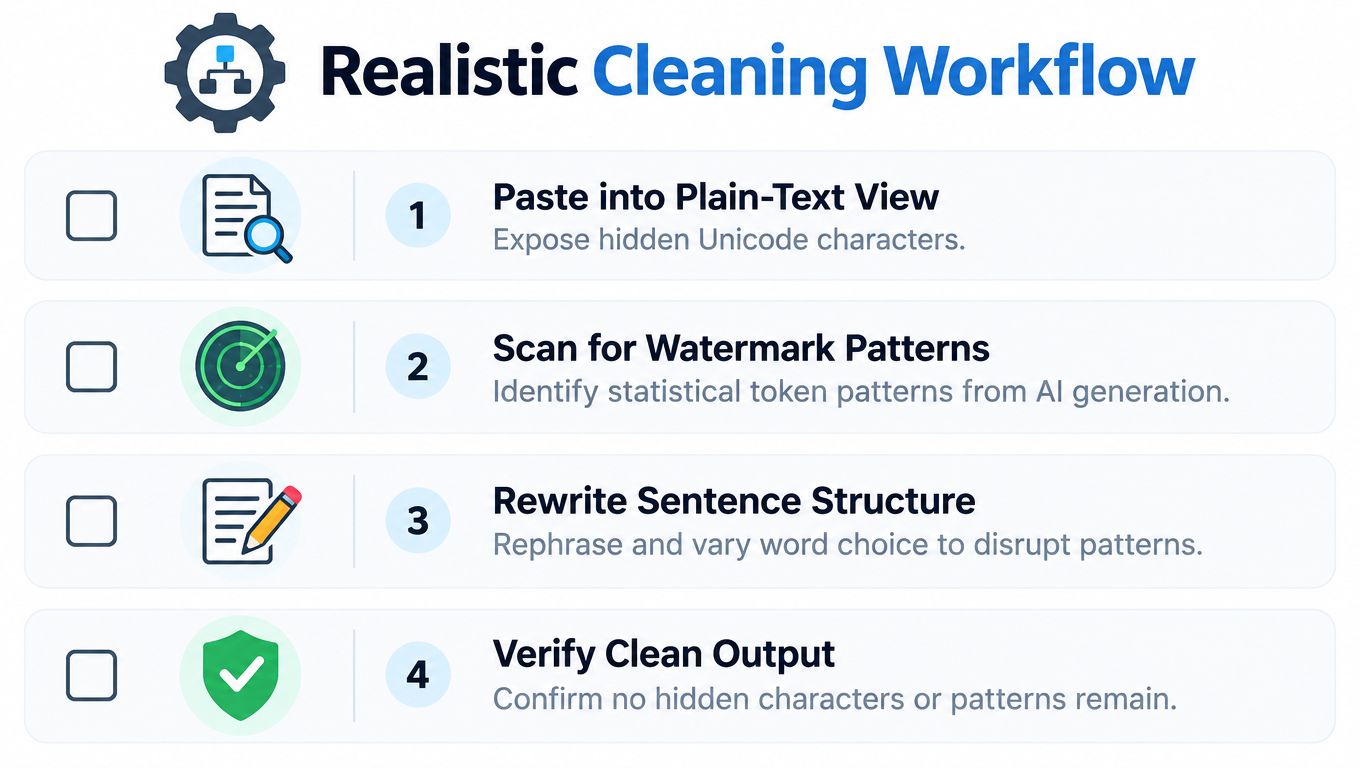
Start with the text as it was pasted, not the version you hope it is. Put it into a plain-text view first, because that's the easiest way to expose hidden Unicode artifacts and obvious formatting junk. Then scan for zero-width marks and directional controls, and only remove the characters that don't belong in that language or context.
A simple pass on one example
Take a short chatbot line like this: “The report looks complete, but the figures need review.” If those extra spaces came from copy-paste, cleanup should remove them without changing the words. If the same line also carried a watermarked generation pattern, the next step is a meaning-preserving rewrite that changes the sentence structure, not just a few words.
Clean first, rewrite second, verify last.
After that rewrite, read the passage for tone, facts, and proper nouns. The point isn't to make the text more dramatic. The point is to keep the meaning while reducing both hidden artifacts and the statistical pattern that watermark detectors may look for. That's also the logic behind tools that pair scan feedback with a rewrite action instead of pretending one button can do everything.
A full workflow should treat each step as a separate check. Cleanup handles invisible characters. Rewriting handles token-choice patterns. Verification makes sure you didn't damage names, numbers, or meaning while doing either one. If you skip the first step, you may carry invisible junk into the rewrite. If you skip the last step, you can fix the signal and still break the sentence.
What Rewriting Cannot Promise
A rewritten passage can still be easy to spot if the detector is working from a strong token pattern and the text is long enough to expose it. Short passages are the weakest case. At around 200 tokens, a detector may feel confident. At around 50 tokens, the same pattern can fall below its decision threshold, even after careful rewriting.
This is a property of the system, not a tool defect. Watermark detection is probabilistic, and the result changes with text length, language, how much structure you alter, and where the detector draws its line.
Detectors can also misfire on human writing. Paraphrased text can still be labeled suspicious, so editors, publishers, and compliance teams should treat detector output as a clue, not a verdict. Rewriting can weaken a signal, but it cannot promise a specific outcome from any detector, and it cannot guarantee that authorship signals disappear.
Quick Checklist Before You Clean a Passage
Check three things after cleanup and rewrite. First, the meaning stayed the same. Second, the facts, numbers, and proper nouns are intact. Third, no legitimate multilingual, scientific, or bidirectional characters were removed by mistake.
Keep one expectation locked in: an ai content rewriter can reduce statistical watermark signals and clear invisible artifacts, but it can't guarantee any detector verdict. If you want to go deeper, the core concept to study is token-choice watermarking, because that's what the rewrite is trying to disturb.
Simple Unmark cleans hidden Unicode characters and rewrites passages to reduce probabilistic watermark signals while preserving meaning, facts, numbers, proper nouns, tone, and intent. If you're dealing with pasted AI text and you want one workflow that handles cleanup and rewrite together, visit Simple Unmark and see whether it fits your draft.
- ai content rewriter
- ai rewriting
- watermark removal
- synthid
- content cleanup
More posts

Zero Width Space: What It Is and How to Remove It
Zero width space explained: what it is, why it breaks copied text, and how to detect and remove U+200B without breaking real formatting.
Plain Text Converter Guide: Clean AI Output
Learn how a plain text converter removes invisible Unicode characters and AI watermarks. Discover the difference between stripping text and intelligent
AI Essay Rewriter: What It Is and How It Works
Understand how AI essay rewriters function, their benefits for text improvement, and practical strategies for using them responsibly in your writing.