
AI Essay Rewriter: What It Is and How It Works
Understand how AI essay rewriters function, their benefits for text improvement, and practical strategies for using them responsibly in your writing.
You're staring at a draft that looks fine at a glance, then the tools start complaining. Maybe the essay sounds too polished, maybe the voice feels flat, maybe a detector flag makes the whole thing feel risky. That's where an AI essay rewriter sits, between rough AI output and something a human can live with. The problem is many users rely on it to conceal weak writing instead of resolving the core issue.
Table of Contents
- What AI Essay Rewriters Actually Do
- How Rewriting Engines Process Your Text
- Simple Paraphrasing Versus Meaningful Rewriting
- Watermarks, Detection, and What Research Shows
- Ethical Considerations for Students and Writers
- How Simple Unmark Fits the Rewriting Landscape
- Making the Right Choice for Your Needs
What AI Essay Rewriters Actually Do
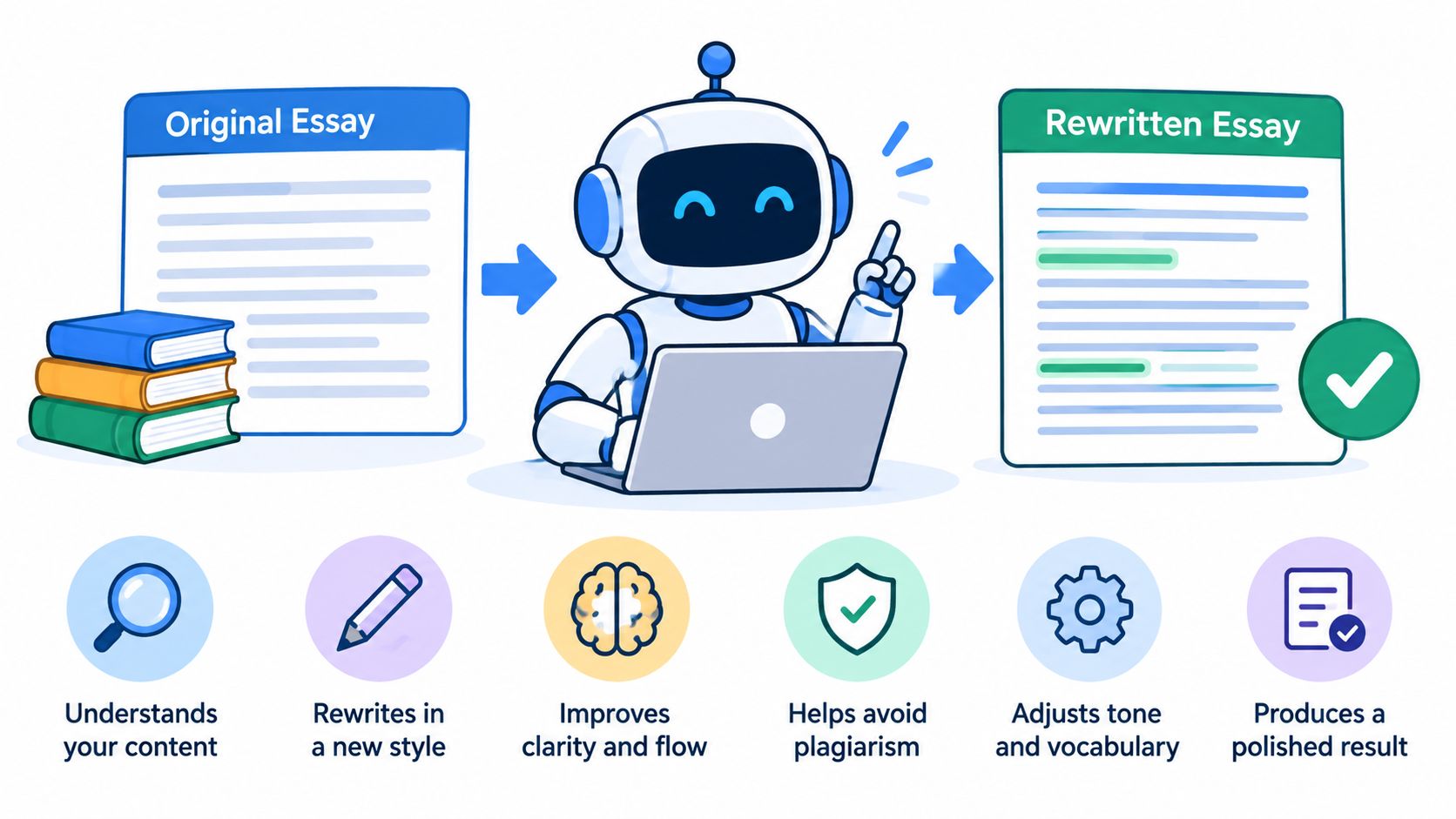
You paste in a draft, and the tool doesn't just swap a few words. A decent AI essay rewriter looks at sentence shape, repetition, and flow, then rewrites the text so it reads more naturally while keeping the core idea intact.
That matters because the tool is working on a passage, not a single sentence. It has to preserve meaning, keep the argument standing, and avoid mangling names, numbers, and technical terms. If it only changes surface words, you get awkward prose. If it understands the text, you get something closer to a clean edit.
A student who submits an AI-assisted essay often learns this the hard way. The first version sounds machine-made, the second version sounds smoother, and the third version is the one that still says what the writer meant.
For a simple comparison, a teacher-facing tool like lesson planning text rewriter shows the same basic idea at a smaller scale, text goes in, wording comes out differently, meaning should stay put.
Practical rule: If the rewrite changes the claim, it's not a rewrite anymore, it's a mistake.
How Rewriting Engines Process Your Text
These systems break text into parts first, then rebuild it. They read sentence boundaries, clause structure, and phrasing patterns, then decide where the writing feels stiff or repetitive. The goal isn't random synonym swapping, it's semantic preservation with a cleaner surface.
What the engine looks for
The best rewrites target the boring parts, not the facts. That means changing clunky transitions, smoothing sentence rhythm, and cutting the tells that make AI writing easy to spot. A tool might keep a technical term exactly as written and adjust everything around it.
What should stay fixed
Numbers, names, citations, and specialized terms should survive the process unchanged. If a rewrite blurs those, the tool is doing the wrong job. A serious workflow treats the output as a draft that still needs human checking.
If you need a targeted clean-up pass instead of a full rewrite, the internal workflow described at https://simpleunmark.com/ai-watermark-remover is the kind of thing people use when they care more about text cleanup than reinvention.
The engine should make the prose better, not make the content unrecognizable.
Simple Paraphrasing Versus Meaningful Rewriting
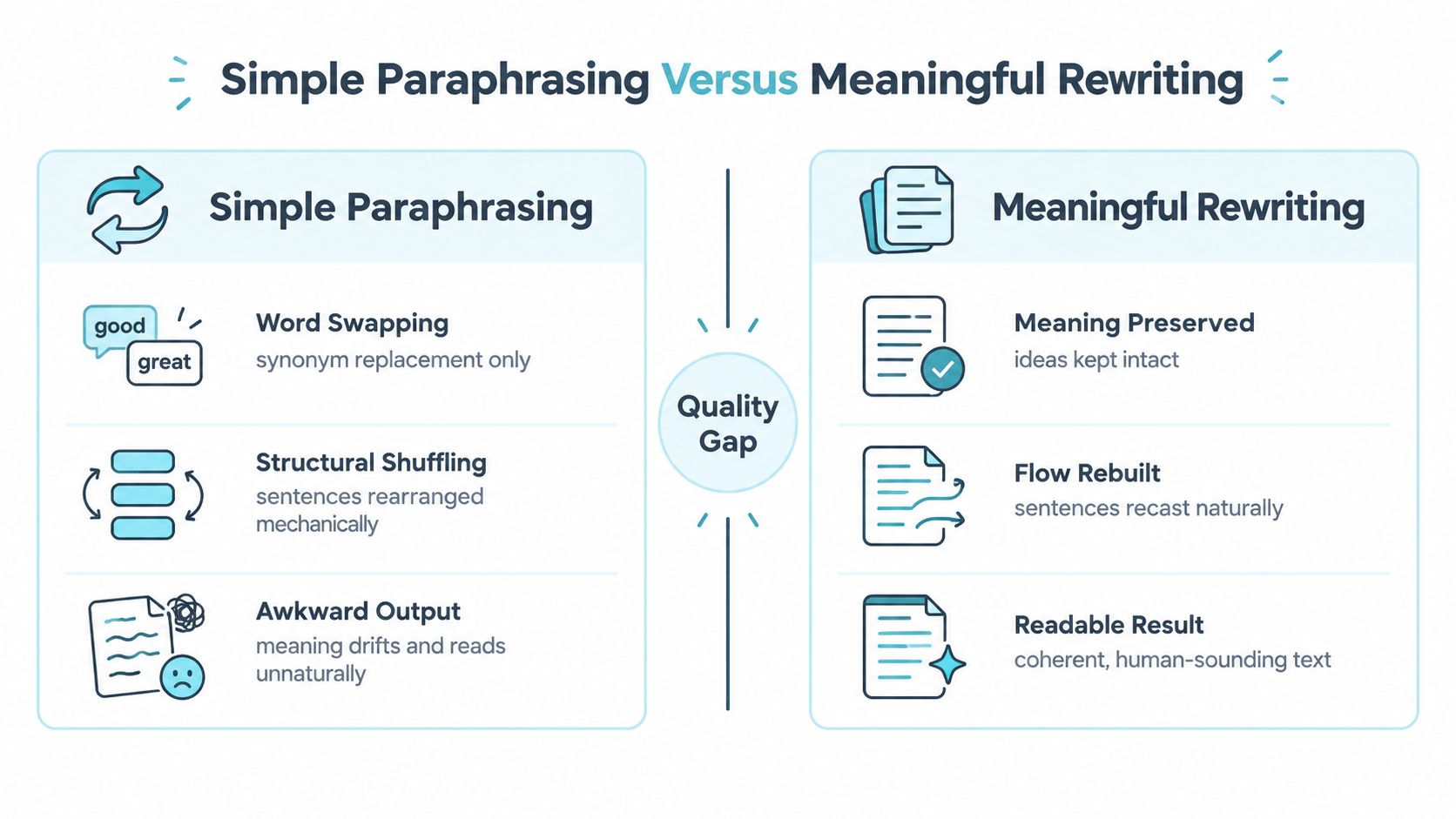
Basic paraphrasing is cheap and obvious. It swaps words, flips clauses around, and hopes the result passes for new. Sometimes it does. Most of the time it just produces text that feels off.
Meaningful rewriting is different. It keeps the point, keeps the tone, and rebuilds the sentence so a reader doesn't have to fight through it. That's the difference between cosmetic change and real revision.
Side by side
Simple paraphrasing is word-swapping, structural shuffling, and awkward output. It often loses nuance, especially in academic writing where one term carries real meaning.
Meaningful rewriting preserves the idea, rebuilds flow, and keeps the text readable. A tool that can humanize AI drafts naturally is useful only if it keeps the argument intact while cleaning the surface.
The difference shows up fast in technical work. If a rewritten paragraph distorts a methodology, changes a claim, or mangles a citation, it failed. If the rewrite sounds better and still says the same thing, it did the job.
Bottom line: If you wouldn't sign your name to the facts, don't submit the rewrite.
Watermarks, Detection, and What Research Shows
AI text can carry statistical traces, and rewriting can weaken them. That is why this category matters. Detection is probabilistic, not magic.
A 2026 study reported that meaning-preserving paraphrase eliminated watermark detection in 100% of initially detected texts for two watermark schemes, KGW and Unigram, and in 98.3% of texts carrying SynthID, while also producing a 5.4% false-positive rate on clean text. Those results cut both ways, rewriting can weaken a watermark signal, and detectors can still misfire on text that was never watermarked. The study's report on paraphrase resistance and false positives makes that trade-off hard to dismiss.
Another experiment found that detection accuracy for DetectGPT fell from 70.3% to 4.6% after paraphrasing, while watermarked GPT-2 text dropped from 100% to 57.2% after the same treatment. That paraphrase study on watermark weakening shows how heavy rewriting disrupts the signal detectors rely on.
What this means in practice
A rewrite can blur the statistical pattern, but it does not create a guarantee. Longer passages can still leave enough residue for detection to work, and some detectors are weaker than others. If you are editing for real use, preserve meaning first and treat detector outcomes as uncertain, as explained in this guide to AI watermarks vs AI detectors (https://simpleunmark.com/guides/ai-watermarks-vs-ai-detectors).
The technical lesson is simple. Rewriting changes token patterns, and many detectors inspect those patterns directly. The result is less predictable text, not invisible text.
Ethical Considerations for Students and Writers
Students need a hard line here. If your school bans AI assistance, a rewrite tool doesn't become ethical just because it's convenient. If your school allows editing help, the limit is still clear, the work has to remain yours.
That means checking facts, keeping citations real, and making sure the final draft reflects your understanding. A tool can smooth a paragraph, but it can't own the argument for you. If the ideas aren't yours, the polished version is still not yours.
Writers and freelancers have a different issue, trust. Clients don't like surprises, especially when the deliverable sounds one way in the call and another way in the draft. Clear disclosure builds trust. Hiding AI help usually burns it.
Use it like an editor, not a ghostwriter
- Keep ownership of claims: Verify every factual statement yourself before submission.
- Preserve voice: If the rewrite sounds unlike you, fix it.
- Check the policy first: Academic, editorial, and client rules aren't interchangeable.
- Disclose when required: Don't gamble with integrity for a cleaner paragraph.
The ethical standard is simple. Use rewriting to improve clarity, not to disguise authorship.
How Simple Unmark Fits the Rewriting Landscape
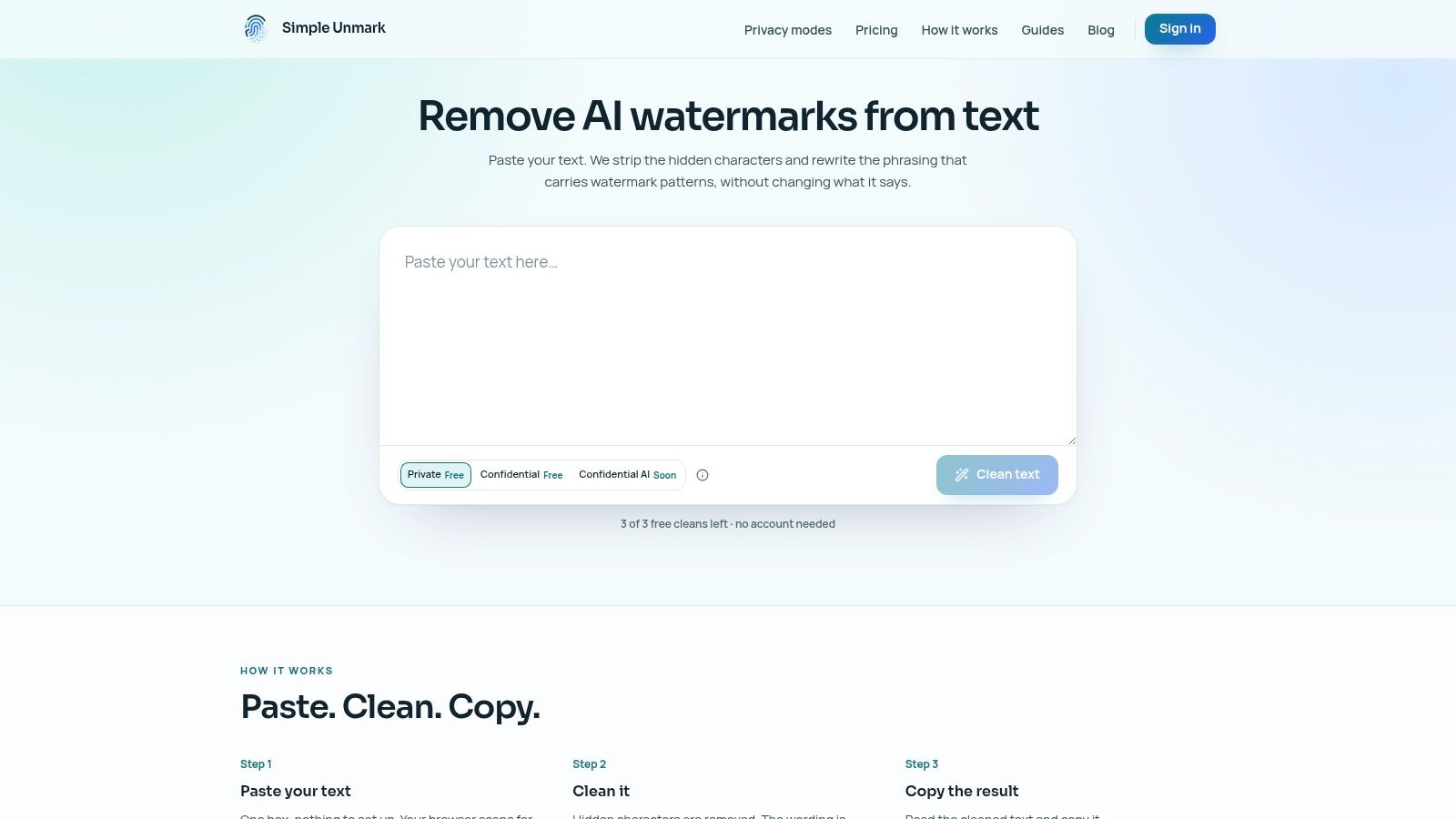
Simple Unmark sits in a narrower lane than a full essay rewriter. It focuses on cleaning hidden Unicode characters and rephrasing text to reduce probabilistic watermark signals while preserving meaning, facts, numbers, proper nouns, tone, and intent. It also handles up to 5,000 words per request and prices work at 0.1 credit per started 100 words; guest users get three free cleans of up to 100 words without creating an account.
Where it fits
This isn't for inventing a new essay from scratch. It's for cleaning up AI-assisted text that already has the right substance but the wrong surface. That makes it useful for writers, editors, and teams that need targeted cleanup instead of a complete rewrite.
The value is in the workflow. You paste, clean, and copy. You don't get a subscription trap, and you don't have to treat every edit like a total rebuild. The internal workflow on Simple Unmark is built around that narrower use case.
If you're dealing with hidden marks, awkward phrasing, or a passage that needs to stay factually stable, this kind of tool makes more sense than a generic paraphraser. It's a cleaner fit when the job is precision, not reinvention.
Making the Right Choice for Your Needs
Start with the actual goal. If you need a full rewrite that keeps the original meaning intact, use a tool built for semantic preservation. If you need to clean hidden characters or reduce watermark signals, use a specialized cleaner instead of pretending every paraphraser does the same job.
Test the output with a short sample before you trust it on a full draft. Check whether numbers survive, names stay correct, and the tone still sounds like the original writer. If the tool gets those wrong, it's not helping, it's introducing risk.
Privacy matters too. If you're handling student work, client drafts, or sensitive research, read the handling policy before you paste anything. A tool that only does surface cleanup is often the safer choice than one that tries to be clever with your content.
The right choice is boring in a good way. It keeps the facts, keeps the intent, and saves you from cleanup later. If that's the standard you need, use Simple Unmark for targeted text cleaning and compare it against whatever broader rewrite tool you're considering.
- ai essay rewriter
- ai writing tools
- text rewriting
- plagiarism risks
- academic writing
More posts
AI Text Converter Guide: What It Does and When to Use It
Learn what AI text converters actually do, how they work, when they help, and the real limitations. Honest guide for writers and editors.
10 Free AI Rewriter Tool Options Compared for 2026
Find the right free AI rewriter tool fast. We compare 10 options by free limits, privacy, strengths, and weaknesses, with honest notes for writers.
AI Humanizer Free: 7 Options Compared for 2026
Compare 7 AI Humanizer Free options with honest trade-offs, quick humanizing steps, before-and-after examples, and privacy notes.