
AI Text Converter Guide: What It Does and When to Use It
Learn what AI text converters actually do, how they work, when they help, and the real limitations. Honest guide for writers and editors.
The popular advice is wrong. An AI text converter doesn't make writing human, and it doesn't prove anything about authorship. It changes signals, cleans junk, and sometimes improves readability, but the hard part is still the same, verifying that the text says what it should say.
Table of Contents
- What AI Text Converters Claim
- How These Tools Work Under the Hood
- The Honest Truth About Capabilities and Limits
- Comparison of Converter Types and Their Trade-offs
- Verification Checklist After Conversion
- When Conversion Helps and When It Hurts
- The Bigger Picture Beyond Detectors
What AI Text Converters Claim
The pitch is predictable, make AI undetectable, sound more human, remove watermarks. That is marketing language, and it only matters if you confuse presentation with proof. In practice, these tools usually do cleanup, rephrasing, and statistical nudging. They change the surface of the text, not its authorship or truth. For a plain primer on watermarking mechanics, see how AI text watermarks work.
What the promise really means
A lot of tools can strip invisible Unicode junk, smooth awkward phrasing, and reduce obvious AI formula. That is real utility. It helps when pasted text breaks search, accessibility, or downstream formatting.
The “human-like” claim is looser. A converter can change how a detector reads the text without changing whether the claims are correct, who wrote it, or whether it deserves to be published. If the tool cannot preserve meaning, the rest is noise.
Practical rule: if a tool promises to make content “pass as human,” treat that claim as overstated until you verify the output yourself.
How These Tools Work Under the Hood
An AI text converter starts with the text you already have. It does not read intent like a human editor. It scans tokens, spacing, phrasing, and repeated patterns, then changes the parts that affect cleanup or detection.
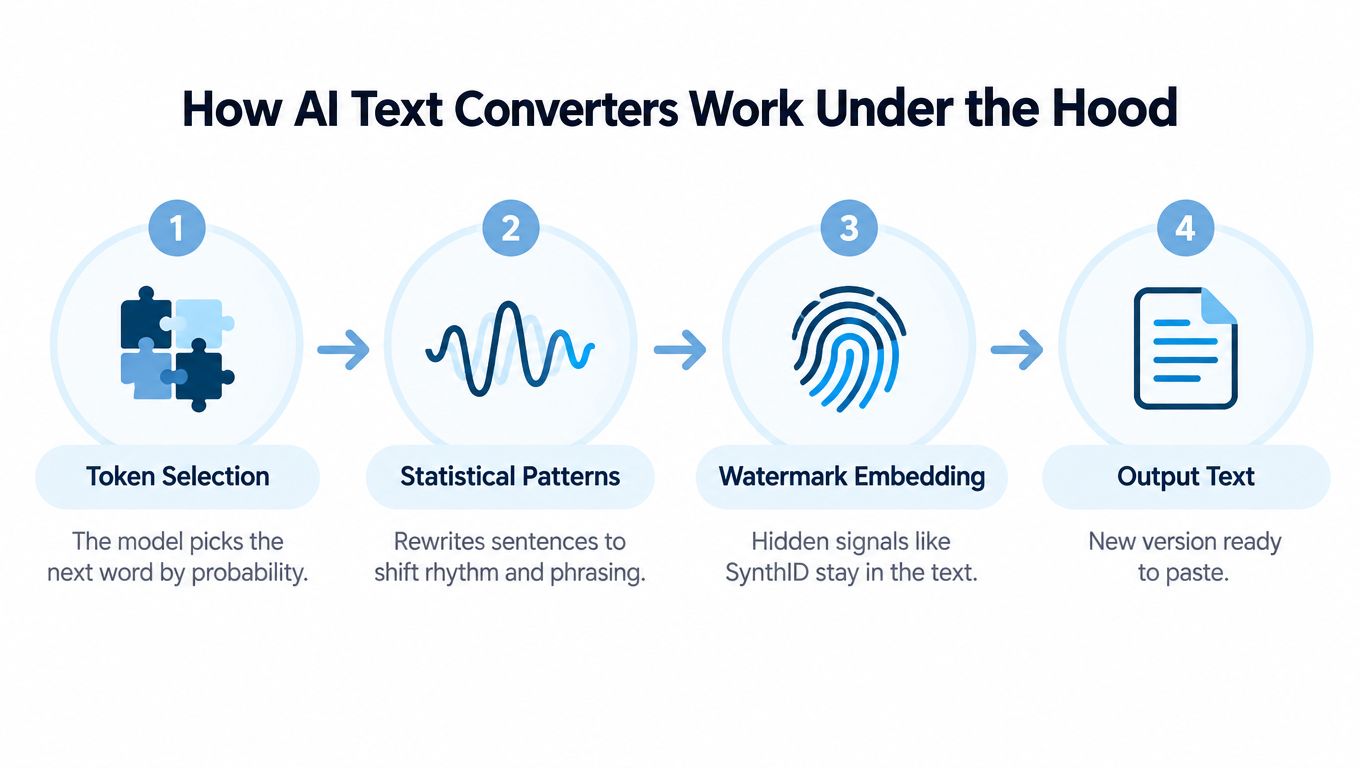
The three mechanics that matter
Invisible-character removal comes first. This strips zero-width spaces and direction controls that often sneak into pasted text and break copying, search, or accessibility. It is boring, and it is often the cleanest win.
Watermark pattern disruption comes next. DeepMind's SynthID-Text works by influencing token-selection probabilities during generation, so the text carries a statistical fingerprint instead of a visible label, and rewriting can disturb that pattern (DeepMind's SynthID overview). Google's public work on SynthID also shows why simple rewriting is not the whole story, because confidence can drop after heavier editing or translation.
Style transfer handles the surface. A formal sentence becomes less stiff, a repetitive paragraph becomes less mechanical, and the output reads better to a human reviewer.
The point is not mystery. The point is variance. Converters reshape phrasing enough to alter statistical signals, then hope the meaning survives intact.
Simple example, the idea stays close, but the signal changes:
- Original watermarked idea, “The model selects the next word based on probability patterns.”
- Converted version, “The model chooses each next word according to its likely fit in the sentence.”
Same point. Different phrasing. Different signal.
If you want a hands-on cleaner for token-pattern disruption, Simple Unmark's watermark remover sits in that category. For a broader industry view, see why Translators USA tracks AI trends.
Conversion changes how text looks to systems. It does not certify what the text is.
The Honest Truth About Capabilities and Limits
The useful part is narrow. A good converter can remove hidden Unicode artifacts, reduce repetitive AI phrasing, and alter token-choice patterns enough to change statistical signals. That's useful for copy-paste cleanup and for drafts that need a more natural pass before a human reviews them.
The useless part is bigger than the marketing admits. Conversion does not prove human authorship. It does not validate facts. It does not make a bad source trustworthy. Detector results are probabilistic, not provenance records, and the evidence around detectors is ugly. One review reports a mean false-positive rate of 61.3% for authentic TOEFL essays written by non-native English speakers across seven detectors, and it says detector results aren't reliable enough for high-stakes decisions (Springer review).
Cosmetic surgery versus identity change
That's the right lens. Conversion can change the surface, just like cosmetic work changes appearance. It doesn't tell you whether the underlying claims survived intact.
Google's own SynthID documentation says confidence can fall after thorough rewriting or translation, and a separate evaluation of 14 AI-detection tools found that none reached 80% accuracy while all produced false positives and false negatives (arXiv evaluation). Those two facts together kill the fantasy that a converter can promise a clean detector outcome. It can't.
Bottom line: if the text matters, review the text. Don't worship the detector score.
Comparison of Converter Types and Their Trade-offs
There are three real categories here, and they do very different jobs. Don't buy a one-size-fits-all story.
| Type | Detection Impact | Fact Preservation | Best For |
|---|---|---|---|
| Invisible-character cleaner | Low, but important for junk removal | Very high | Copy-paste cleanup, accessibility, parsing |
| Rewriting-based converter | Medium, because it changes token patterns | High if the tool is disciplined | AI-assisted drafts, editorial polishing |
| Translation-based converter | Often strongest on detectors, but unstable | Lower, especially across languages | Multilingual cleanup with human review |
Invisible-character cleaners are the safest. They don't pretend to rewrite meaning, they just strip out junk that shouldn't be there.
Rewriting-based tools are the practical middle ground. They can reduce obvious AI cadence, but they also introduce risk if they smooth over details, numbers, or nuance.
Translation-based conversion is the blunt instrument. It can make detection harder, but it can also damage precision because language shifts don't map cleanly across systems. For the right workflow, that may be acceptable. For anything legal, academic, or technical, it's a risk you need to take seriously.
Verification Checklist After Conversion
Don't publish converted text blind. Run a simple check, every time.
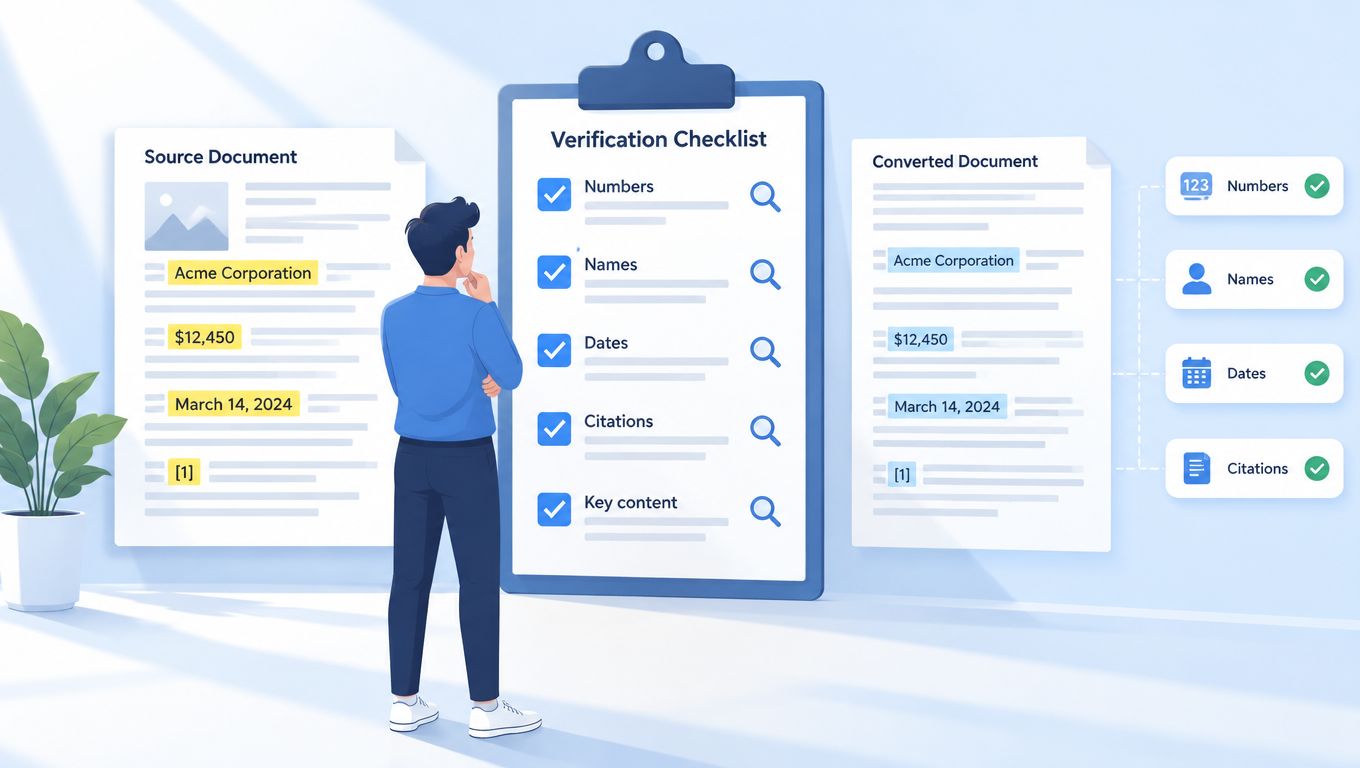
What to verify first
- Numbers and units: Make sure every figure matches the source exactly.
- Proper nouns and names: Check people, companies, products, and places.
- Dates and citations: Confirm nothing moved, vanished, or got generalized.
- Tone and intent: Read for accidental shifts from cautious to certain.
- Meaning under pressure: Scan for negation flips, hedging loss, and softened precision.
A bad converter can turn “not impossible” into “possible”, which is a real meaning change. It can also flatten “might” into “will”, or turn “approximately 40%” into “about 40%” when the source needed exactness. Those are not cosmetic edits. They're editorial errors.
For a cleaner view of where hidden characters differ from statistical watermarking, Simple Unmark's hidden Unicode guide is relevant because it separates formatting cleanup from phrasing changes.
Check the facts before you check the detector. Those are two different jobs.
When Conversion Helps and When It Hurts
Use conversion when the problem is mechanical. If pasted text contains invisible Unicode junk, awkward AI rhythm, or obvious repetitive phrasing that needs a human pass, a converter can save time. It's also useful in low-stakes internal drafts where the goal is to make text easier to read, not to prove anything about origin.
Don't use it as a shield in high-stakes work. Academic submissions, legal language, compliance copy, and technical material need exact meaning more than they need smoother surface text. A converter that changes emphasis, certainty, or terminology can create real damage even if the prose sounds better.
A simple decision rule
- Use it when cleanup and readability matter more than traceability.
- Avoid it when exact wording matters more than style.
- Review it manually when the text includes claims, citations, or multilingual sections.
If the actual issue is disclosure, not wording, then the cleaner move is often to acknowledge AI assistance and edit the draft in good faith instead of trying to disguise it. That's especially true when translation or domain-specific terminology is involved, because those are the places where meaning slips first.
The Bigger Picture Beyond Detectors
The underlying question isn't whether text can fool a classifier. What matters is whether the text does its job accurately and ethically. That's why the AI-versus-human binary is mostly noise for professional editors. What counts is whether the final version preserves facts, intent, and context.
That framing fits where publishing and AI-assisted writing are already headed. Editors care less about theatrical purity and more about reviewable, accountable workflows. A practical overview of that mindset shows up in Blog Health App on blogging and AI, where the emphasis stays on using AI inside an editorial process instead of pretending the process disappeared.

Convert what needs cleaning, verify what matters, and never confuse detector scores with truth. That's the only useful rule here.
Simple Unmark helps you clean AI-assisted text without pretending that surface changes are the same as verified authorship. It removes hidden Unicode characters and rewrites phrasing to reduce statistical watermark signals while preserving meaning, facts, numbers, proper nouns, tone, and intent. Visit Simple Unmark if you want a direct workflow for cleaning text and then checking it like an editor, not like a marketer.
- ai text converter
- ai watermark
- text humanizer
- synthid
- ai content
More posts
10 Free AI Rewriter Tool Options Compared for 2026
Find the right free AI rewriter tool fast. We compare 10 options by free limits, privacy, strengths, and weaknesses, with honest notes for writers.
AI Humanizer Free: 7 Options Compared for 2026
Compare 7 AI Humanizer Free options with honest trade-offs, quick humanizing steps, before-and-after examples, and privacy notes.
Watermark Remover Best App: 7 Options Compared for 2026
Watermark Remover Best App picks compared on features, SynthID handling, privacy, pricing and use cases, with honest recommendations for each user type.