
Digital Watermarking Explained: Types, Uses and Limits
Digital watermarking explained: visible vs invisible marks, how text watermarks work, and what they can and cannot prove.
If a detector finds a watermark, has it identified the author, or only a pattern someone embedded? Digital watermarking embeds information in content for later detection, but the meaning of a match depends on the kind of mark, the detector and what happened to the content along the way.
A logo across a photograph, an invisible signal in audio and a statistical pattern in generated text aren't interchangeable. Writers, editors and developers need to distinguish those mechanisms before treating a watermark result as evidence.
Table of Contents
- What Digital Watering Means in Plain Terms
- Visible, Invisible, Robust and Fragile Watermarks Compared
- Where Digital Watermarking Is Used Today
- How Text Watermarks Hide Signals in Word Choice
- Why Some Edits Break a Watermark and Others Do Not
- Hidden Characters, Unicode Cleanup and Statistical Watermarks Differ
- Decide What to Do With a Watermark Result
What Digital Watering Means in Plain Terms
A banknote held to the light offers a useful starting point. Its faint paper watermark forms part of the material rather than sitting on a removable label. Digital watermarking follows a similar idea: information becomes part of digital content so someone can check for it later.
Say a photographer distributes a preview containing an embedded licence identifier. The photograph carries the signal, the identifier connects it to a licence record, and compatible software checks for that signal when another copy appears.

The parts of a watermarking system
- Carrier: The image, audio clip, video frame or passage of text containing the mark.
- Payload or signal: An owner identifier, timestamp, tamper indication or provenance signal. Some systems indicate presence without encoding a readable record.
- Detector: The software or procedure that checks for the signal and, where supported, recovers its contents.
Not every watermark is hidden, and not every watermark should survive editing. A visible logo identifies a preview openly but may disappear when cropped. An invisible resilient mark distributes evidence through content so ordinary processing can leave enough for detection.
An invisible fragile mark serves the opposite purpose: changes disrupt it, helping flag possible tampering. A statistical text watermark belongs to another family altogether, influencing token selection during generation rather than attaching a visible tag.
The purpose determines the design
The foundational watermarking benchmark by Petitcolas and colleagues describes applications including copyright protection, monitoring and authentication. Those purposes require different balances between perceptual quality, recoverable information and resistance to processing.
Working definition: A watermark is information embedded in content so it can later be detected, read or verified.
The type comparison below provides a practical lookup for the question each mark is designed to answer.
Visible, Invisible, Robust and Fragile Watermarks Compared
Watermark types by visibility and resilience
| Type | Visible to viewers | Survives ordinary edits | Typical example | Main purpose |
|---|---|---|---|---|
| Visible overlay | Yes | Low: cropping or removing the overlay defeats it | Logo or text across a stock photo preview | Attribution and branding |
| Invisible robust | No | High against supported resizing and compression | Spread-spectrum mark in an image | Copyright and broadcast monitoring |
| Invisible fragile | No | Low: changes within its protected scope break it by design | Authentication mark on an image file | Detecting tampering and data authentication |
| Statistical text watermark | No | Light edits may preserve it; extensive rewriting can weaken it | Token-choice bias in model output | Provenance signal, not proof of authorship |
A visible overlay communicates directly with viewers. A stock-photo preview carrying a photographer's name signals attribution without requiring special software. However, the overlay doesn't prevent copying, and a crop or image edit can defeat its visible message.
Visible AI labels also address a public transparency preference. Baringa reported in 2025 that 62% of surveyed respondents supported visible watermarks or labels indicating whether or how much AI was used in content. That preference concerns disclosure, not the technical reliability of an invisible detector.
Robust and fragile solve opposite problems
An invisible watermark aims to remain detectable after specified transformations. Instead of concentrating its evidence in a corner, a system can distribute the signal across image or audio components. Compression may alter those components without destroying every useful trace.
Resilient doesn't mean permanent. A developer still needs to specify which transformations, quality settings and detector conditions the implementation supports.
An invisible fragile watermark is valuable precisely because it fails under relevant changes. An editor checking an authenticated image wants modifications to become apparent, not pass through undetected. The protected scope matters: a system may authenticate image content without treating an unrelated metadata update as tampering.
Text requires a different comparison
A statistical text watermark changes selection probabilities during generation. It isn't a translucent layer, a hidden image or a block of metadata that a document exporter can discard.
The central engineering trade-off is persistence versus distortion or redundancy. More evidence can improve detection, but embedding that evidence may constrain the content. Fragile authentication deliberately chooses sensitivity instead.
Selection rule: Match the watermark to the question: attribution, integrity or a generator-associated signal. Treat the answer as evidence within that scope, not a universal verdict.
Where Digital Watermarking Is Used Today
Digital watermarking use cases and what each proves
| Use case | Watermark family | What it can establish | Main limit |
|---|---|---|---|
| Copyright protection | Invisible robust | Likely owner or licensed copy | Ownership claims need evidence beyond the mark |
| Broadcast monitoring | Invisible robust | That protected material appeared on a channel | Requires successful detection at the monitoring point |
| Device control | Invisible robust or embedded signal | Whether a device should play or copy content | Requires device support |
| Data authentication | Invisible fragile | Whether content was altered after marking | Says nothing about who created it |
| AI image provenance | Machine-readable marking | Whether a generator tagged the image | Only where the generator applies a mark |
| AI text provenance | Statistical text watermark | Statistical evidence consistent with a provider's marked output | Not proof of authorship |
The pattern behind these applications is straightforward: an organisation embeds a signal for a particular operational decision. The same signal needn't answer every question a later recipient might ask.
The multimedia watermarking overview by Cox and colleagues identifies copyright control, broadcast monitoring, device control and data authentication as major application areas. These uses extend well beyond checking whether content was generated by AI.
Rights management and integrity checks
A photographer might assign licence identifiers to distributed copies. Finding an identifier can connect a discovered image to a distribution record, but the photographer still needs contracts, originals and other records to support an ownership claim.
A broadcaster has a different task. Monitoring software checks a channel for marked material, helping establish whether an advertisement or programme appeared there. Device-control systems use embedded signals to communicate playback or copying rules, provided the equipment recognises and honours them.
Authentication reverses the survival requirement. A publisher checking a fragile mark wants to know whether the protected content changed after marking, not whether the depicted event was truthful.
AI provenance has an adoption limit
A 2025 empirical study of AI image-generation systems found that 19 of 50 systems, or 38%, included some form of machine-readable marking in generated images. That finding concerns marking across the systems examined, not universal coverage of AI imagery.
Consider a newsroom receiving a photograph. A compatible detector's match may associate the image with a generator's marking scheme. No match means that the check found no recognised signal, not that a camera necessarily captured the scene.
A responsible publication workflow therefore combines technical checks with practical verification:
- Establish custody: Preserve the received file and record who supplied it.
- Check the claimed origin: Request the original capture or generation record where relevant.
- Read the detector's scope: Confirm which watermark family and generator the tool supports.
Each use case becomes useful only when its operational limit remains attached to the result.
How Text Watermarks Hide Signals in Word Choice
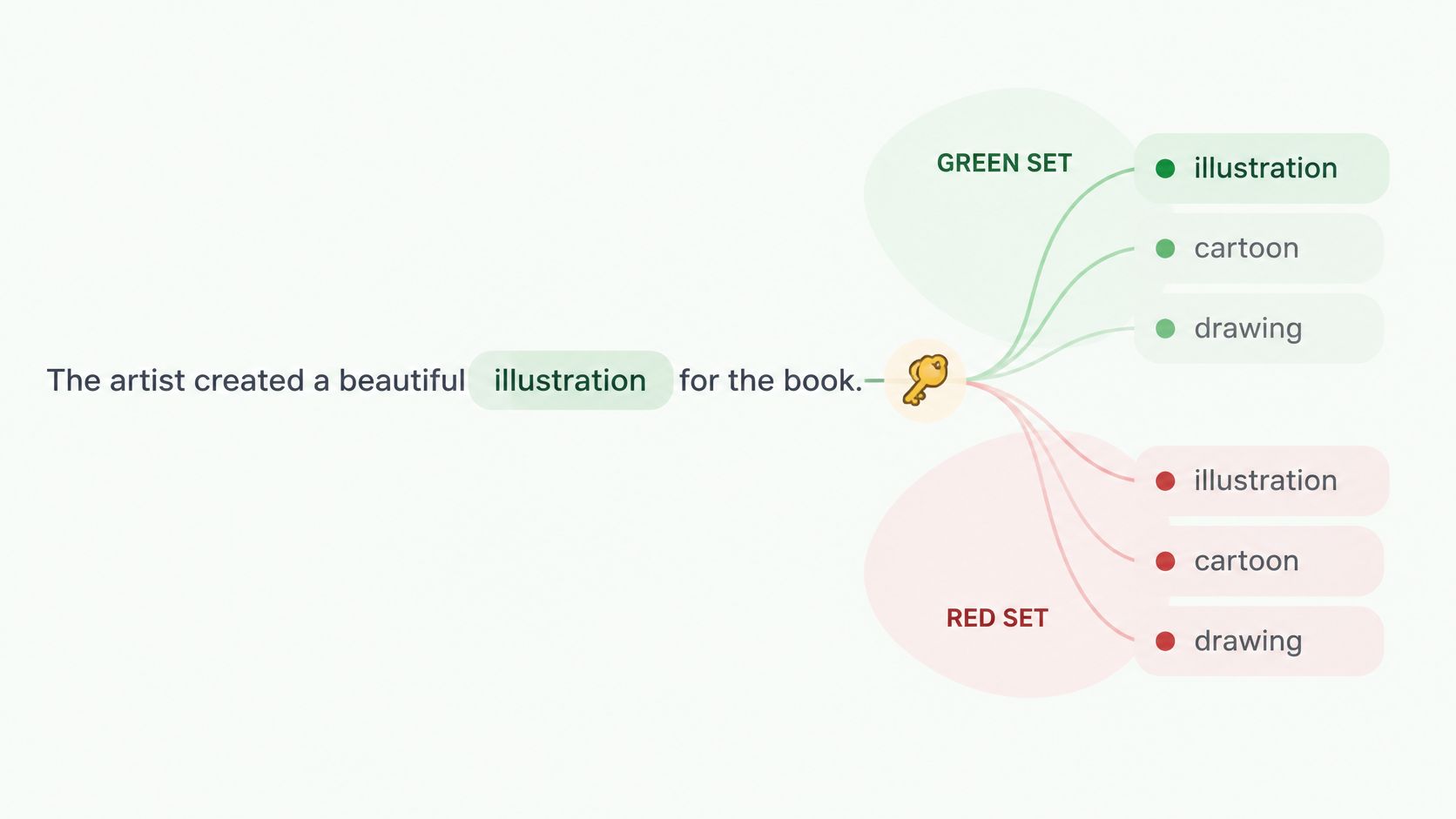
Consider the sentence, “The editor requested a clearer illustration.” A language model generating that sentence chooses successive tokens, which may be words, word fragments or punctuation. At a suitable point, alternatives such as “drawing,” “diagram” or “illustration” might all be plausible, though they aren't interchangeable in every context.
For background on that generation process, Tech Today's explanation helps readers understand AI chat responses step by step. The watermarking step adds a controlled preference to the model's existing next-token choices.
A small bias becomes passage-level evidence
In the scheme described in the ICML paper by Kirchenbauer and colleagues, a keyed rule partitions the vocabulary into green and red token sets at each generation step. The decoder slightly increases the probability of choosing green tokens.
Those colours are conceptual categories, not visible formatting or fixed judgements about words. A token's membership follows the scheme's keyed rule and generation context. Across a sufficiently informative passage, the resulting excess of green selections provides evidence for detection.
The detector reconstructs the relevant partitions, counts green-token usage and applies a statistical test. It doesn't require the model's weights or API, but it does require the appropriate detection configuration and keying information.
The resulting p-value measures how surprising the observed pattern would be under the test's unwatermarked assumption. It isn't the probability that a particular person used AI, nor a percentage of the passage written by a machine.
Why some passages offer fewer choices
A stronger preference can make a mark easier to detect, but it can also constrain phrasing and alter quality or resilience under editing. The original work reports negligible quality impact in its tested settings, which shouldn't become a guarantee for every model or task.
Entropy describes how much uncertainty remains among plausible next tokens. Open-ended descriptive prose often offers many acceptable continuations. A factual answer requiring an exact name, formula or value offers fewer safe alternatives.
That distinction matters for implementation:
- Detection rate: Measure how often known marked outputs are detected at the chosen threshold.
- False-positive rate: Check how often unmarked text crosses that threshold.
- Text length: Evaluate short passages separately from longer documents.
- Quality change: Compare accuracy, readability and task performance before and after embedding.
The guide to how AI text watermarks work provides additional context for decoding-based signals. The essential point is that the evidence accumulates across token choices, not as a readable tag attached to an individual sentence.
Why Some Edits Break a Watermark and Others Do Not
Watermark evidence lives in particular features of the content. Editing those features changes the evidence, even when a reader considers the meaning unchanged.
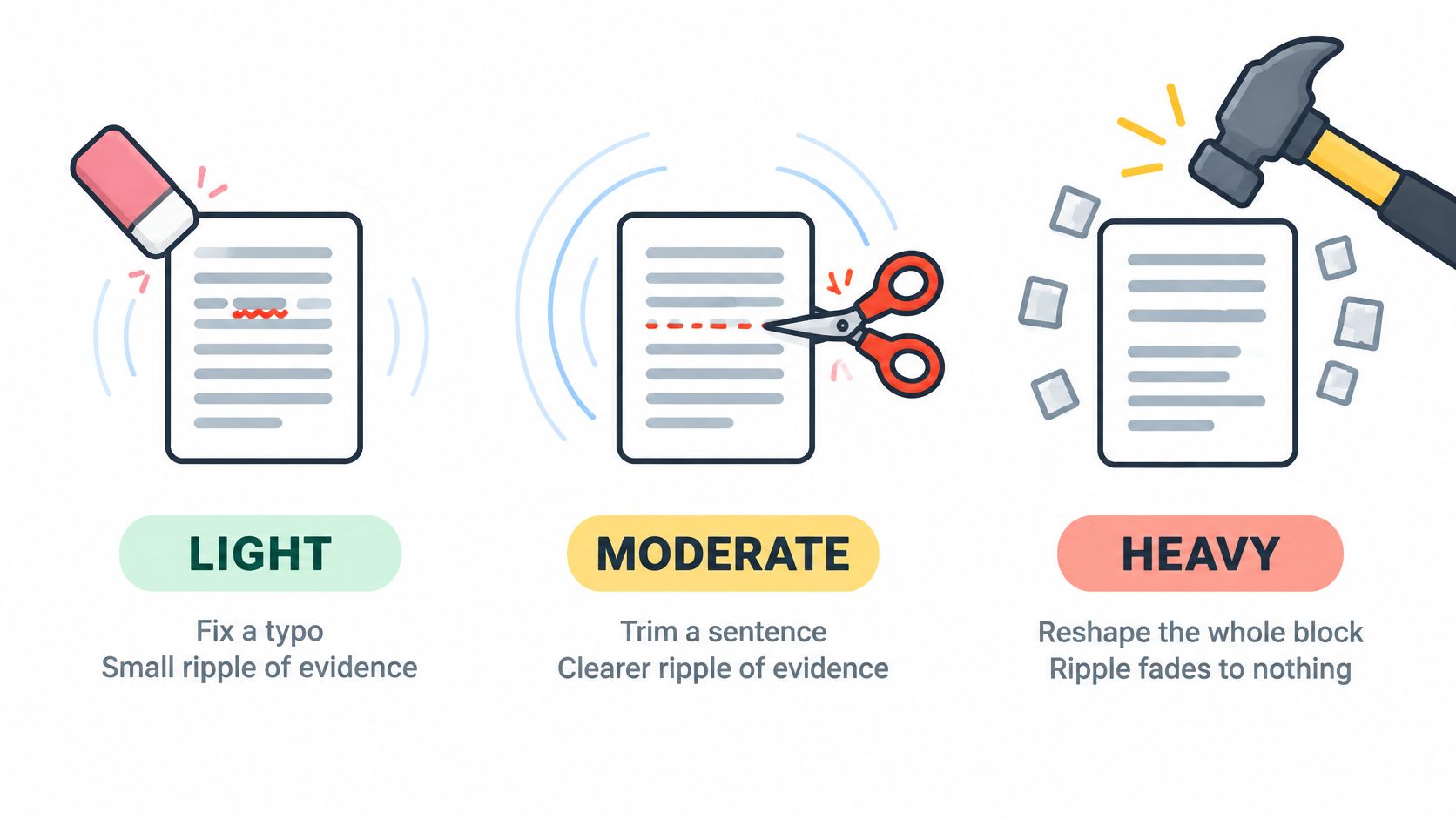
A typo correction may preserve nearly all of a passage's token choices. Translation replaces them extensively. Neither operation can be judged solely by how similar the final message feels.
Editing intensity is only part of the explanation
- Light editing: Fixing a typo, replacing isolated words or trimming a paragraph may leave sufficient evidence for detection. Shortening also reduces the amount available to test.
- Intermediate changes: Summarisation retains selected ideas but discards substantial wording. Sentence reordering can also change context-dependent detection patterns without replacing every word.
- Extensive transformation: Heavy paraphrasing and translation replace much of the original sequence, potentially weakening the statistical relationship the detector measures.
A 2026 survey of LLM watermarking reports that token-level watermark true-positive rates can fall below 0.4 after 40% paraphrasing, while some distribution-shift methods retain rates above 0.8. These are method-specific findings, not a universal editing threshold.
A pilot study of paraphrasing attacks eliminated initially detected KGW and Unigram marks and removed 98.3% of detected SynthID-Text marks in its setup. However, it used an open-source implementation, small open models and intact English text, so it doesn't establish commercial-system performance.
Content type also matters. Code, factual lists and tightly constrained answers provide different embedding opportunities from open prose. Short passages offer less evidence, regardless of whether an editor changed them.
The proof gap remains after detection
A score is not authorship, and a missing score is not human writing. A negative result after substantial editing cannot distinguish an originally unmarked passage from one whose evidence was disrupted.
The forensic analysis of text watermark evidence describes SynthID-Text as a zero-bit system, returning a statistical score rather than readable model, time, user or source information. It also identifies possible signals from direct generation, traces inherited through distillation or deliberate spoofing, alongside unstable forensic error rates in tested systems.
A detector result needs a documented interpretation before anyone uses it to accuse, clear or attribute.
A useful evaluation starts with a preserved original and applies one edit type at a time. Developers should record detector configuration, threshold, text length and quality after each transformation; across a labelled sample set, they can then calculate detection and false-positive rates. Editors considering consequential action also need calibration evidence, uncertainty estimates and a documented chain of custody.
Hidden Characters, Unicode Cleanup and Statistical Watermarks Differ
Removing invisible characters is often confused with removing an AI watermark. The two operations change different properties of a text: one cleans the surface encoding, the other touches the wording itself. Wiping a smudge off a photocopy works the same way, since the sentences on the page remain exactly as written.
Three separate text issues and what each one changes
| Issue | What it is | What cleaning does | What it does not prove |
|---|---|---|---|
| Hidden characters | Zero-width or direction-control code points in pasted text | Removes selected characters to simplify pasted text | Does not prove AI authorship |
| Unicode normalization | Equivalent characters stored in different forms | Standardises equivalent representations | Does not change wording or remove a token-choice signal |
| Statistical watermark | Token-choice bias across a passage | Rewriting can weaken it; plain-text conversion does not | Does not establish authorship or supply a universal yes-or-no answer |
A sentence copied from a web page can carry a zero-width space inside a word like “publication.” The free invisible-character remover in Simple Unmark's browser tools flags supported characters by code point, so the reader can see exactly which invisible code points sit inside the paste. It runs locally in the browser and requires no signup, credits or upload.
After removal, the hidden character is gone and the visible wording is unchanged. Any statistical token-choice pattern survives because the sentence has not been rewritten.
Cleanup should respect the text
Zero-width characters, joiners and direction controls are not automatically suspicious. Some have legitimate linguistic or layout functions: emoji sequences and joined scripts, for example, depend on invisible code points that a reader never sees but a renderer needs. Indiscriminate deletion can break that behaviour, so a copy-safe workflow checks the character and its context rather than assuming every invisible code point is unwanted.
Standard Unicode normalization handles a different problem. The same visible character can have more than one underlying representation, and normalizing picks a consistent form, which improves matching and downstream processing while leaving the author's word choices untouched.
Free line-break removal and plain-text conversion also run locally in the browser. Line-break cleanup can preserve paragraph breaks, while the converter accepts rich pasted text or HTML and supports a text-file download. Neither utility rewrites wording or verifies statistical watermark removal.
Rewriting is a separate editorial decision
Simple Unmark rewrites word choices to reduce statistical watermark patterns, but it cannot measure the remaining provider watermark signal. It does not guarantee removal, permanent undetectability or a particular detector score.
A practical working order keeps the operations separate:
- Inspect characters and remove only unwanted artifacts.
- Normalize representations where the destination workflow requires consistency.
- Review wording and facts if a rewrite is warranted, checking names, numbers, tone and emphasis against the original.
Hidden characters do not prove AI authorship. Their absence does not establish human authorship either, and rewriting does not establish originality or resolve plagiarism.
Decide What to Do With a Watermark Result
A watermark result works like a smoke alarm: it confirms that something triggered, and it says nothing about who lit the match. That gap between detecting a mark and proving authorship is where most decisions go wrong, so the response starts with the question being asked rather than with the score.
A sound decision procedure has three parts:
- Name the question. Ownership, alteration and a generator-associated signal require different evidence.
- Record the conditions. Preserve passage length, editing or translation history, detector configuration and any reported false-positive rate.
- Set the evidence threshold. Document the threshold and supporting records before academic, employment or legal action.
The comparison of AI watermarks and AI detectors helps distinguish keyed signal detection from broader classification. Provider-specific claims also need a date and configuration check; a provider name alone does not establish that every output carries a mark.
Keep editing and verification separate
For a pasted draft that needs wording help, Simple Unmark is a text-only editing product, not a working AI detector. Guests receive three cleans of up to 100 words each. Accounts include 10 starter credits and support up to 5,000 words per clean.
Private processing, the lowest-cost mode, costs 0.1 credit per started 100 words and sends text through the application workload to DeepInfra for rewriting. Confidential mode skips the web backend entirely: the browser verifies the cleaning service and encrypts text to it, while DeepInfra still performs the rewrite. A third option, Confidential AI with the model running inside a confidential GPU at 0.4 credit per started 100 words, is coming soon. Selecting it now registers interest only and submits no text and spends no credits.
Credits are a one-time purchase, never expire and require no subscription. Rewrites aim to preserve meaning but need human review: Simple Unmark does not guarantee perfect preservation, removal of every watermark or any particular detector result. The output is an editing aid, and its use must respect applicable academic, workplace and publishing rules.
Simple Unmark offers local text-cleanup utilities and separate wording rewrites for drafts that need editorial attention. Writers and editors can begin with character inspection, choose rewriting only when appropriate, and review the resulting wording and facts before publication.
- digital watermarking
- watermarking explained
- text watermarking
- AI watermark
- invisible watermark
Related articles
Online Text Watermark Removers: Methods and Limits
Compare Unicode cleanup and rewrite-based approaches to AI text. Learn which signal each method changes and why detection remains uncertain.
AI Detection Bypass Tools: Claims and Limits
Understand what bypass tools change, why classifier scores differ from watermark tests, and how to review rewritten text without false confidence.
Text Watermark Removers: Cleanup vs. Rewriting
Understand hidden-character cleanup and statistical watermark rewriting. Choose a method by the text problem and review every substantive change.