
AI Detection Bypass Tool: The Honest Truth
Discover how an AI detection bypass tool actually works. Learn about watermarks, detector flaws, and how to clean text responsibly without losing meaning.
The most popular advice about an AI detection bypass tool is also the least reliable: rewrite the text, run it through a detector, and treat a clean score as proof that the work is human. That logic is broken. Detectors measure patterns associated with generated text, not authorship itself, and rewriting changes those patterns without establishing who wrote the passage.
The practical question isn't “How do I fool every detector?” It's “How do I clean text responsibly, preserve what it means, and document how it was created?” That shift matters for editors, students, publishers, and teams using AI as part of a legitimate writing workflow.
Table of Contents
- The Flawed Reality of AI Text Detectors
- How Probabilistic Watermarks and Unicode Markers Work
- The Technical and Ethical Risks of Rewriting
- Comparing Text Cleaning Approaches and Tools
- A Responsible Approach with Simple Unmark
- Handling False Positives and Verification Strategies
- Final Takeaways for AI Text Management
The Flawed Reality of AI Text Detectors
AI detectors estimate whether a passage resembles patterns associated with generated text. They do not establish authorship. Their probability scores can fail in both directions: human writing may be flagged, while generated writing may receive a low score. Treat the output as an imperfect measurement that requires context.
A later peer-reviewed evaluation of a 2023 study covering 16 detection tools and 126 documents found substantial variation among systems. Many performed poorly on GPT-4-generated writing, and some correctly classified only about 30% of documents. The research also recorded false positives and false negatives, so a detector score should not stand alone in an academic-misconduct decision. The peer-reviewed evaluation supplies the technical context.
Why scores move
Detector output changes with factors that users often overlook:
- Text length: Short passages give a classifier less evidence than longer passages.
- Genre: Academic prose, marketing copy, technical documentation, and personal writing follow different conventions.
- Model version: A detector tuned to one generation model may behave differently with another.
- Language and editing: Multilingual writing, human revisions, and mixed human-AI drafts can change the measured signal.
- Threshold selection: The vendor's cutoff determines when a probability becomes a flag.
A separate peer-reviewed evaluation reported ROC-area-under-the-curve values from 0.75 to 1.00, while none of the tested systems achieved complete reliability in distinguishing AI-generated from human-written text. Different datasets and probabilistic methods can therefore produce different judgments for the same passage. The study on detector reliability also describes misclassification of human writing and confusion between generated text and AI-paraphrased text.
Practical rule: Treat a detector result as a reason to investigate. On its own, it cannot settle who wrote a passage.
An AI detection bypass tool has a narrower legitimate role. Use it to clean formatting artifacts or revise awkward, repetitive prose. It cannot certify human authorship or convert prohibited AI-generated work into acceptable original work. Rewriting changes measurable patterns, but it also risks changing meaning, voice, and evidence. That trade-off deserves more attention than any supposedly clean detector score.
How Probabilistic Watermarks and Unicode Markers Work
Two very different mechanisms are often lumped together under “AI detection.” One concerns statistical watermarks created during generation. The other concerns invisible Unicode characters introduced by formatting, copying, or application interfaces. They need different remedies.
A probabilistic watermark influences token selection while a model generates text. The system subtly favors certain token choices according to a secret or controlled pattern. The result looks ordinary to a reader, but a specialized detector can test whether the distribution of words and tokens matches the expected signal. It's closer to a statistical fingerprint than a visible stamp.
NIST's overview of technical approaches for synthetic content describes watermarking and metadata recording as methods for tracking or authenticating synthetic content. It also places them alongside labeling, detection, software testing, auditing, and provenance. That broader framework matters because no single signal solves the authorship problem.
Watermarks versus invisible characters
A watermark lives in token choices and distributions. Rewriting can alter sentence structure, vocabulary, and token sequences, which may reduce the signal. It doesn't erase a universal mark because watermark designs, detector thresholds, and model updates differ.
Unicode artifacts operate at the character layer. Zero-width spaces, direction controls, unusual spacing, and other invisible characters can affect copying, searching, indexing, or text comparison. Removing them is text hygiene, not watermark removal. A plain-text cleanup can eliminate the artifact while leaving the wording unchanged.
The distinction is laid out in this guide to hidden Unicode markers and statistical watermarks. Cleaning one layer won't reliably address the other.
Why rewriting changes the measurement
Meaning-preserving rewriting changes the observable text. It may replace words, restructure clauses, or alter token distributions, so a detector can produce a different score. That change doesn't prove that authorship changed. It only shows that the classifier is sensitive to the surface form it receives.
An effective cleanup workflow should therefore identify the layer first. Remove invisible formatting when the problem is hidden characters. Use careful editorial rewriting when the prose itself is repetitive or mechanically structured. Then validate meaning, facts, names, and citations independently.
The Technical and Ethical Risks of Rewriting
Rewriting improves the odds against a detector, but it introduces its own failure modes. A system may produce smoother prose while changing a date, weakening a qualification, replacing a proper noun, or turning a precise claim into a vague one. A lower detector score cannot compensate for damaged meaning, altered facts, or a citation that no longer supports the revised sentence.
A 2025 assessment reported that SynthID-Text could lose detectability after meaning-preserving paraphrasing, copy-and-paste modifications, and back-translation. Paraphrase resilience is only half the picture. A second evaluation measured how often watermarks vanished entirely, finding that 58 of 59 initially detected SynthID samples lost their watermark after paraphrasing. It also reported a 5.4% false-positive rate on paraphrased human-written controls. The paraphrase robustness study is clear on the limitation: changed detectability doesn't establish changed authorship.
What aggressive rewriting can damage
Review the parts of a document that language models and paraphrasers commonly mishandle:
- Numbers and units: A rewrite can alter a quantity, range, decimal, or measurement.
- Names and terminology: Proper nouns, product names, legal terms, and scientific labels may be replaced with near-synonyms.
- Citations: A tool can detach a citation from the claim it supports or make the sentence stronger than the source.
- Scope and certainty: “May” can become “will,” while a qualified finding can sound definitive.
- Voice and intent: A personal or carefully restrained passage can become generic, inflated, or overly formal.
A 2025 academic study recorded detector-score changes from 0.02% to 99.52% after paraphrasing in one experiment, and from 61.96% to 99.98% in another. Those dramatic shifts show measurement sensitivity. They do not show successful conversion to human authorship. The study on paraphrasing and detection scores also emphasizes that the model, text length, and editing level affect results.
Rewriting can change what a detector sees. It can also change what a reader understands.
The ethical boundary
Removing accidental Unicode artifacts from your own draft is a defensible editorial task. Revising awkward AI-assisted prose for clarity may also be legitimate where an institution or employer permits that workflow. Submitting generated work as your own violates the applicable policy when that policy prohibits it. A text-cleaning tool cannot resolve that conflict.
Judge the transformation by its purpose, the governing policy, and the quality of the final document. Before processing sensitive or regulated content, check retention terms and preserve the original draft. Simple Unmark's AI watermark remover is one tool positioned for cleanup and rewriting, but no product can guarantee a detector result. The user remains responsible for checking facts, citations, meaning, and permitted use.
Comparing Text Cleaning Approaches and Tools
Different cleaning methods change different layers of a document. Token swapping targets isolated word choices. Unicode normalization targets invisible characters. Structural rewriting changes clauses, sentences, and paragraph flow. Treating these as interchangeable leads to poor quality and false confidence.
A simple character injection or synonym replacement may alter a few surface features without changing the statistical structure of the passage. It can also create awkward wording that damages credibility. More complete processing combines Unicode cleanup with controlled rewriting, then checks whether the result still says the same thing.
A 2024 study of seven AI detectors found average accuracy of 39.5% on unmodified AI-generated text and 67% on human-written controls. After adversarial modifications, average detection accuracy fell to 22.14%, with the impact varying by technique and detector. The study identified spelling errors and increased linguistic burstiness as modifications that reduced detector performance. The detector evaluation supports a narrow conclusion: manipulation can affect classification, but classification was already imperfect.
AI Text Cleaning Methods Compared
| Method | Mechanism | Effectiveness Against Watermarks | Risk to Original Meaning |
|---|---|---|---|
| Manual editing | A writer revises structure, clarity, and voice | Variable, because results depend on the edits | Low when the writer checks every change |
| Token swapping | Replaces selected words with synonyms | Weak and inconsistent against structural or statistical signals | Moderate, especially with technical terms |
| Spelling or character injection | Adds surface irregularities or hidden characters | Unreliable and potentially damaging | High, because it can create errors or formatting problems |
| Unicode normalization | Removes zero-width marks and direction controls | Useful for character-level artifacts, not statistical watermarks | Low if the cleanup preserves visible text |
| Structural rewriting | Rebuilds clauses, sentences, and paragraph flow | Can change statistical signals, but offers no guarantee | Moderate, unless facts and terminology are reviewed |
| Combined cleaning and rewriting | Normalizes characters, then revises wording | More complete coverage of separate text layers | Moderate, requiring post-edit validation |
The sensible choice is the least aggressive method that solves the actual problem. If invisible characters are causing trouble, normalize Unicode first. If prose is repetitive, edit for clarity and rhythm. Don't distort a document merely to chase a percentage from a classifier that may change after its next update.
A Responsible Approach with Simple Unmark
A responsible workflow treats an AI detection bypass tool as a text-cleaning system, not an authorship certificate. Start with the original passage and decide what needs fixing. If the issue is hidden formatting, use character cleanup. If the writing is repetitive or awkward, use restrained rewriting. If the passage contains important claims, plan a manual review after processing.
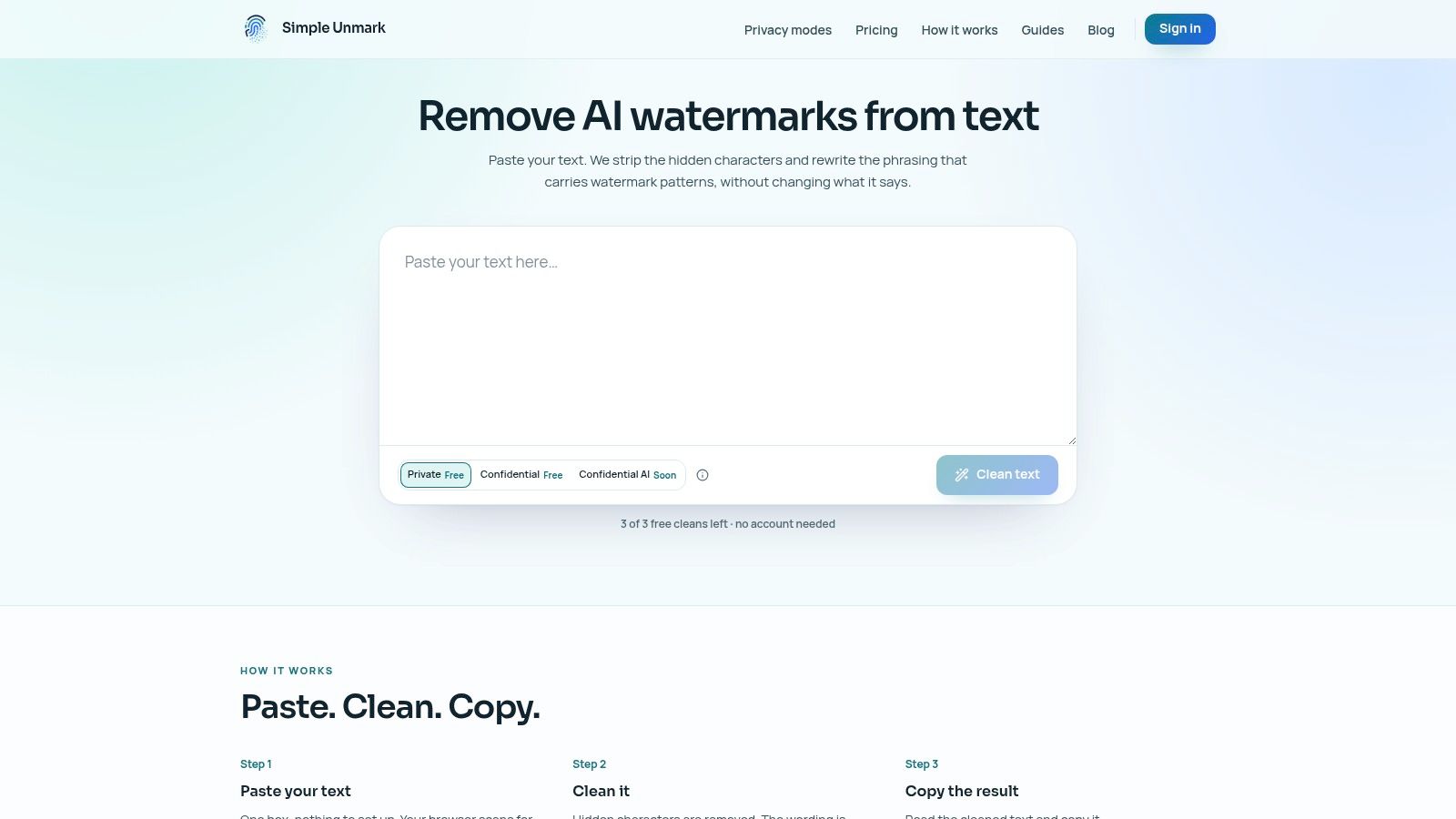
Simple Unmark provides a paste, clean, and copy workflow. Its stated processing combines removal of hidden Unicode artifacts with wording rewrites intended to reduce probabilistic signals such as SynthID. The publisher describes preservation of facts, numbers, proper nouns, tone, and intent as part of the rewriting approach. Those are useful controls, but they still need to be checked against the source.
A practical review sequence
- Save the source first. Keep the untouched draft, source notes, citations, and version history. Never make the processed copy your only copy.
- Paste the text into the cleaner. Review the visible input for odd spacing or formatting before processing.
- Run the cleanup. The service removes hidden characters and rewrites wording in the same operation. It supports passages up to 5,000 words per request, according to the publisher's product information.
- Compare the output with the source. Check names, numbers, dates, quotations, citations, headings, and technical terms line by line.
- Read the result aloud. Awkward substitutions and unnatural shifts in tone are easier to catch by ear than on a quick screen review.
- Check the governing policy. A clean result doesn't make prohibited authorship acceptable.
The service uses credit-based processing at 0.1 credit per started 100 words, with credits that don't expire. The publisher also states that guest submissions are transient and account records track credit activity rather than submitted text. Treat those statements as product claims to verify against the current privacy and service terms before uploading confidential material. The Simple Unmark web app is the place to inspect the current workflow and terms.
Handling False Positives and Verification Strategies
A detector flag is a prompt to inspect the evidence, not permission to manufacture a lower score. If you wrote the document, establish authorship through its development record. Drafts, research notes, revision history, citations, and your ability to explain the argument carry more weight than an isolated classifier result.
The evaluation record reports serious weaknesses in detector performance. In one experiment involving fully AI-generated papers, Turnitin labeled 100% of the papers as false negatives under that study's scoring definition. GPTZero produced 70% false negatives and 30% partial false negatives, while Copyleaks produced 75% false negatives and 25% partial false negatives. These results, and the study's warning against treating detector output as sole evidence, are documented in the evaluation record.
Preserve process evidence
Keep records that show how the document developed:
- Draft history: Save version history from the writing application, not only the final export.
- Research trail: Retain source notes, bookmarked references, outlines, and citation records.
- Revision context: Keep earlier drafts showing changes to arguments, paragraphs, and wording.
- Human explanation: Be prepared to explain the evidence, structure, and conclusions in your own words.
A clean detector result does not prove authorship. A flag does not cancel credible process evidence. Reviewers should weigh provenance, source use, revision history, contextual questions, and detector output together.
Ask for a human review
If an institution raises a concern, respond with documented facts. State that the detector produced a flag, provide your drafting record, identify the sources you used, and ask how its policy addresses false positives. Do not present a rewritten score as proof of human authorship. Request a review based on the complete record.
NIST's framework supports this multi-signal process. It combines provenance records, watermarking, metadata, detection, testing, and human review instead of treating one classifier as decisive. That standard gives human writers, multilingual writers, editors, and students a fairer assessment without claiming that automated detection has resolved authorship.
Final Takeaways for AI Text Management
An AI detection bypass tool can clean text, but it can't prove who wrote it. Detector scores vary with the tool, text length, genre, model, language, editing history, and threshold. Rewriting can change those scores dramatically while leaving authorship unresolved.
Use a short checklist:
- Identify the layer: Decide whether you're fixing Unicode artifacts, statistical patterns, or ordinary prose quality.
- Preserve the original: Keep drafts, source notes, citations, and revision history before processing.
- Rewrite conservatively: Don't trade a detector signal for damaged facts, names, numbers, tone, or intent.
- Validate the output: Compare the result with the source, verify claims, and read the text as a human editor.
- Respect policy: Don't use cleanup to disguise prohibited authorship.
- Treat scores as signals: A low result isn't proof of human writing, and a high result isn't proof of AI authorship.
- Use multiple forms of evidence: Provenance, contextual review, source records, and human explanation are stronger together than any single percentage.
The field is moving toward provenance, labeling, watermarking, metadata, detection, and human review. That's the direction institutions and businesses should follow. Chasing a guaranteed bypass is a dead end because watermark designs, classifiers, and thresholds will keep changing.
Simple Unmark offers Unicode cleanup and meaning-focused rewriting for passages that need practical text hygiene, while making clear that detector outcomes aren't guaranteed. Visit Simple Unmark to review the paste, clean, and copy workflow, then validate every important detail before you use the output.
- ai detection bypass tool
- ai watermark remover
- synthid text remover
- ai text cleaner
- bypass ai detection
More posts

How to Rewrite AI Generated Text Without Losing Meaning
Learn how to rewrite AI generated text while keeping facts, tone, and intent intact. Practical steps, tool workflows, and tips to reduce watermark signals.
10 AI Paraphrase Tool Free Picks for Better Rewrites
Compare 10 ai paraphrase tool free options by features, limits, use cases, and drawbacks, plus when Simple Unmark is the better cleaning choice.
AI Plagiarism Remover: What It Is and What It Actually Does
An honest guide to AI plagiarism removers: how they differ from paraphrasers, what they can and cannot remove, plus a real cleaning workflow and example.