
Text Watermark Remover: How It Works in 2026
Find a text watermark remover that actually works in 2026. Learn how hidden watermarks are detected and what rewriting-based cleanup really delivers.
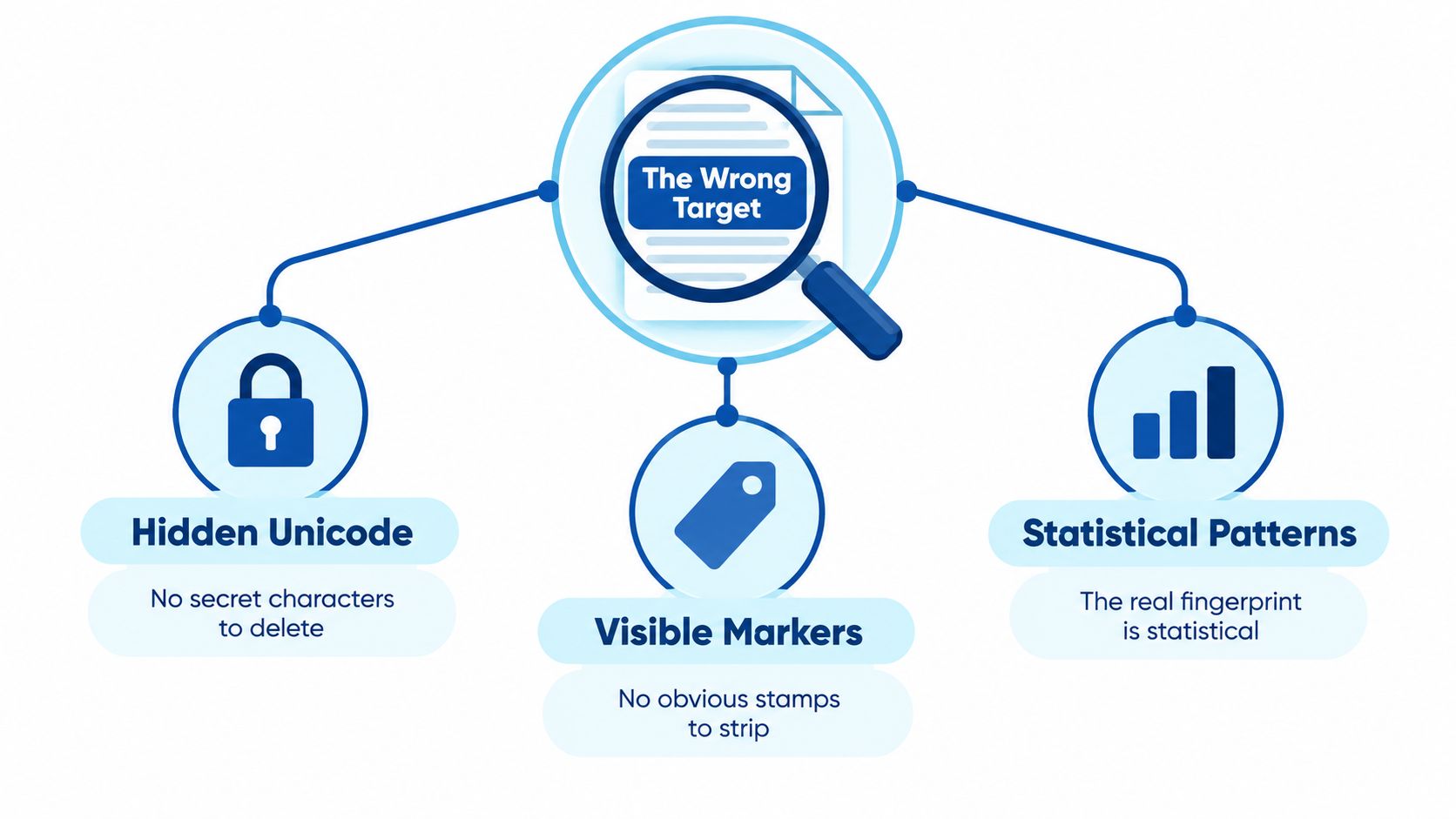
Most advice about a text watermark remover starts with the wrong assumption: AI text contains a secret string of invisible characters that you can delete. Usually, it doesn't. Zero-width spaces, soft hyphens, right-to-left controls, and homoglyphs can appear after PDF extraction, translation, or copy-paste, but those are formatting debris, not proof of an AI watermark.
The problem is split in two. Unicode cleanup removes visible-invisible artifacts deterministically. Statistical rewriting changes wording patterns that may reflect how a model selected tokens. Treating those jobs as identical is how people buy a tool that cleans text but never touches a probabilistic signal.
Table of Contents
- Why Most Text Watermark Removers Solve the Wrong Problem
- How AI Text Watermarks Actually Work
- Unicode Cleanup vs Statistical Rewriting
- The Paste Clean Scan Copy Workflow in Practice
- Matching Simple Unmark to Each Vendor Watermark
- Pricing Limits and Privacy by Design
- Ethics Legal Risk and Detector Honesty
- What a Realistic Removal Workflow Looks Like
Why Most Text Watermark Removers Solve the Wrong Problem
A tool that promises to “strip the AI fingerprint” with one delete button is usually selling hygiene as watermark resistance. If your pasted passage contains a zero-width space, a soft hyphen, a bidirectional override, or a lookalike character from a translation chain, character-level cleanup can remove it without changing the visible wording. Zero-width Unicode can still affect storage, tokenization, comparison, and display, so cleaning it is useful, just not for the reason many product pages claim. Security documentation on zero-width Unicode explains why these characters create mismatches between what people see and what software processes.
The blunt distinction: hidden characters are something you can inspect and delete. A statistical watermark is a pattern you can only weaken, and detection remains probabilistic.
The harder signal sits in token choices. A generator can bias sampling toward particular options during decoding, creating a distributional pattern across the passage. That pattern isn't a visible mark, and it isn't stored as a special character. Rewriting the text can disturb it, but rewriting also changes the text itself and may produce a new pattern that another detector notices.
Two jobs, two levels of certainty
The practical split looks like this:
- Unicode cleanup: removes zero-width space U+200B, zero-width non-joiner U+200C, zero-width joiner U+200D, word joiner U+2060, soft hyphen U+00AD, bidirectional controls, unusual spacing, and related artifacts.
- Statistical rewriting: changes synonyms, syntax, sentence order, and phrasing to disturb token-choice patterns.
- Visible-marker removal: handles neither modern statistical watermarking nor the usual copy-paste debris unless the tool also performs actual text normalization.
The first job is close to mechanical. You can scan the result again and verify that the characters are gone. The second is a gamble against a detector whose key, threshold, and model version you may not know. If you need broader background before choosing a workflow, remove watermarks with AI offers useful context, but don't confuse a general explainer with proof that any particular passage is unmarked.
How AI Text Watermarks Actually Work
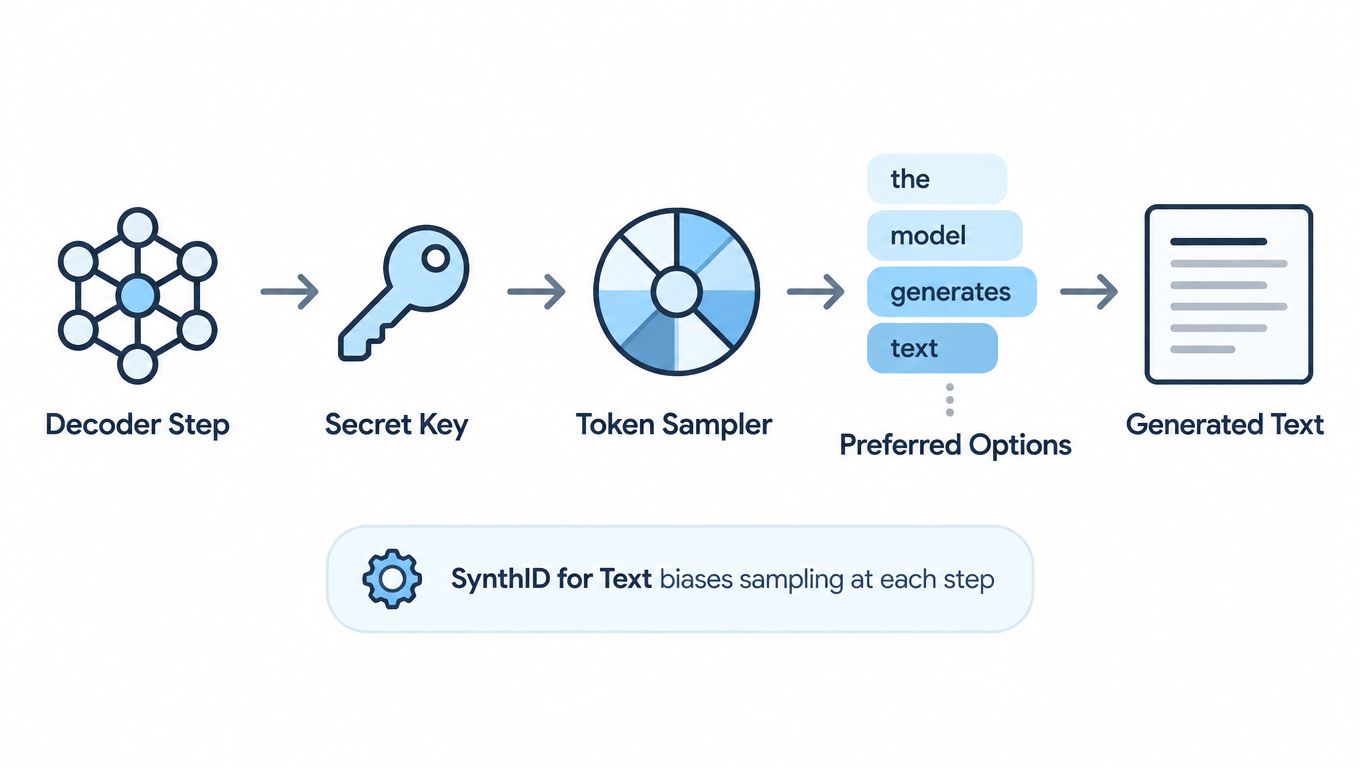
Google's SynthID-Text is the clearest public example. During decoding, the system uses a secret-conditioned sampling method called Tournament sampling to bias token selection. The generated passage looks normal to a reader, while a detector with the relevant secret information can measure whether the sequence contains the expected statistical signal. The method was published in Nature and described as a production-ready watermarking system for large language model outputs. The SynthID-Text research paper documents the sampling approach.
Think of a coin that looks fair but is slightly biased. You can't prove much by watching a few flips, especially if you don't know which direction the bias points. A verifier that knows the mint's secret bias can evaluate many flips and decide whether the sequence looks ordinary or unusually consistent with that mint.
Text detection follows the same logic. The detector doesn't search for a phrase such as “generated by AI.” It scores token choices against a hidden rule and then applies a statistical decision boundary. SynthID-Text can return WATERMARKED, NOT_WATERMARKED, or UNCERTAIN, which is more honest than pretending every result is a binary fact. The independent SynthID assessment describes this three-way classification and the role of probabilistic detection.
Why the secret key matters
A detector normally needs the same secret key used during generation, or access to a service that holds it. Without that key, a third-party remover can't truthfully say it has verified removal. It can rewrite the passage and reduce the likelihood of detection, but that's different from proving the watermark was absent.
The underlying framework has two linked phases, embedding during generation and detection afterward. This review of watermarking-based AI text detection describes markers designed to remain invisible to people while remaining machine-detectable.
Vendor-specific pages also matter because detector behavior can change with model releases and implementation choices. A guide to how AI text watermarks work is useful for understanding why a generic “remove hidden characters” button can't address every vendor's scheme. The honest conclusion is simple: a remover can alter evidence, but it can't promise a universal, permanent escape from every future detector.
Unicode Cleanup vs Statistical Rewriting
These methods belong in the same workflow, not in the same category. Unicode cleanup is deterministic and inspectable. Statistical rewriting is an intervention that trades detector resistance against fidelity, tone, and technical precision.
| Dimension | Unicode Cleanup | Statistical Rewriting |
|---|---|---|
| Target | Zero-width marks, soft hyphens, bidirectional controls, unusual spaces, and homoglyphs | Token-choice patterns and model-shaped phrasing |
| Text change | Can preserve visible wording | Changes wording, syntax, or sentence structure |
| Verification | Re-scan for the same character classes | Compare meaning, facts, terminology, and detector outcomes |
| Main failure | Does nothing when no hidden character exists | Can damage meaning or trigger another detector |
| Confidence | High for identified characters | Probabilistic and dependent on the detector |
| Best use | First pass for pasted or extracted text | Second pass when a statistical signal is the actual concern |
Unicode cleanup should come first because it removes noise without forcing a rewrite. Zero-width space U+200B, zero-width non-joiner U+200C, and zero-width joiner U+200D are invisible when rendered, but they still influence how software stores and processes text. The Unicode security glossary gives the relevant technical context.
Statistical rewriting works differently. A system may replace a phrase, reorder a sentence, split a clause, or alter the rhythm of the prose. Those changes can weaken a watermark because they alter token distributions, but they can also drop a qualification, damage a proper noun, or make technical writing less precise. A technical comparison of hidden Unicode and AI watermark removal tools makes the important distinction between character scrubbing and higher-level rewriting.
Recommended order: clean first, rewrite only when there's a reason, then inspect the output manually and test it again.
A second pass isn't automatically better. More rewriting can increase distance from the source, and a detector may still return an uncertain or positive result. The right question isn't “did the remover change enough words?” It's “did the output preserve the information and intent I'm accountable for?”
The Paste Clean Scan Copy Workflow in Practice
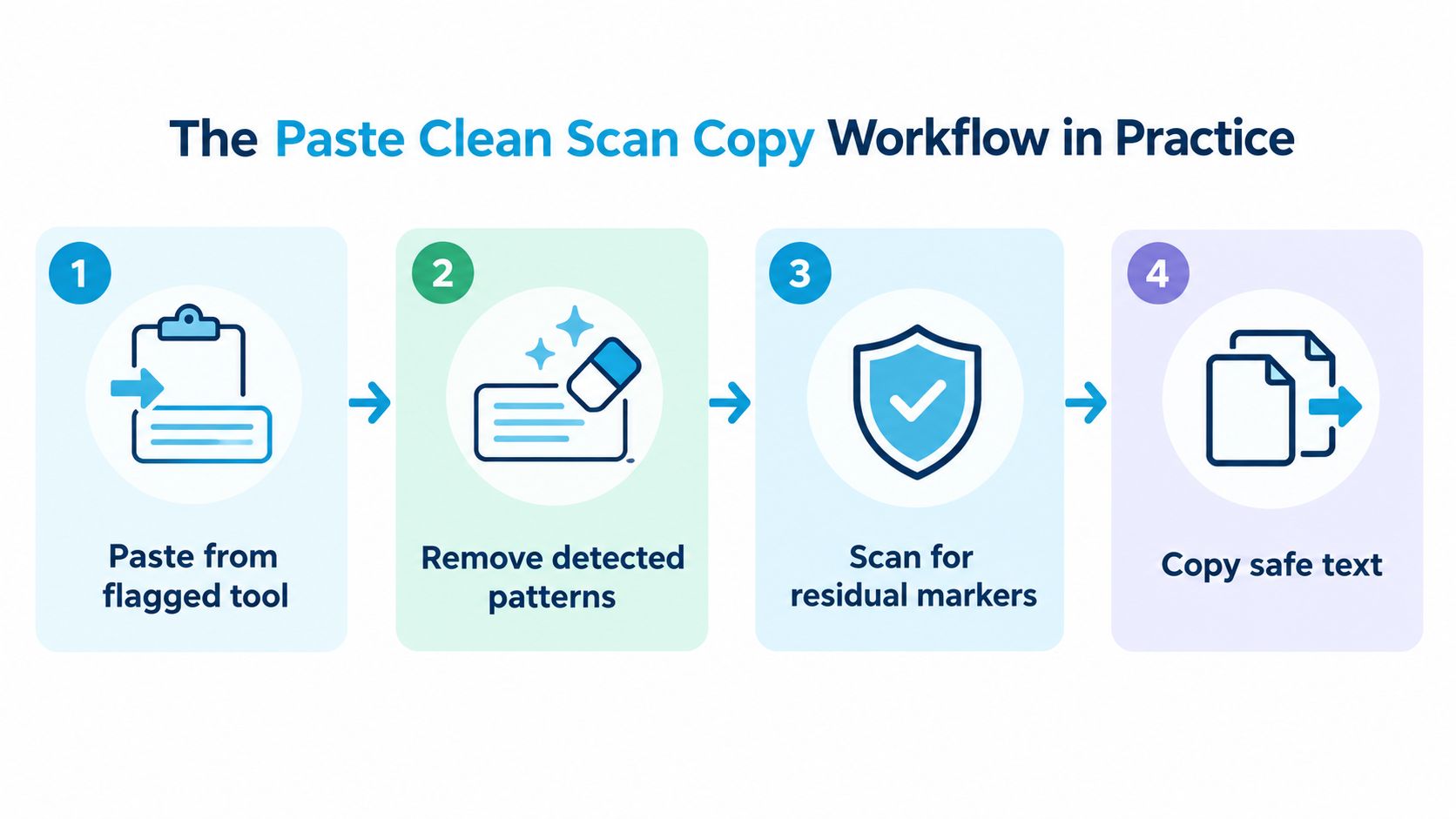
A useful workflow feels boring. That's a strength. Start with the original output from the flagged generator and keep a backup before touching it. Paste the passage into the editor, then run the invisible-character pass. The tool should identify or remove zero-width marks, soft hyphens, direction controls, and spacing anomalies without pretending those artifacts are the vendor's statistical watermark.
One short session
For a short passage, the rhythm is straightforward:
- Paste the source: Keep the original text available so you can compare wording, numbers, names, and claims.
- Clean hidden artifacts: Normalize the text and remove characters that don't belong in ordinary copy.
- Rewrite only if justified: Use a vendor-oriented rewrite when you're addressing a suspected statistical signal.
- Scan and copy: Review the result, check the scan output, and copy the version you approve.
A good interface should make these passes visible. If it rewrites everything without showing the changes, you can't tell whether it performed simple normalization or changed the substance. If the input is long, the user may need to shorten it or retry a failed request, especially when the passage contains unusual formatting or complex tables.
The final scan is not a certificate. It can show a confidence score or residual-marker result, but the score belongs to that detector and that passage. A short passage may not contain enough text for a stable statistical decision, while a longer passage gives a detector more material to score. The workflow is therefore iterative, not magical: paste, clean, inspect, rewrite if needed, and verify the copy you plan to use.
Matching Simple Unmark to Each Vendor Watermark
Simple Unmark presents separate workflows for SynthID, ChatGPT, and Claude rather than treating every generator as identical. That distinction is sensible because token distributions and detector assumptions belong to particular systems. It still doesn't turn the product into a universal unmarker.
| Vendor | Targeted Signature | Rewriting Strategy | Realistic Confidence Drop |
|---|---|---|---|
| Gemini | SynthID-style token-choice pattern | Rephrase wording after Unicode cleanup | May weaken the signal, but removal isn't guaranteed |
| ChatGPT | Statistical patterns associated with OpenAI-generated text | Guided paraphrase and sentence-level variation | Depends on passage length, wording, and detector |
| Claude | Anthropic-associated sampling or entropy patterns | Vendor-oriented rewriting with meaning checks | May reduce a detector score without proving absence |
The SynthID remover is the logical choice when Gemini is the known source. SynthID-Text embeds its signal during sampling, so removing invisible characters alone won't address the load-bearing mechanism. The statistical assessment reported that meaning-preserving paraphrase eliminated detection in 98.3% of initially detected SynthID texts, while clean text produced a 5.4% false-positive rate for SynthID. Those results show both why rewriting can work and why no responsible tool should promise certainty. The 2026 evaluation of paraphrase attacks reports both findings.
The ChatGPT and Claude pages should be treated as guided rewriting pipelines, not as direct access to private vendor keys. They can alter phrasing patterns associated with the selected source, but they can't inspect a proprietary detector's internal state unless the vendor provides an appropriate verification service. Claude also illustrates why market language causes confusion. A page advertising invisible-character cleanup may imply a Unicode mark, while technical explanations of statistical watermarking describe a token-pattern signal instead.
Use the vendor page when you know the source. If you don't, start with cleanup and preserve the original. A generic rewrite can make the passage less accurate without giving you a reliable answer about which watermark, if any, was present.
Pricing Limits and Privacy by Design
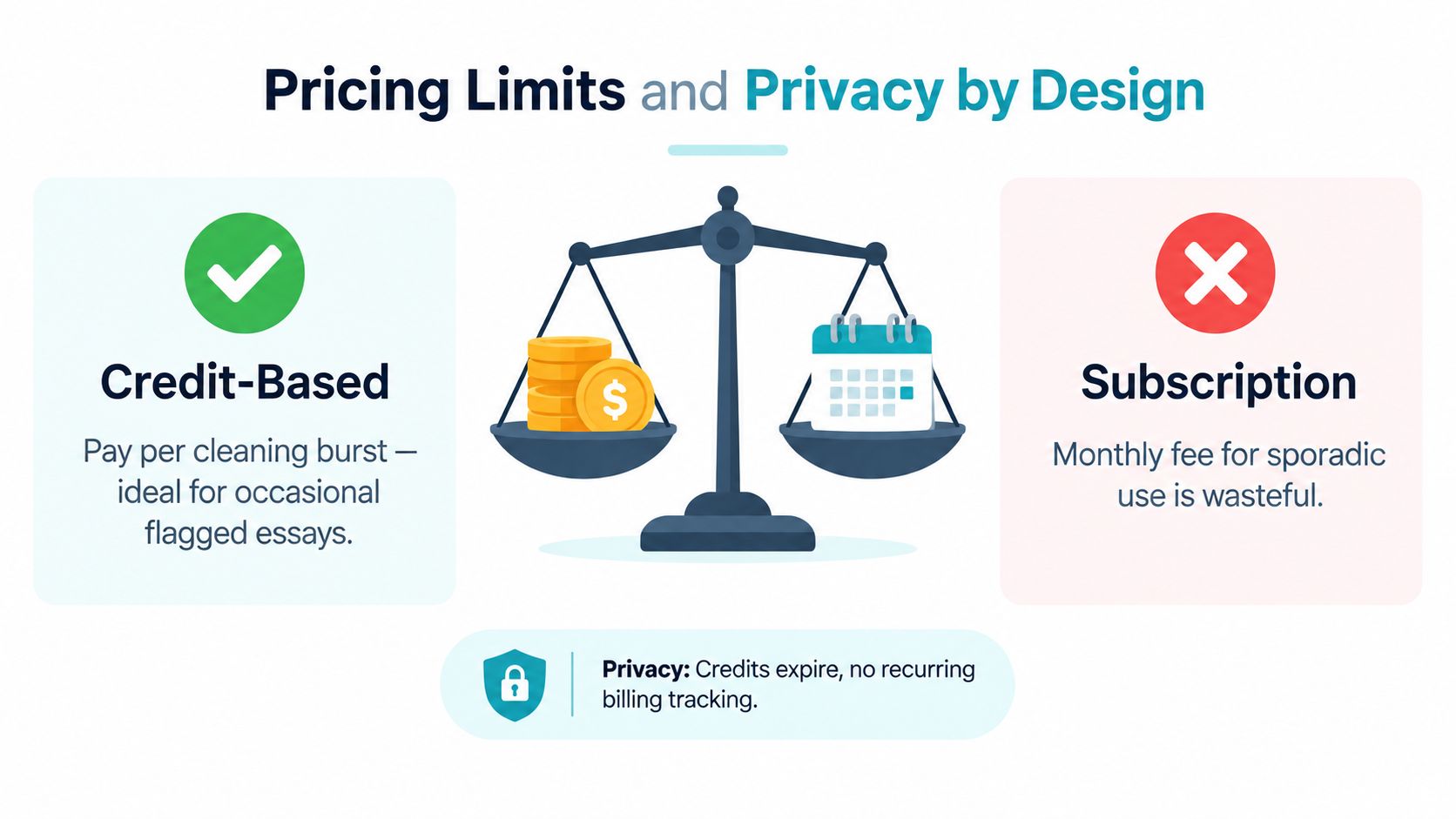
Credit-based billing is the sensible model for occasional watermark cleanup. Most users don't need a text watermark remover every day. They may have a flagged draft, a few client passages, or a periodic review. A monthly subscription charges for idle capacity and encourages people to keep a service they barely use.
Simple Unmark uses 0.1 credit per started 100 words, with processing rounded to the next 100 words. A short piece can use one small credit increment, while a long article consumes several. Requests can contain up to 5,000 words, and new accounts include 10 starter credits. Guest users can make three free cleans of up to 100 words without an account. These are product limits, not guarantees about detector outcomes.
What you trade with your text
Privacy deserves the same scrutiny as pricing. Simple Unmark states that guest submissions aren't saved, while account records track counts and credit activity rather than submitted text. Payments are hosted by Stripe, and credits don't expire. That setup is materially clearer than a tool that retains pasted passages for model improvement, but readers should still review the current service terms before uploading confidential material.
The practical buying decision is therefore narrow:
- Occasional use: Credits avoid a recurring payment for sporadic cleanups.
- Repeated editorial work: A team arrangement can make sense when several editors handle recurring passages.
- Sensitive content: Don't paste material unless the provider's retention and processing terms fit your obligations.
- Large drafts: Split work only when necessary, and preserve headings, tables, references, and terminology during review.
A low price doesn't buy verification. It buys processing capacity and a defined workflow. You're paying for cleanup and rewriting, not a legal or forensic declaration that the output is human-written.
Ethics Legal Risk and Detector Honesty
Removing a watermark from text you're allowed to edit isn't the same as misrepresenting its origin. Rewriting your own AI-assisted draft may be acceptable under one policy and prohibited under another. Submitting the result as entirely human-written when an academic rule, client contract, publisher policy, or workplace requirement forbids that claim creates a risk.
Copyright and disclosure are separate questions. A short AI-assisted passage may raise limited copyright concerns, while a false statement about authorship can breach institutional or contractual terms. The safe workflow is administrative, not evasive: preserve the source, record how AI was used, review the output yourself, and disclose assistance when the applicable policy requires it.
Detector claims versus measured behavior
| Detector | Marketed accuracy | Behavior after rewrites | Documented failure mode |
|---|---|---|---|
| SynthID-Text | Statistical classification, not certainty | Meaning-preserving paraphrase can sharply reduce detection | False positives and uncertain results |
| KGW | Watermark score based on token preferences | Meaning-preserving paraphrase can remove detection in tested text | Signal depends on the secret key and threshold |
| Unigram | Statistical watermark score | Meaning-preserving paraphrase can remove detection in tested text | Rewriting changes both evidence and text quality |
| General AI detectors | Often presented as authorship indicators | Scores can shift after editing | A score doesn't prove who wrote a passage |
The 2026 performance evaluation found meaning-preserving paraphrase removed detection in 100% of initially detected KGW and Unigram texts and 98.3% for SynthID. It also reported a 5.4% false-positive rate on clean text for SynthID. The published evaluation supports a narrow conclusion, not a universal promise: paraphrasing can weaken tested watermark signals, while detection can still misclassify clean text.
Compliance rule: never use a detector result as your only proof of origin, and never use a remover as proof that disclosure rules no longer apply.
Simple Unmark isn't a laundering tool and doesn't guarantee detector evasion. It removes hidden characters and rewrites wording to reduce a probabilistic signal. You remain responsible for labeling the content, checking facts, protecting confidential material, and following the policy that governs its use.
What a Realistic Removal Workflow Looks Like
Start with the source, not the detector score. Save the original passage, note whether it came from Gemini, ChatGPT, Claude, or an unknown tool, and record the detector outputs that caused concern. That evidence gives you something to compare after editing and prevents a rewrite from erasing the trail you may later need.
Paste the text into the cleaner and run the invisible-character scan first. This is the high-confidence part of the process. If the source is known, choose the corresponding vendor workflow, then review the rewritten output for facts, numbers, proper nouns, tone, citations, and intent. A guide to how to remove AI watermarks from text can help organize those steps, but it can't replace your own review.
A defensible checklist
- Back up the original: Keep an untouched copy with its source and date.
- Identify the vendor: Select SynthID, ChatGPT, or Claude only when the source is known.
- Clean Unicode first: Remove zero-width marks, direction controls, and spacing debris.
- Review the rewrite: Compare claims, terminology, names, numbers, and meaning.
- Verify independently: Use two independent detector checks when the decision has real consequences.
- Document the limitation: Record that statistical reduction isn't proof of removal.
- Apply the policy: Disclose AI assistance when a contract, institution, or publisher requires it.
The two jobs remain distinct. Unicode cleanup produces plain, copy-safe text and can be checked directly. Statistical rewriting may bury a token-pattern signal under new wording, but it can also change the passage and still leave a detector uncertain or positive. No remover sells certainty. A responsible workflow buys cleaner text, documented choices, and a stronger basis for explaining what happened.
Simple Unmark removes hidden Unicode artifacts and rewrites text to reduce probabilistic watermark signals from workflows associated with Gemini, ChatGPT, and Claude. Test a short passage first, compare the output against the original, and visit Simple Unmark when you need a credit-based paste, clean, scan, and copy workflow.
- text watermark remover
- AI watermark removal
- SynthID remover
- ChatGPT watermark cleaner
- invisible character remover
More posts
How to Remove Watermarks from AI Text in 2026
Learn how to remove watermarks from AI text honestly. Covers SynthID, hidden Unicode, and practical rewriting methods with clear limits and verification steps.
Watermark Remover Online: What Works and What Doesn't
Compare watermark remover online options for AI text. See how rephrasing, Unicode cleanup, and token edits differ, plus where Simple Unmark fits.
How to Use Watermark Remover Without Losing Meaning
Learn how to use watermark remover tools to clean AI text quickly. Practical steps, settings, and honest tips for better results with Simple Unmark.