
Watermark Remover Online: What Works and What Doesn't
Compare watermark remover online options for AI text. See how rephrasing, Unicode cleanup, and token edits differ, plus where Simple Unmark fits.

Most advice about a watermark remover online starts with the wrong fix. It tells you to strip invisible characters, change the font, or paste the text into a plain-text editor. That can remove formatting noise, but it doesn't remove a statistical watermark such as SynthID, because statistical marks live in word-choice patterns rather than visible characters. Google DeepMind's Nature paper on SynthID-Text describes a production-ready watermarking system for large language model outputs that was already deployed in Gemini.
That distinction matters. If your copied text contains zero-width spaces, use a Unicode cleaner. If Gemini, ChatGPT, or Claude produced wording with a probabilistic token signal, you need meaning-preserving rephrasing. Anything else is mostly cosmetic, and detector results still aren't proof of authorship or provenance.
Table of Contents
- What an Online Watermark Remover Does
- Two Different Problems Hidden Inside the Same Search
- Comparing the Three Online Approaches Side by Side
- How Simple Unmark Handles SynthID and ChatGPT Marks
- Why Rephrasing Beats Token Swaps for Probabilistic Watermarks
- Pricing, Credits, and the Cost of a Clean
- Which Approach Fits Your Situation
What an Online Watermark Remover Does
A watermark remover online can refer to very different cleanup operations. The useful question is not whether a tool removes a watermark, but what signal it can detect and change.
Surface cleanup targets text that contains invisible formatting controls, unusual spacing, soft hyphens, or homoglyphs. These characters can disrupt search queries, document editors, spell-checkers, and comparison tools. A zero-width space between two parts of a search term may look like an ordinary gap while causing the query to return the wrong results or fail to match. Unicode identifies U+200B ZERO WIDTH SPACE as a character with no intrinsic width that can indicate a word or line-break opportunity. Zero-width joiners and non-joiners are format controls that some text-analysis processes, including spell-checking and search, ordinarily ignore. Unicode's core specification explains their intended behavior.
Statistical reduction requires a different operation. A system such as SynthID-Text influences token selection during generation, so its signal is not stored in a hidden character that you can highlight and delete. A rephrase-based tool changes sentence construction, vocabulary choices, and clause order to weaken the original pattern while keeping the passage usable. For a tool built around this distinction, see the AI watermark remover overview.
The popular shortcut fails
Changing fonts, copying through Notepad, or removing invisible characters creates cleaner plain text, but it leaves a statistical token distribution intact. These actions clean the text layer rather than rewriting the model's word-choice pattern.
Practical rule: If the text looks normal but a detector flags it, character stripping is the wrong first move.
Some products marketed as removers only delete nonprinting characters. Others make a few token swaps or shuffle punctuation. Those features can help with mechanical noise, but they do not meaningfully address a modern statistical watermark.
For Gemini, ChatGPT, or Claude output, choose a rephrase-based reducer that rewrites naturally, preserves facts and intent, and avoids promising guaranteed detector results. Use a Unicode cleaner for corrupted copy and paste. The search term is singular, but the cleanup task depends on the signal.
Two Different Problems Hidden Inside the Same Search
Start by classifying the signal. Don't upload text to a random remover until you know whether you're dealing with statistical watermarking or invisible Unicode artifacts.
Statistical watermarking operates through token selection. SynthID-Text is the clearest production example. Google DeepMind described it as configurable for non-distortionary or distortionary behavior, designed to preserve text quality, and deployed in Gemini. The watermark detector looks for a statistical pattern across generated wording, not a string of special characters.
That means a paragraph can look completely ordinary and still carry a detectable pattern. Copying it into another editor doesn't erase that pattern. Neither does changing the typeface. A meaningful rewrite has to alter enough of the wording and syntax to disturb the distribution the detector measures.
Unicode artifacts are different. Consider a passage with U+200B characters inserted between words. They render blank, but they remain part of the text stream and can affect copying, searching, indexing, or downstream processing. A Unicode stripper can remove or normalize those characters almost instantly.
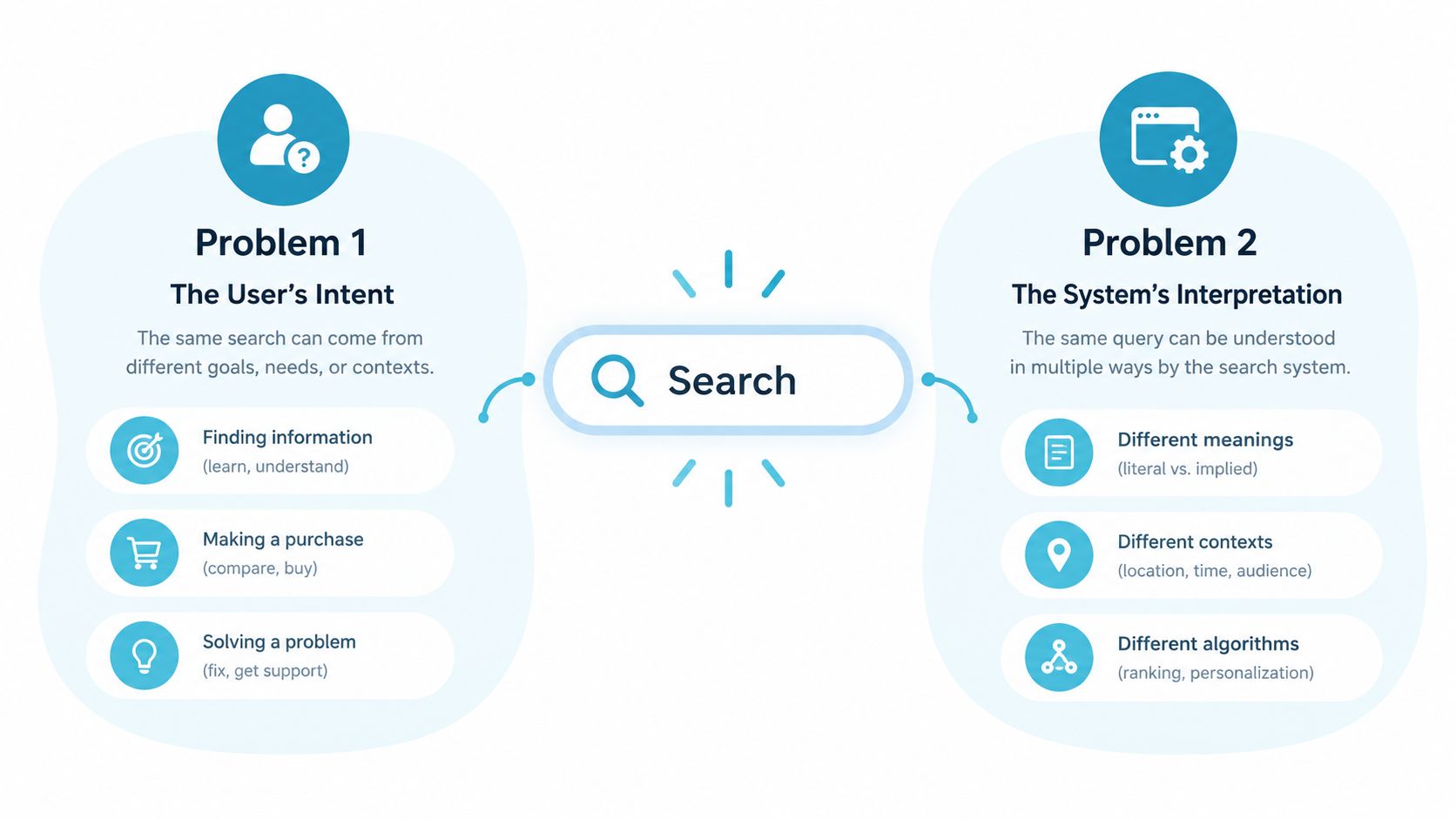
The solutions don't overlap as much as tool pages suggest. A Unicode cleaner solves the artifact problem and does nothing to a statistical watermark. A rephrase-based reducer addresses the statistical problem, but it's unnecessary overkill if all you need is plain, copy-safe text. This guide to hidden Unicode and statistical watermarks separates the two mechanisms clearly.
Use the right diagnostic
Ask three questions before choosing a tool:
- Does the text contain strange spacing or broken search behavior? Start with Unicode inspection and cleanup.
- Does the text look normal but trigger an AI detector? Consider semantic rephrasing, not character deletion.
- Do you need provenance or compliance evidence? Preserve the original and document the editing process instead of treating removal as proof that the text was human-written.
The confusion persists because both problems are described with the same word, watermark. They require different operations, have different failure modes, and raise different ethical questions.
Comparing the Three Online Approaches Side by Side
There are three common approaches, but only one is a serious candidate for SynthID-style marks.
| Approach | Method | Effective vs SynthID | Speed | Cost | Best For |
|---|---|---|---|---|---|
| Rephrasing-based reduction | Rewrites sentences, synonyms, clauses, and structure | The only credible category for reducing a probabilistic signal | Moderate | Credit-based or usage-based | Gemini, ChatGPT, and Claude passages that need semantic rewriting |
| Token-level editing | Swaps individual words or punctuation in place | Usually ineffective because the wider token pattern remains | Fast | Low | Minor wording changes and limited surface cleanup |
| Unicode stripping | Removes or normalizes invisible characters and controls | Irrelevant to statistical watermarks | Very fast | Often free | Zero-width spaces, soft hyphens, homoglyphs, and malformed pasted text |
Rephrasing-based reduction
A rephrase-first tool changes the passage at sentence level. It may replace synonyms, restructure clauses, vary transitions, and reorder phrasing. That broader rewrite is important because a detector doesn't rely on one suspicious word. It evaluates a pattern distributed across the text.
The trade-off is real. Rewriting takes longer than deleting characters, may consume credits, and can introduce slight meaning drift in highly technical passages. A reliable workflow should preserve numbers, proper nouns, cited claims, code, and formatting wherever possible, then require a human review for sensitive content.
Token-level editing
Token shuffling looks attractive because it feels surgical. Replace a word, change a comma, and keep everything else untouched. That approach can be useful when a document contains awkward wording or a small amount of formatting noise, but it doesn't reliably disrupt a multi-token statistical signal.
A detector measures patterns across choices. One isolated synonym swap rarely changes the broader structure enough to matter. Token editing is cheap and quick, but its apparent precision is also its weakness against probabilistic marks.
Unicode stripping
Unicode cleanup is the right tool for the narrow problem it solves. It can remove zero-width characters and normalize unusual controls without changing the author's wording. Aggressive cleanup can still damage encoding or legitimate script behavior, so a tool should distinguish suspicious artifacts from characters used intentionally in languages such as Thai, Myanmar, Khmer, and Japanese.
The verdict is straightforward. For generated text from Gemini, ChatGPT, or Claude, choose rephrasing. For invisible formatting noise, choose Unicode stripping. A token swapper sits between them, useful for light edits but not a credible answer to modern statistical watermarking.
How Simple Unmark Handles SynthID and ChatGPT Marks
Simple Unmark starts with rephrasing because probabilistic marks require changes to wording patterns, not a handful of character substitutions. Paste the passage, let the service process it, and review the copy-ready result. Unicode cleanup runs in the same workflow. Its supported use cases include AI-generated text from Gemini, with SynthID-focused cleanup and guided handling for ChatGPT and Claude outputs.
| Pipeline Stage | Target | Preserved |
|---|---|---|
| Sentence-level rewrite | Structure, clause order, and repeated phrasing | Meaning, intent, and overall voice |
| Lexical variation | High-probability wording streaks and repetitive token choices | Facts, numbers, and proper nouns |
| Unicode cleanup | Zero-width marks, direction controls, unusual spacing, and homoglyph issues | Normal visible formatting |
| Output review | Copy safety and readable final text | Cited statistics, code blocks, and document structure where supported |
What gets rewritten
The service changes wording instead of stripping characters. A long Gemini paragraph may return with a different rhythm, alternate vocabulary, and revised clause construction. The goal is to reduce a statistical pattern, not to disguise the original through formatting tricks.
Independent evaluation supports this approach. One study found that meaning-preserving paraphrase removed watermark detection in 98.3% of texts that initially triggered SynthID, while producing a 5.4% false-positive rate on clean text. The forensic-readiness study also demonstrates why detection and removal results require interpretation rather than automatic acceptance.
Simple Unmark aims to retain formatting, code blocks, cited statistics, proper nouns, and intent. Inspect technical passages yourself. A legally defined term, scientific label, or product name may need to remain unchanged, even when surrounding sentences are rewritten.
Where it stops
A text rewriter cannot remove a mark stored in side-channel metadata, a hardware signal, or another file layer. It also cannot guarantee a detector result after translation, repeated rewriting, or additional transformations. Input length sets a practical limit: passages shorter than a few complete sentences give the tool too little context to rewrite safely. For those snippets, a manual edit is often safer than forcing a broader rewrite.
For example, “The model improves retrieval accuracy by preserving query context” could become “Keeping the query context helps the model return more relevant results.” The claim stays intact, while the syntax, verb choice, and sentence rhythm change. That is the kind of controlled rewrite to review, not a blind search-and-replace operation.
Short responses are difficult for detectors before any cleanup occurs. Reporting on the SynthID-Text work noted that detection for short AI replies could fall below 50%, while the strongest reported case reached up to 95% accuracy, as discussed in The Nature coverage and paper. Treat very short results as weak evidence, and judge the rewritten text for meaning and readability before using it.
Why Rephrasing Beats Token Swaps for Probabilistic Watermarks
Token-level edits fail because they preserve too much of the original distribution. Swap one adjective, replace a comma, or alter a single transition, and the surrounding token choices remain largely intact. A detector can still see the broader pattern.
Rephrasing changes the unit of intervention. Instead of patching isolated words, a sentence-level rewriter changes syntax, clause order, vocabulary, and rhythm together. That pushes the passage into a different region of possible wording, which is the only credible way to dilute a watermark based on repeated token-choice preferences.
Attack research supports this distinction. One study reported nearly 100% attack success across seven recent watermarking systems, including SynthID-style schemes, while maintaining text quality and using about $0.88 per million tokens in compute cost. The attack study also describes how scrubbing can reduce SynthID-Text's AUC to about 0.7 for texts around 1,000 tokens, reinforcing the weakness of superficial edits.
This doesn't make rephrasing a magic eraser. Meaning can drift, technical wording can soften, and a detector can still produce an uncertain result. It does make rephrasing the correct category for statistical signals.
The working rule: Use rephrasing for probabilistic watermarks. Use token swaps only for surface-level edits and Unicode cleanup.
Pure token edits still have a place. If the problem is a copied passage filled with zero-width spaces, changing the prose is wasteful and potentially harmful. If the problem is SynthID-style wording, character-level tools are the wrong instrument.
Pricing, Credits, and the Cost of a Clean
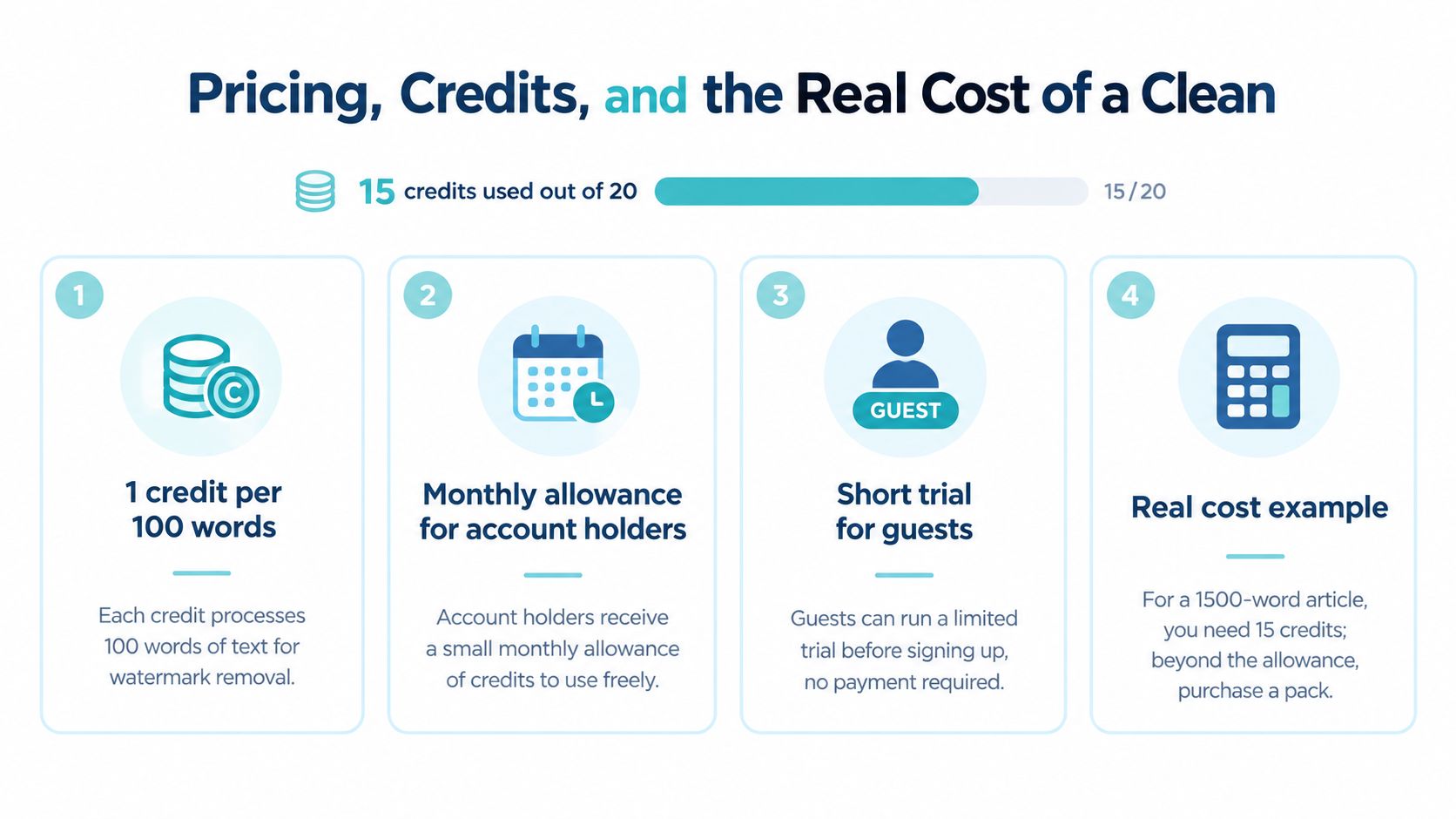
Simple Unmark uses credits instead of a recurring subscription. Processing costs 0.1 credit per started 100 words, requests are capped at 5,000 words, and unused credits do not expire. The Simple Unmark pricing page lists the current usage rules. Account holders receive starter credits, while guests can test the workflow with short text.
Use the per-run calculation to estimate repeat edits. A 1,200-word article rewritten twice counts as 24 started 100-word units, or 2.4 credits. A single 100-word run costs 0.1 credit. A 1,000-word run costs 1 credit. A 5,000-word run costs 5 credits. Splitting one article into chunks can change the total because each request is counted separately, so keep related text together when the service permits it.
Compare the alternatives
A flat-fee remover suits frequent use, but it can waste money during quiet periods. A credit model fits occasional editorial work better, provided the service clearly explains word counting, request limits, and repeat-pass charges.
Check these points before paying:
- Free access: Confirm how many words guests can process and whether an account is required.
- Rerun cost: Verify whether another pass consumes another charge or includes a revision.
- Scope: Confirm that the product handles statistical text watermarks, rather than only visible image marks or hidden characters.
- Privacy: Review storage practices and the account records retained after submission.
For broader content operations, teams can compare affordable SEO platform plans before placing cleanup inside a wider editorial and search workflow. That comparison does not measure watermark removal quality. It does help separate a low-use text tool from recurring software costs.
A credit price is not a clean-text guarantee. Judge the service by meaning retention, output quality, and the cost of another pass when the first rewrite needs human review.
Which Approach Fits Your Situation
Choose based on the signal, not the search phrase.
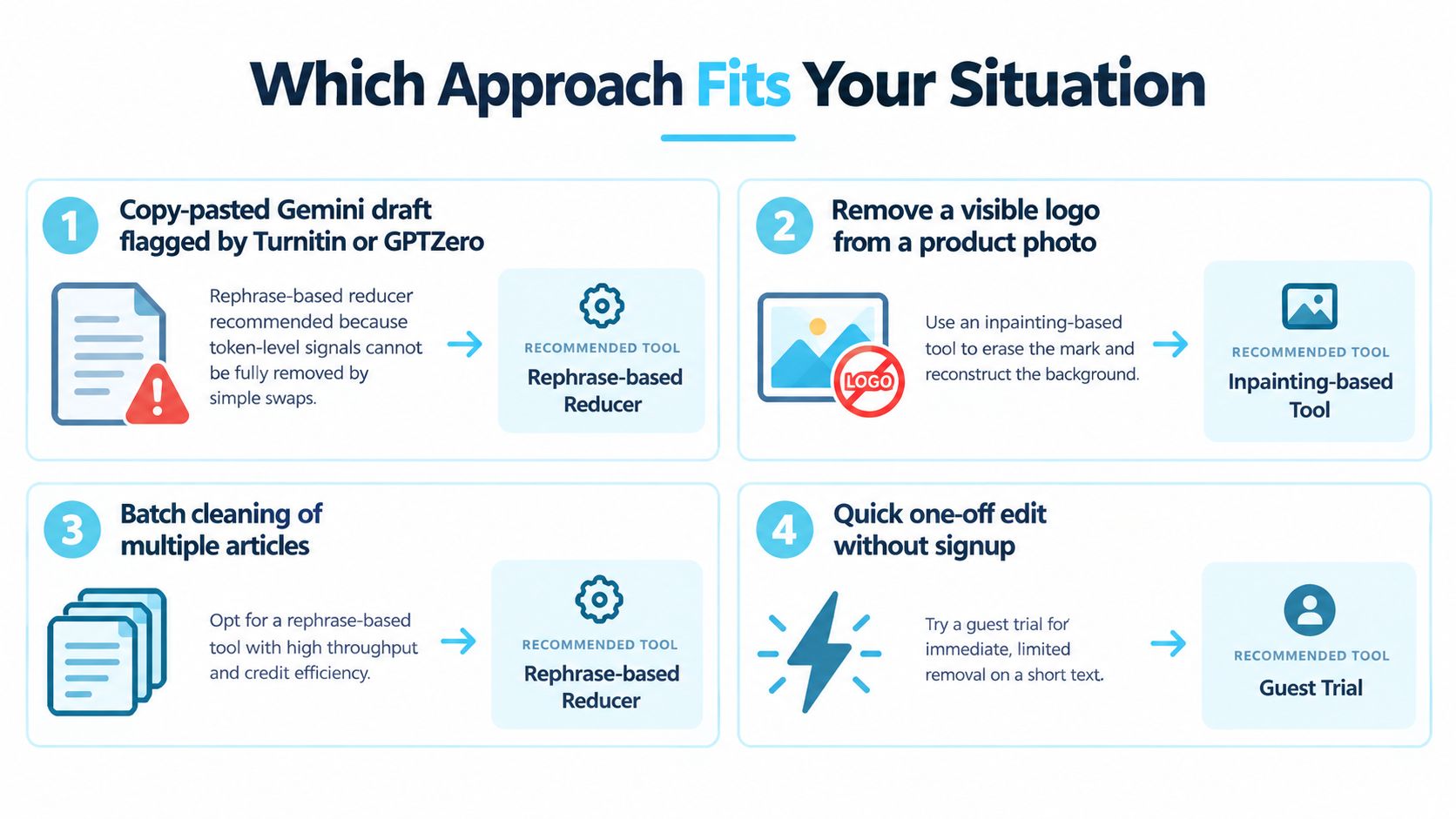
A copy-pasted Gemini draft flagged by Turnitin or GPTZero calls for a rephrase-based reducer, because changing a few characters won't rewrite token-level patterns. The detector itself may be wrong, especially on short or heavily edited text, so keep the original draft and review the cleaned version for meaning before publishing or submitting it.
A document filled with zero-width spaces or soft hyphens needs a Unicode cleaner. This is a mechanical problem. Run the cleanup locally when privacy or document sensitivity matters, then compare the cleaned text against the original to ensure legitimate language-specific characters weren't removed.
A developer holding a model checkpoint and testing raw watermark signals needs a custom detector and an appropriate evaluation setup. An online remover can't inspect your model internals or reproduce a research workflow just because you pasted a sample into a browser.
Use this appropriateness checklist
- Your own AI-assisted draft: Removing accidental Unicode noise or rewriting your own material can be a defensible editing step.
- Someone else's protected work: Don't use a remover to launder copied writing or conceal its provenance.
- Academic assessment: Bypassing an integrity system violates the rules of many institutions, regardless of whether the detector is reliable.
- Publisher or compliance review: Preserve the source, record the edits, and disclose AI assistance where policy requires it.
- Image watermark: Use an image inpainting tool for a visible logo or overlay. A text rewriter is irrelevant.
For related discovery and evaluation workflows, the Sight AI tools page can help teams review available tools, but it won't change the basic classification. Text signals need text treatment. Image marks need image editing.
The European Parliament has warned that AI-text watermarking isn't standardized, can be manipulated or removed, and can produce false positives. Its briefing on AI-generated text also notes the technical difficulty of marking text without changing meaning. Treat removal as an editing operation, not as evidence that a passage was written without AI.
Simple Unmark combines Unicode cleanup with meaning-preserving rephrasing for AI-generated text from Gemini, ChatGPT, and Claude. If you need to clean a passage, reduce a SynthID-style statistical signal, and keep the facts and intent intact, visit Simple Unmark, paste a sample first, and review the result before using it in a real document.
- watermark remover online
- AI watermark remover
- SynthID text remover
- invisible character remover
- Simple Unmark
More posts
How to Use Watermark Remover Without Losing Meaning
Learn how to use watermark remover tools to clean AI text quickly. Practical steps, settings, and honest tips for better results with Simple Unmark.
Invisible Numbers Explained and How to Remove Them
Learn what invisible numbers and hidden Unicode characters are, how they watermark text, and how to detect and remove invisible numbers safely.
AI Text Humanizer Explained and How to Use It Right
Learn what an AI text humanizer does, how rewriting and Unicode cleanup reduce watermark signals, and how to humanize AI text without losing meaning.