
AI Text Humanizer Explained and How to Use It Right
Learn what an AI text humanizer does, how rewriting and Unicode cleanup reduce watermark signals, and how to humanize AI text without losing meaning.
You paste an AI draft into Google Docs or a CMS. The wording looks fine. Then weird stuff starts happening. Search stops matching a phrase you can clearly see. A line wraps badly for no obvious reason. Or a detector throws a flag even after you edited the copy by hand.
That's the moment you might start searching for an AI text humanizer.
The problem is that “humanizing” gets treated like one job when it's really two. First, you may need to clean out invisible Unicode junk that survives copy paste. Second, you may need to reshape wording patterns that carry statistical watermark signals. Those are different problems. They need different fixes.
If your workflow also turns text into audio, the same principle applies there too. Clean wording matters before narration, pacing, and delivery, which is why it helps to find the best TTS voice only after the text itself is readable and stable.
Most articles blur all of this together and call it “bypass detection.” That's too sloppy to be useful. If you're editing AI-assisted text for publishing, research, compliance, or plain old clean copy reuse, you need a sharper mental model.
Table of Contents
- Introduction Why AI Text Needs Humanizing
- What an AI Text Humanizer Actually Does
- How Probabilistic Watermarks Like SynthID Work
- Invisible Characters and Why They Survive Copy Paste
- How to Humanize AI Text Without Losing Meaning
- Choosing the Right Humanizing Approach for Your Use Case
- Key Takeaways for Clean and Copy Safe AI Text
Introduction Why AI Text Needs Humanizing
The real problem isn't just tone
A lot of AI text doesn't fail because it sounds robotic. It fails because it's awkward to reuse.
You might get a draft from Gemini, ChatGPT, or Claude that reads well enough. Then you paste it into a publishing system and hidden formatting comes along for the ride. Or you rewrite a few lines, run a detector, and get a result that doesn't match your own judgment. That's frustrating because you're not trying to cheat a test. You're trying to make text clean, natural, and safe to work with.
Clean text should survive copy, paste, editing, search, and formatting without surprises.
That's why “humanizing” needs a more practical definition. It can mean making sentences sound more natural. But it can also mean removing hidden characters and reducing token-choice patterns that some watermarking systems rely on.
Two jobs, not one
Most people mix these up:
- Unicode cleanup: Remove zero-width marks, direction controls, odd spacing, and similar artifacts that are valid characters but visually invisible.
- Watermark rewriting: Change token choices while preserving meaning, so the statistical pattern in the original output is weakened.
- Style editing: Fix stiff rhythm, repetitive structure, and generic phrasing so the text reads like something a person would publish.
Those jobs can overlap, but they aren't the same.
If your pasted draft breaks formatting, rewriting alone may not fix it. If your concern is watermarking or detector behavior, stripping invisible characters alone won't solve that either. You need to know which layer you're dealing with before you touch the text.
What an AI Text Humanizer Actually Does
A real AI text humanizer is not just a synonym replacer.
A basic paraphraser swaps phrases around. A humanizer, at least a useful one, tries to keep the meaning, facts, numbers, proper nouns, tone, and intent while changing the way the text is expressed. It's like shuffling the order of cards without changing the hand you were dealt.
Here's the simple version. The message stays the same. The wording pattern changes.
Paraphrasing versus signal reduction
Readers usually get confused.
If you change “The tool improves workflow efficiency” to “The software helps teams work faster,” you've paraphrased it. That may improve readability. But from a technical view, the bigger question is whether you also changed the token pattern enough to reduce a hidden statistical signal.
That distinction matters because watermarking systems don't look for meaning. They look for patterns in word choice.
A practical humanizer often does three things at once:
- It rewrites wording patterns instead of making tiny cosmetic edits.
- It preserves anchor details like names, numbers, and factual claims.
- It cleans hidden text artifacts that can survive copy paste.
If you're using AI to speed up drafting, that broader workflow matters more than detector scores alone. For the writing side of that process, this guide to faster content with AI is useful because it focuses on where AI helps and where human editing still does the work.
Why humanizers became their own category
This wasn't just a branding trick.
A 2025 study on adversarially modified AI text found that after paraphrasing, SynthID's true positive rate fell from 87.6% to 5.4% at a 5% false-positive rate, showing that watermark-based detection can drop sharply when text is rewritten to sound more human (research summary). That shift is a big reason humanizers became a separate category from ordinary rewriters.
The key lesson is blunt. If a system looks strong on untouched AI output, that doesn't tell you much about how it performs after real editing.
How Probabilistic Watermarks Like SynthID Work
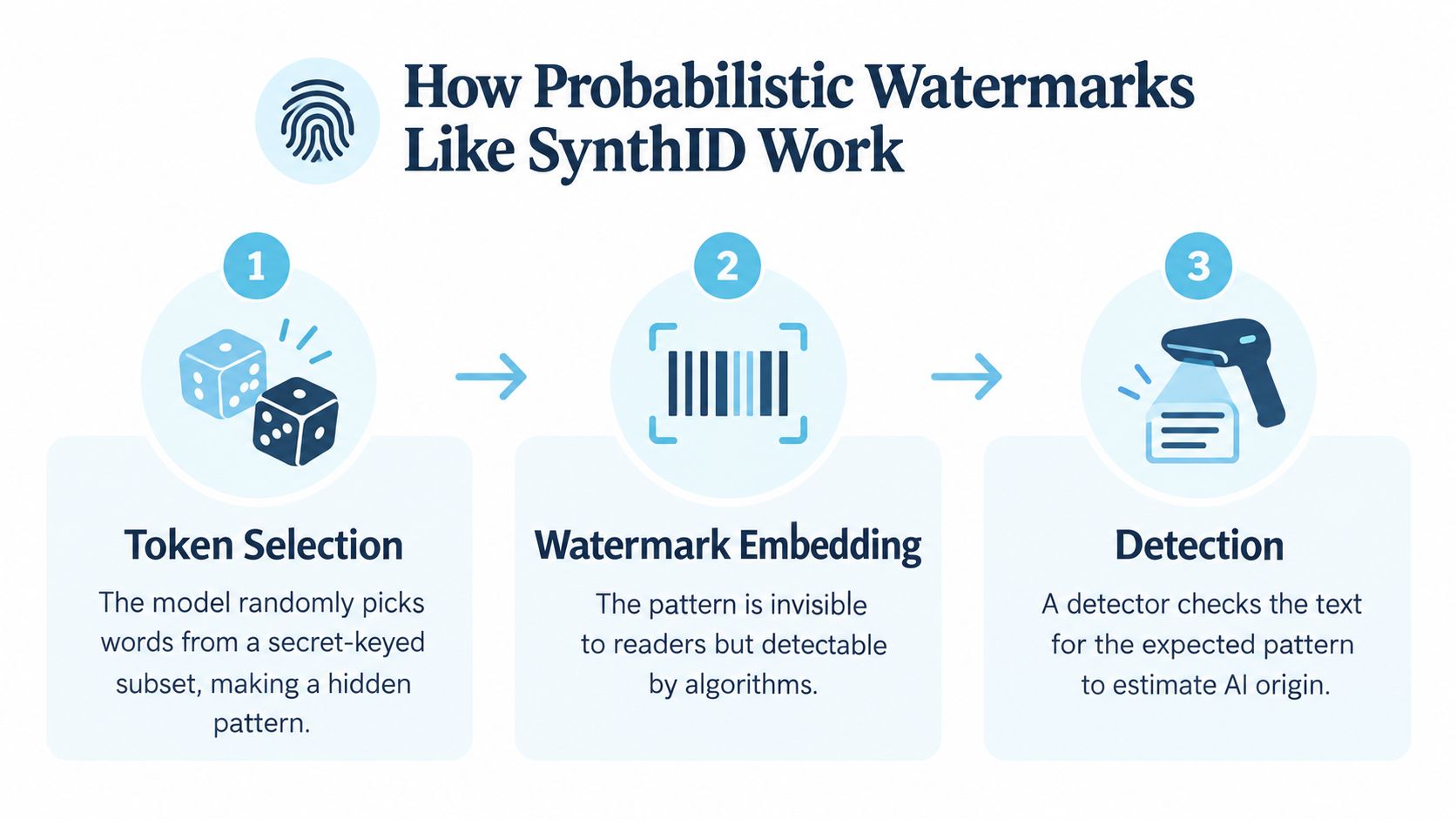
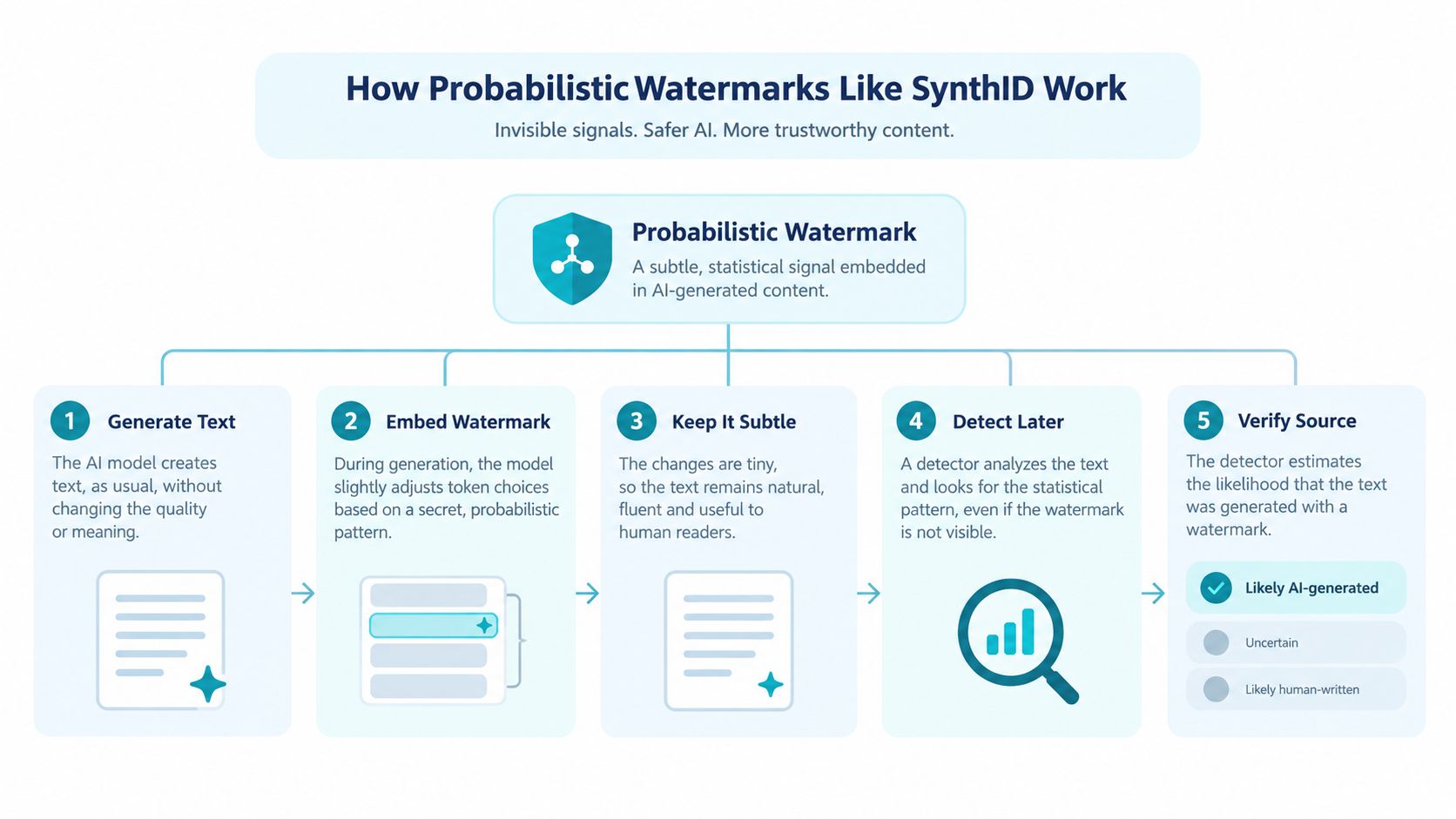
Probabilistic watermarking sounds exotic, but the core idea is simple. The model is nudged to prefer some word choices over others, using a hidden rule. Later, a detector checks whether the final text shows that pattern more often than chance.
That is very different from a visible marker or a hidden metadata tag.
The basic mechanism
Reviews of text watermarking describe the process this way: a watermarking system biases token selection toward a secret-keyed subset of tokens, then detection uses a statistical test on the observed token distribution. Detection works when the share of “green” tokens crosses a significance threshold (watermarking review).
In plain English, the model keeps leaning toward certain acceptable words. Not enough for a human reader to notice. Enough for a detector to test later.
DeepMind says SynthID embeds watermarks directly into AI-generated text by modulating token likelihoods during generation, and that the watermark comes from the final pattern of word choices plus adjusted probability scores rather than from any visible marker (DeepMind overview).
For a more tool-oriented explanation, this technical guide to AI text watermarks is a good companion read.
Why rewriting weakens the signal
This is the part that matters for humanizers.
If the signal depends on the original spread of token choices, then meaning-preserving rewriting can break that spread. The text may still say the same thing, but it no longer carries the same statistical fingerprint.
Google DeepMind's Nature paper says SynthID-Text uses a novel tournament-sampling algorithm and can run in non-distortionary mode, which preserves text quality, or distortionary mode, which improves detectability at the cost of quality (Nature paper).
That tradeoff tells you something important. Watermarking is not magic. It's engineering. And engineering comes with failure modes.
Change enough of the word-choice pattern, and a statistical watermark can get much harder to detect even when the message stays intact.
Passing a detector is not the same as removing a watermark
Those are related, not identical.
A detector may fail because it's weak, because the text is hybrid, or because the wording changed enough to blur the original signal. That doesn't mean every trace is gone in some absolute sense. It means the detection claim got weaker.
That distinction matters later when people make big forensic or compliance claims from detector outputs.
Invisible Characters and Why They Survive Copy Paste
Not all “AI text problems” are about wording. Some are about characters you can't see.
Unicode includes plenty of valid code points that have no visible width or act as formatting controls. That's normal in computing. It becomes a mess when those characters hitch a ride into ordinary prose.
What these characters are
The Unicode Standard defines U+200B ZERO WIDTH SPACE as a break opportunity with no intrinsic width. It also classifies U+200E LEFT-TO-RIGHT MARK and U+200F RIGHT-TO-LEFT MARK as invisible zero-width format characters with strong directionality (Unicode specification).
So yes, these are real characters. They aren't glitches in the mystical sense. They're just hard to spot.
Research on invisible Unicode channels also describes zero-width spaces, bidirectional controls, tag characters, and related code points as visually invisible but valid Unicode, which is why normalization and removal is a reliable first-pass cleanup step (research overview).
Why copy paste doesn't fix them
Copy paste usually preserves characters unless the destination strips them out. Many editors don't.
That means invisible marks can move from an AI tool into:
- Docs and notes apps: Search or cursor movement behaves oddly.
- CMS fields: Formatting breaks appear after publish.
- Moderation or indexing systems: Matching and parsing can act inconsistently.
- Shared drafts: One person sees “clean” text, another inherits hidden junk.
If you want to inspect or strip those artifacts directly, an invisible character remover is the right kind of tool. That job is separate from rewriting.
Practical rule: Clean invisible Unicode first. Then decide whether the wording itself needs heavier editing.
Why this matters more than people think
A lot of online discussion jumps straight to detector evasion. That misses the boring, common failure case. Text gets reused across systems that were never designed to expose hidden characters to human editors.
If your main risk is formatting, search, or moderation weirdness, Unicode cleanup may be the only step you need. No fancy “humanizing” required.
How to Humanize AI Text Without Losing Meaning
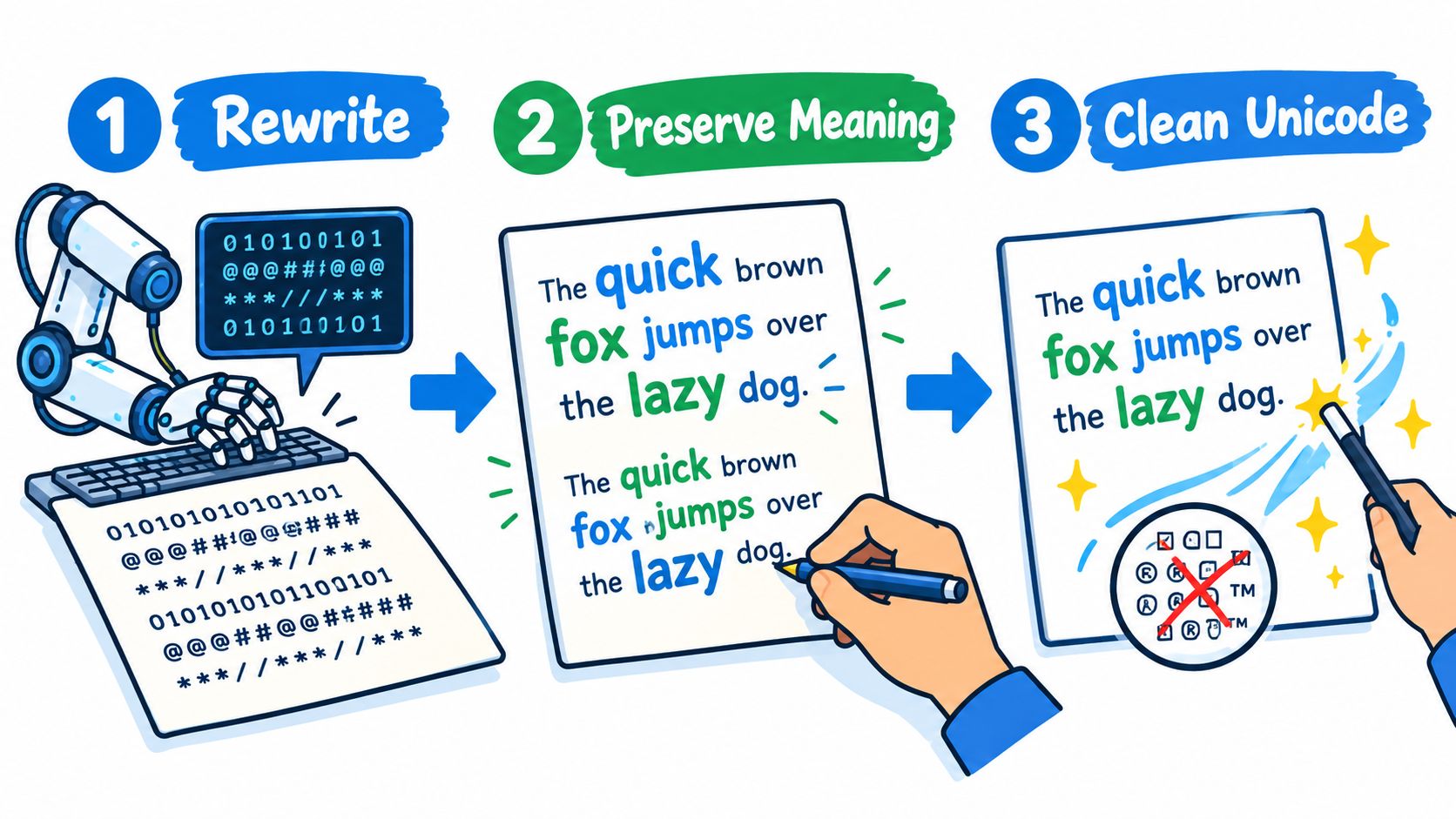
The safest workflow is simple. Clean the text, rewrite only as much as needed, and verify that the meaning didn't move.
That sounds obvious, but most bad outputs come from skipping one of those three checks.
Start with preservation rules
Before you rewrite anything, decide what must not change.
Use this short checklist:
- Facts stay fixed: If the original text includes a factual claim, don't let the tool soften, exaggerate, or replace it.
- Numbers stay exact: Don't let “5.4%” become “about five percent” unless you chose to simplify it.
- Proper nouns survive: Product names, people, brands, and technical terms need to remain intact.
- Intent stays the same: A cautious statement shouldn't become more confident just because the wording got smoother.
That's the difference between humanizing and laundering meaning.
Then rewrite for variation, not decoration
A good rewrite changes the pattern, not just a few surface words.
Weak edit:
- swaps a handful of adjectives
- keeps the same sentence skeleton
- leaves repetitive cadence untouched
Stronger edit:
- changes sentence structure
- varies clause order
- replaces predictable phrasing with natural alternatives
- trims filler instead of piling on synonyms
Here's the mental model: don't repaint the house. Move the walls carefully while keeping the address the same.
A practical paste clean copy workflow
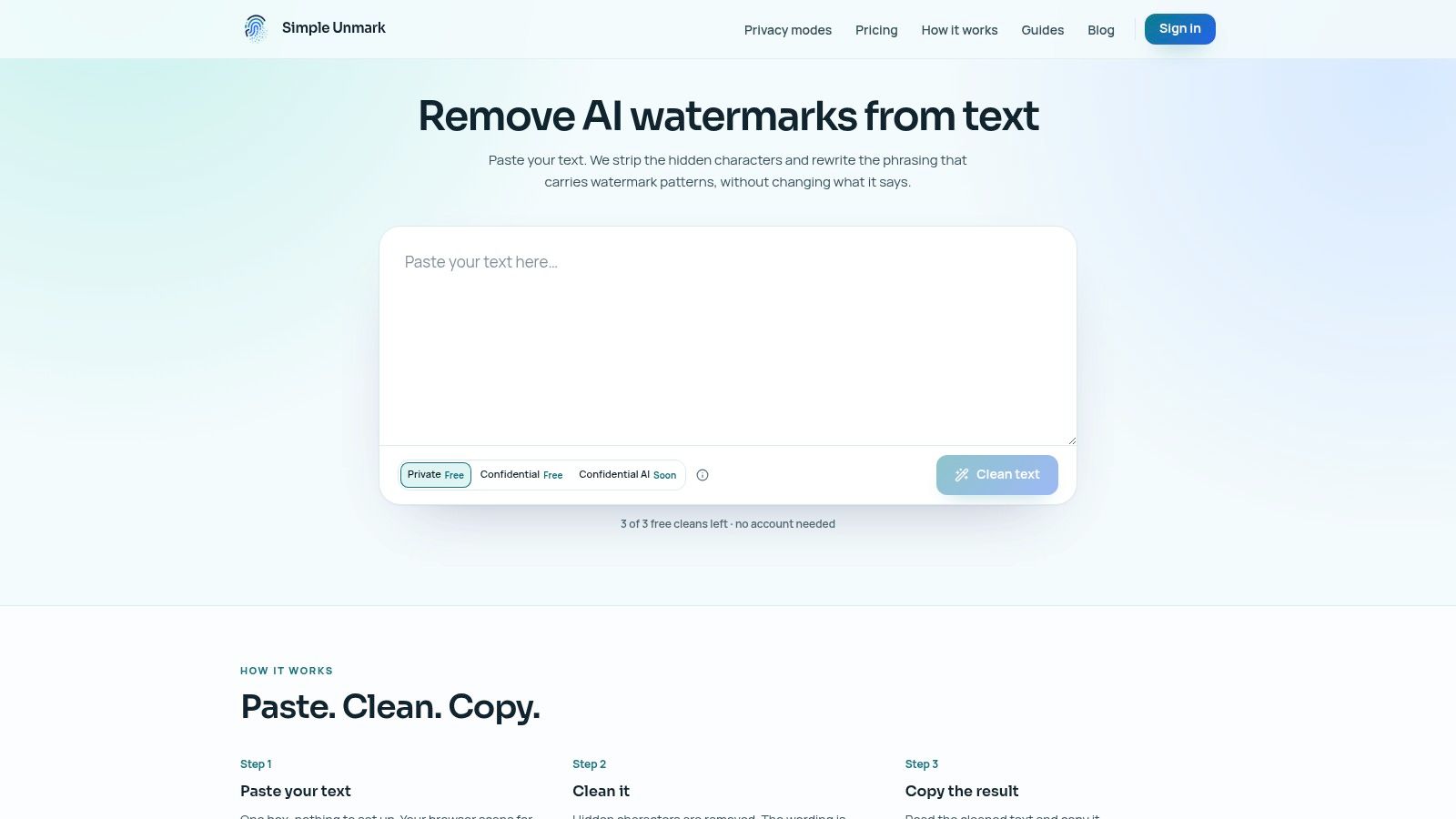
If you want one web-based option built around this exact problem, Simple Unmark removes hidden Unicode characters and rewrites passages to reduce probabilistic watermark signals while preserving meaning, facts, numbers, proper nouns, tone, and intent. The app uses a paste-clean-copy flow with local scan feedback as text is entered, supports up to 5,000 words per request, rounds processing to the next 100 words, and charges 0.1 credit per started 100 words. It uses one-time credits rather than a subscription, new accounts get 10 starter credits, and people without an account get three free cleans up to 100 words. Guest submissions are not saved, while account records track counts and credit activity rather than submitted text.
Those details matter because this kind of editing is often occasional. You may need it for one publication batch, one research handoff, or one cleanup pass after drafting.
Final checks before reuse
Don't trust the first output blindly. Read it like an editor.
Use a quick review pass:
- Compare the factual anchors. Names, dates, figures, and claims should match.
- Read for human rhythm. The text should sound natural, not over-polished or bloated.
- Paste into the destination. Your CMS, doc editor, or form field is the actual test.
- Check purpose, not just style. If the draft was meant to explain, ask, warn, or persuade, that job should still be clear.
If you wouldn't stand behind the rewritten version with your name on it, it isn't ready.
Choosing the Right Humanizing Approach for Your Use Case
Not every draft needs the same treatment. Sometimes you just need to strip hidden junk. Sometimes you need a full rewrite to reduce statistical signals. Sometimes a plain editorial pass is enough.
The mistake is assuming one detector result settles the matter.
Independent benchmark data from 2024 showed how messy this gets in practice. One technical report claimed 99.85% accuracy with a 0.19% false-positive rate across controlled examples, but the same report stressed that even a 9% false-positive rate would mean roughly 1 in 11 human documents mislabeled as AI, while a 1.4% false-negative rate still lets about 1 in 70 AI documents slip through undetected. It also noted rapid growth in AI-authored text shares on major platforms, from 1.77% to 37.03% on Medium and from 2.06% to 38.95% on Quora over the measured period (technical report summary).
That's why a clean workflow should be based on risk and use case, not detector theater.
Which Humanizing Method Fits Your Need
| Approach | Best For | Limitation |
|---|---|---|
| Unicode-only cleanup | Pasted text with formatting glitches, search mismatch, or strange spacing | Doesn't address statistical watermark patterns |
| Light stylistic editing | Blog drafts or emails that sound stiff but don't carry higher compliance risk | May leave token-choice patterns mostly intact |
| Rewriting-based humanizing | AI-assisted text where wording patterns need deeper reshaping | Requires careful meaning checks after rewrite |
| Watermark-focused cleaning tool | Text from systems where probabilistic watermarking is a concern, such as outputs you want to sanitize before reuse with an AI watermark remover | Cannot guarantee any specific detector outcome |
The big misconception
People often say, “It passed the detector, so the watermark is gone.” That's too strong.
A later independent study found that meaning-preserving paraphrase eliminated watermark detection in 100% of initially detected texts for KGW and Unigram, and 98.3% for a SynthID configuration, while also reporting a 5.4% false-positive rate on clean text for SynthID. The same research argues these watermarking methods fall short of forensic-evidence admissibility standards (independent analysis).
That doesn't mean watermarking is useless. It means you should be careful about what conclusions you draw from it.
Key Takeaways for Clean and Copy Safe AI Text
An AI text humanizer does two different kinds of work. One is cleanup. The other is rewriting.
Cleanup removes hidden Unicode artifacts that can break formatting, search, and publishing workflows. Rewriting changes wording patterns while trying to keep the original meaning intact. If you treat those as the same job, you'll either over-edit or miss the underlying problem.
The practical order is straightforward:
- Clean first: Strip invisible junk before you judge the prose.
- Rewrite second: Only if wording patterns or watermark risk matter.
- Verify last: Check facts, numbers, names, and intent against the original.
There's also a limit you should keep in mind. No tool can promise guaranteed detector outcomes across every model, platform, and text condition. Hybrid text, edited text, and transformed text are messy. That's exactly why this topic needs less hype and more precision.
If your use case is publishing, research, or compliance, the safest mindset is simple. Don't chase magic invisibility. Make the text readable, clean, and faithful to the original meaning. Then test it inside the workflow where it will be used.
If you need a practical tool for this, Simple Unmark handles both sides of the job: hidden Unicode cleanup and meaning-preserving rewriting aimed at reducing probabilistic watermark signals. Paste in the text, clean it, and copy out a version that's easier to reuse in docs, CMS workflows, and publishing systems.
- ai text humanizer
- AI watermark remover
- SynthID remover
- humanize AI text
- AI writing tools
More posts
Invisible Numbers Explained and How to Remove Them
Learn what invisible numbers and hidden Unicode characters are, how they watermark text, and how to detect and remove invisible numbers safely.
Word Count Limit Rules at Simple Unmark
Simple Unmark word count limit rules explained. Up to 5,000 words per clean, 0.1 credit per started 100 words, rounded to the next 100.
How to Use Watermark Tools and Reduce AI Signals
Learn how to use watermark tools to detect, clean, and reduce AI text watermarks like SynthID while keeping meaning intact.