
AI Content Humanizer: Remove Watermarks Without Losing Facts
Use an AI content humanizer to rewrite AI watermarks and detection markers while preserving every factual detail, tone, and nuance of your original text.

Most advice about an AI content humanizer starts with the wrong promise: rewrite a passage, run a detector, and treat a lower score as proof that a person wrote it. That's not how watermarking or authorship works. Rewriting can reduce statistical evidence, improve readability, and remove hidden characters, but it can't create a trustworthy authorship record after the fact.
The practical standard is stricter. Keep the facts, numbers, names, tone, and intent intact. Remove artifacts that make copied text unsafe or awkward. Treat detector output as a probability, not a verdict, and preserve drafts, prompts, citations, and edit history when the stakes matter.
Table of Contents
- Why Humanization Is Not Authorship Proof
- What AI Watermarks Actually Are
- Rewriting Approaches and Tradeoffs
- How Tools Like Simple Unmark Implement Humanization
- What the Research Says About Detection Confidence
- Responsible Workflows for Writers and Editors
Why Humanization Is Not Authorship Proof
An AI content humanizer does not establish that a person wrote a passage. It changes the text presented to a detector, which can reduce statistical signals without changing the passage's origin. That distinction matters for students, publishers, employers, researchers, and compliance teams making authorship decisions.
“Detected” or “undetected” compresses three separate checks:
- Did the wording change? Rewriting can alter vocabulary, syntax, rhythm, and token sequences.
- Did the meaning survive? Aggressive edits can damage facts, figures, names, tone, or intent.
- Can authorship be verified? Detector output cannot replace drafts, source notes, prompts, version history, or a clear disclosure policy.

The useful definition
Humanization is best treated as probability reduction. The tool may reduce evidence associated with a watermark or predictable machine-written phrasing. Watermark weakening and invisible Unicode cleanup are separate tasks: the first changes statistical patterns, while the second removes hidden characters or formatting artifacts. Neither one certifies the writer, reconstructs the drafting process, or proves that no AI system was involved.
High-stakes review requires more than a detector result. Human writing can receive a false positive, while heavily edited AI text can receive a negative result. Ask what changed, what remained intact, and which records support the claimed authorship.
Practical rule: A detector score is an input to review, not a final authorship decision.
Independent detector evaluations have reported double-digit false-positive rates in high-stakes settings, so detector output should not stand alone. A humanizer may improve usability or reduce a detectable signal. It cannot create provenance that was never recorded during creation. Use edit history and source records to establish process, then treat the score as one limited review signal.
What AI Watermarks Actually Are
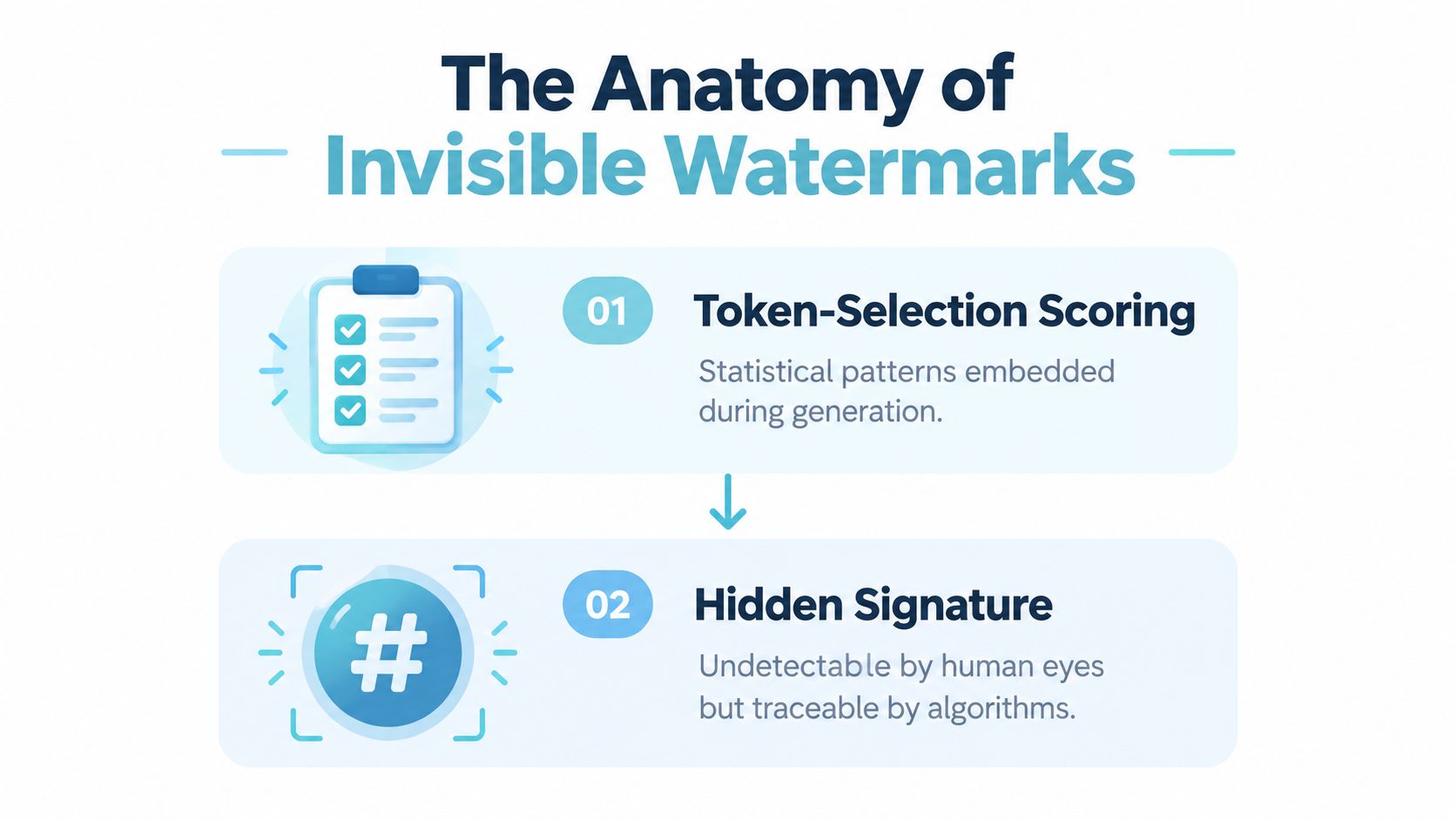
An AI watermark is not necessarily a hidden character, metadata field, or visible marker. Statistical text watermarking works during generation by influencing which tokens a model selects. The resulting signal remains invisible to readers because it is distributed across ordinary word choices.
Google DeepMind's SynthID-Text is a commercial example of this approach. Public technical descriptions from 2024 explain that it assigns pseudorandom scores to candidate tokens and embeds a statistical signal during generation rather than adding symbols or metadata afterward. The system was tested on 20 million prompts submitted to Gemini, with evaluation covering response quality, accuracy, creativity, and generation speed (IEEE Spectrum's explanation of SynthID-Text).
Token selection creates the signal
SynthID-Text preferentially selects higher-scoring candidate tokens. A detector later calculates the aggregate score across a passage and applies statistical hypothesis testing. It may classify the text as watermarked, not watermarked, or uncertain, depending on the selected thresholds.
The practical consequence is straightforward: token patterns matter more than visible formatting. A punctuation adjustment may leave the pattern largely intact. Rewriting sentence structure and word choices can alter enough token selections to reduce detector confidence, even when the underlying claim remains unchanged. Read this guide to how AI text watermarks work for a technical explanation of the process.
Unicode cleanup is another problem
Zero-width characters, bidirectional controls, unusual whitespace, and other nonprinting marks belong to a different layer. They can enter text during copying between browsers, documents, editors, and publishing systems, affecting display, portability, tokenization, or how pasted content is interpreted.
A paragraph can look clean while containing invisible Unicode characters. Text with no such artifacts can still carry a probabilistic watermark. Character scanning and normalization address the first issue. Meaning-preserving rewriting addresses the second by changing token sequences.
Use both checks when needed, but diagnose them separately. An AI content humanizer can reduce evidence associated with a watermark. It cannot certify authorship, reconstruct the drafting process, or prove that AI was never involved. That makes humanization a probability-reduction method, not an authorship test.
Rewriting Approaches and Tradeoffs
Cosmetic editing rarely changes enough text to matter. Commas, isolated synonyms, or a few deleted words can preserve the watermark's broader token pattern. Cropping and mild paraphrasing may leave detection intact, while thorough rewriting or translation can lower detector confidence, according to Google's SynthID-Text documentation (Google's SynthID safeguards documentation).
Use meaning-preserving variation across sentences. Change sentence structure, clause order, vocabulary, transitions, and rhythm, then apply explicit constraints for facts and intent. Without those constraints, a tool may weaken a signal by changing the document's substance.
Compare the main approaches
| Approach | Signal reduction | Main risk |
|---|---|---|
| Punctuation edits | Low | Leaves token patterns largely intact |
| Isolated synonym swaps | Low to moderate | Can create awkward or inaccurate wording |
| Mild paraphrasing | Variable | Detection may survive, especially in longer passages |
| Thorough rewriting | Higher potential | Greater risk to facts, names, tone, and intent |
| Unicode scrubbing only | Doesn't target statistical watermarking | May change display behavior or formatting |
The trade-off is semantic fidelity versus statistical change. A rewrite that changes every sentence may weaken one watermark while damaging a legal qualification, product name, citation, or technical instruction. A restrained pass protects the document better, yet leaves more residual evidence.
Published watermark-resistance experiments found that one ChatGPT paraphrasing round reduced detection rates for every tested watermarking method to below 0.30 (experiments on watermark resistance to paraphrasing). That finding does not support a binary conclusion. Other research finds that sufficiently long paraphrases can retain detectable n-grams or longer fragments. Longer text gives a detector more observations, allowing statistical confidence to recover after local rewriting.
Use a verification loop
Review more than the detector result:
- Facts and numbers: Compare the original and rewritten passages side by side.
- Named entities: Check people, companies, products, locations, and technical terms.
- Tone and intent: Confirm that a warning remains a warning and that qualifications stay visible.
- Residual signal: Treat detector output as a comparison point, not a certificate.
- Reader value: Reject any rewrite that sounds less clear, useful, or credible.
Search performance adds another constraint. If your goal includes getting discovered by AI assistants, preserve headings, links, terminology, and direct answers instead of flattening the prose into generic “human” language. Unicode cleanup and watermark weakening are separate tasks, and neither one proves who authored the text. A humanizer reduces detectable evidence; it does not certify authorship.
How Tools Like Simple Unmark Implement Humanization
A workable cleanup process has two passes. First, scan and remove hidden Unicode artifacts. Then rewrite the visible prose broadly enough to alter statistical token patterns while checking that the text still says the same thing.
The workflow should look like this:
- Paste the source text. Review scan feedback for zero-width marks, direction controls, unusual spacing, or other nonprinting characters.
- Run the cleanup and rewrite. Use broad lexical and syntactic variation, not a cosmetic synonym pass.
- Inspect the output. Compare numbers, proper nouns, citations, qualifications, tone, and intent.
- Test the destination. Paste the clean text into the target CMS, document editor, code editor, or publishing system.
- Keep the original. The cleaned output is not a substitute for provenance.
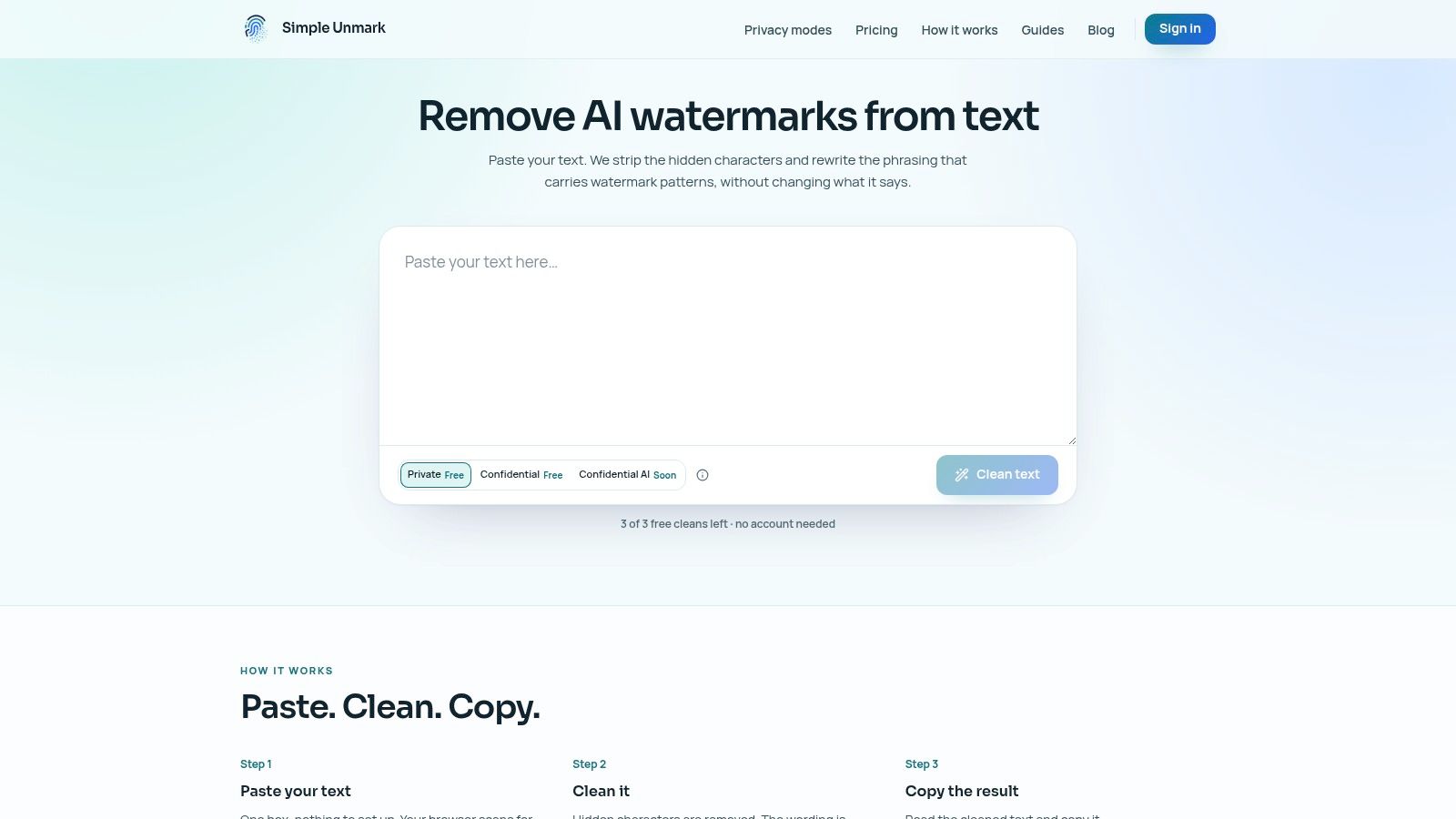
Simple Unmark combines Unicode cleanup and wording rewrite in the same run. Its stated scope includes preservation of facts, numbers, proper nouns, tone, and intent, with processing for passages of up to 5,000 words per request (Simple Unmark's AI watermark remover). Processing uses 0.1 credit per started 100 words, and credits don't expire. Guest submissions are processed transiently, while account records track usage and credit activity rather than submitted text.
That design addresses two different failure modes without pretending they're identical. For additional comparison criteria, a practical overview of tools that help users avoid AI detection with this tool should still be read alongside the tool's limitations and preservation checks.
| Approach | Preserves facts and tone | Removes hidden Unicode | Weakens statistical watermark |
|---|---|---|---|
| Punctuation-only editing | Usually | No | Weakly |
| Unicode scrubber | Yes, if normalization is safe | Yes | No |
| Generic paraphraser | Not reliably | Usually no | Potentially |
| Combined cleanup and rewrite | Requires verification | Yes | Potentially |
The important limitation is explicit: no transformation can guarantee a particular detector outcome. Text length, generation settings, model behavior, watermark design, and detector thresholds all affect the result. Removing direction controls can also change display behavior in multilingual text, while whitespace normalization may affect tables, code, citations, or line-sensitive documents.
What the Research Says About Detection Confidence
The strongest research doesn't support a winner-takes-all contest between humanizers and detectors. It supports a more useful conclusion: watermark evidence can be measurable, resistant in some conditions, and still removable enough that it can't establish authorship.
An ETH Zurich SRI Lab assessment published on December 20, 2024 found that SynthID-Text could be detected through black-box queries and was more resistant to spoofing than several contemporary schemes. It also found that spoofing attempts left detectable clues, while the watermark was easier to remove than other tested approaches, including for relatively naive adversaries (ETH Zurich SRI Lab assessment).
Detection is evidence, not identity
A detector accumulates statistical evidence across a passage. That isn't equivalent to a signed document, a dated draft, or a complete edit history. Short text, substantial editing, translation, and changes in model behavior can reduce confidence. An aggressive rewrite may retain the original meaning while changing the token-choice patterns that produced the watermark.
That creates two common errors:
- A positive result becomes an accusation. The detector may be reacting to statistical regularities, not proving who wrote the passage.
- A negative result becomes an acquittal. Rewriting may have removed one signal without proving human authorship or defeating another detection method.
A useful review records both the residual detector result and the quality of the transformation. If names or numbers changed, the output failed even if a detector score fell. If the prose stayed accurate and readable, a lower signal may be operationally useful, but it remains probabilistic.
Don't confuse watermarks with broader detectors
Watermark detectors look for generation-linked statistical patterns. Other systems may examine authorship style, retrieval overlap, linguistic features, or other signals. A rewrite that weakens SynthID-style evidence may not address those systems. That's why detector testing should never become the sole quality gate.
For a sharper distinction between these categories, use this guide to AI watermarks versus AI detectors. It helps reviewers ask what a result measures before they act on it.
Responsible Workflows for Writers and Editors
“Make it undetectable” is the wrong objective. Improve the text, remove unwanted artifacts, and preserve evidence of how it was produced. An AI content humanizer can reduce detectable patterns or clean hidden characters, but it cannot certify authorship or replace disclosure rules and editorial judgment.
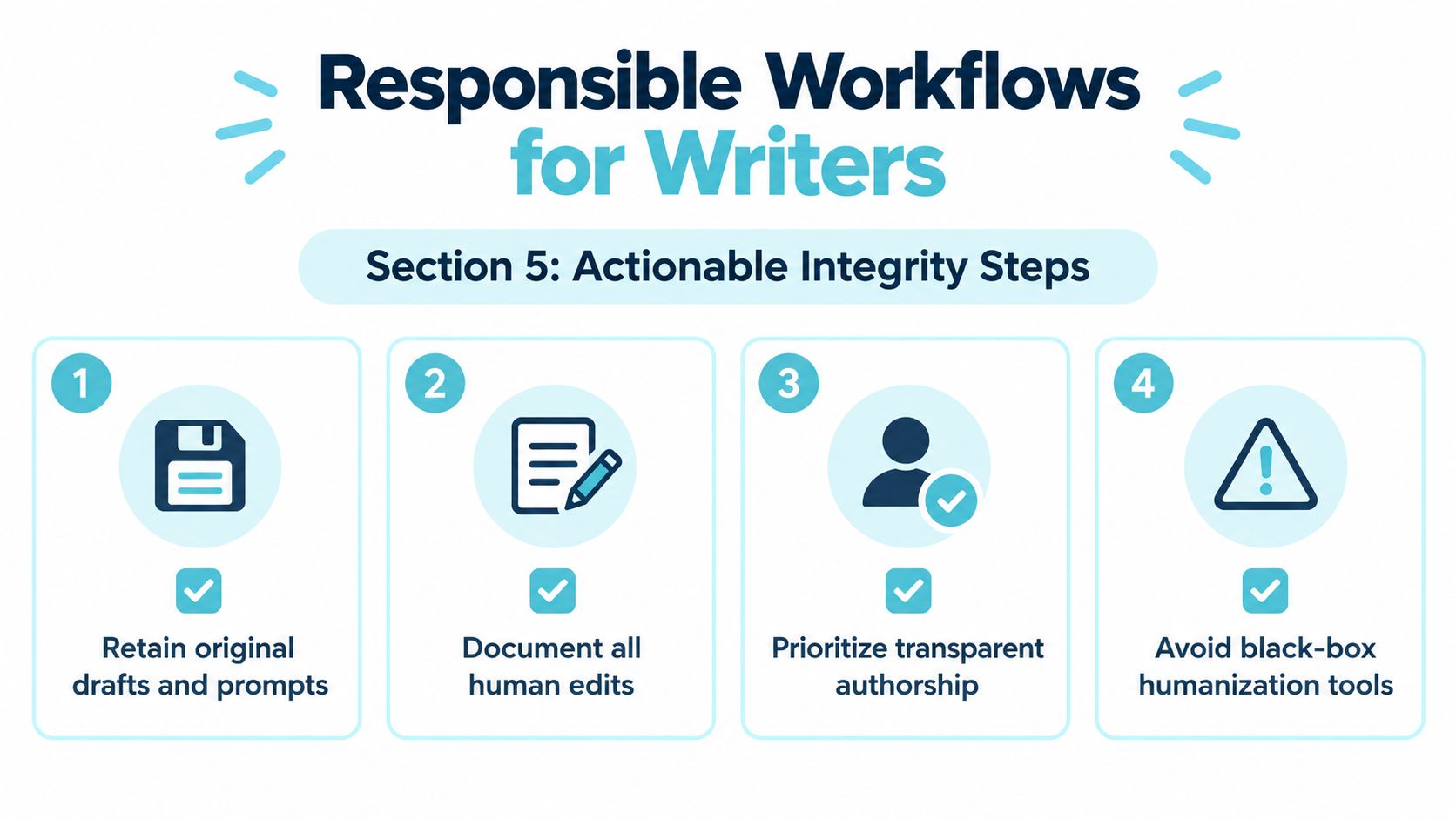
Keep the original material before rewriting. Save relevant prompts, retain drafts, record substantial human edits, and preserve the sources used to check claims. Those records explain the work if a reviewer questions authorship. A detector score cannot provide that context.
Recommendations by role
Writers and creators should use rewriting to improve clarity and remove hidden Unicode characters, not to invent a human origin. Check every number, name, source, and qualification after the rewrite. Follow disclosure requirements from a school, client, publisher, or employer even if a detector returns a negative result.
Editors and publishers should compare submitted work with drafts and sources before escalating a detector flag. Ask the author to explain major revisions, verify factual claims, and assess whether the prose meets publication standards. A detector can start a conversation. It should not decide the outcome alone.
Compliance and legal teams need a written policy covering permitted AI assistance, required disclosures, retained records, and procedures for conflicting detector results. Organizations building a wider publishing process can use specialist content SEO services to preserve search structure while editors apply these governance rules.
Independent evaluation shows why detector output needs careful handling. A University of Chicago evaluation reported false-positive rates of roughly 30–78% for an open-source RoBERTa detector. The same study found meaning-preserving paraphrasing eliminated detection for 100% of initially detected KGW and Unigram samples and 98.3% of SynthID samples, while SynthID falsely flagged 5.4% of paraphrased human-written controls (University of Chicago evaluation). A negative result therefore reduces one signal. It does not prove human writing.
Keep provenance records because a rewrite can change what a detector sees, not what happened during drafting.
Use this checklist during review:
- Preserve evidence: Save drafts, prompts, sources, and edit history.
- Clean safely: Scan hidden Unicode before publishing or sharing.
- Rewrite deliberately: Change wording broadly while protecting meaning.
- Verify manually: Check facts, numbers, names, citations, tone, and intent.
- Interpret cautiously: Treat detector results as probabilistic and specific to the tool.
- Test the destination: Confirm that tables, code, links, citations, and multilingual text still work.
Simple Unmark combines hidden-character cleanup with meaning-preserving rewriting to reduce probabilistic watermark signals. It does not establish authorship. Use the Simple Unmark paste, clean, and copy workflow, then retain original drafts and verify every factual detail before publishing.
- ai content humanizer
- synthid removal
- ai watermark
- text rewriting
- ai detection
More posts
Invisible Character Copy: What It Is and How to Clean It
Invisible character copy explained: what zero-width and bidi characters are, why copied text hides them, and practical methods to detect and remove them safely.
AI Detection Bypass Tool: The Honest Truth
Discover how an AI detection bypass tool actually works. Learn about watermarks, detector flaws, and how to clean text responsibly without losing meaning.

How to Rewrite AI Generated Text Without Losing Meaning
Learn how to rewrite AI generated text while keeping facts, tone, and intent intact. Practical steps, tool workflows, and tips to reduce watermark signals.