
Invisible Numbers Explained and How to Remove Them
Learn what invisible numbers and hidden Unicode characters are, how they watermark text, and how to detect and remove invisible numbers safely.
You paste a paragraph into a form. It looks clean. No weird symbols. No extra spaces. Then the form rejects it, search won't find it, or your word counter changes after you paste it somewhere else.
That usually isn't a mystery. It's hidden Unicode.
A lot of people call these invisible numbers or invisible text. The label is sloppy, but the problem is real. A character can be present in the text even when you can't see it. Software still sees it. Parsers still count it. Filters still react to it.
If you edit AI-assisted text, this matters more than most "blank text" guides admit. The issue isn't novelty. It's interoperability, provenance, and cleanup. A pasted sentence can carry hidden state that changes how apps, validators, detectors, or review systems handle it.
This is for people who need plain answers. Writers cleaning drafts. Editors fixing broken copy. Researchers comparing strings. Compliance teams checking whether a document is clean. By the end, you'll know what invisible numbers are, why copy and paste keeps breaking, and when basic Unicode cleanup is enough versus when you need rewriting.
Table of Contents
- Introduction to Invisible Numbers and Why They Matter
- What Invisible Numbers and Hidden Unicode Characters Actually Are
- How Invisible Characters Encode Metadata and Watermarks
- Why Copy Paste Breaks and How Detection Really Works
- How to Detect and Remove Invisible Characters Step by Step
- Cleaning AI Watermarks and What Rewriting Can and Cannot Do
- Choosing the Right Cleanup for Your Workflow
Introduction to Invisible Numbers and Why They Matter
The most common failure looks boring.
You copy a sentence from one app into another. It displays fine in both places. But the receiving app says the field contains unsupported characters. Or a search for the exact phrase returns nothing. Or two filenames that look identical won't match in a script.
That isn't cosmetic damage. It's a hidden character problem.
The text looks the same, but it isn't
Humans read glyphs. Software reads code points, byte sequences, token boundaries, and formatting controls. Those aren't always the same thing.
A string can contain an invisible character that changes line breaking, joining behavior, or reading direction. On screen, nothing appears to happen. Under the hood, the text is different.
Hidden state matters more than hidden appearance.
That's why the phrase invisible numbers is useful only if it leads to the concept. You're not dealing with magic. You're dealing with Unicode control characters, formatting marks, and sometimes watermark-related artifacts that survive copy and paste.
Who gets hit by this
This problem shows up in more places than people think:
- Writers: A pasted sentence fails a submission form or picks up odd spacing.
- Editors: A draft looks normal but behaves differently across Google Docs, Word, CMS fields, and chat apps.
- Researchers: Two strings that look identical compare as different.
- Compliance teams: Review logs and text exports don't match what staff saw on screen.
There's a good historical parallel for the idea of hidden but consequential populations. The U.S. Consumer Financial Protection Bureau reported that 26 million adults in the United States were credit invisible in 2010, about 11% of the adult population, and another 19 million, or 8.3%, had unscorable credit records. Together that was about 45 million adults, or roughly 19.3%, outside the standard credit scoring system at the time, according to the CFPB Data Point on credit invisibles. Different domain, same lesson. Hidden states can be large enough to shape real decisions.
What clean workflow looks like
For text work, the practical routine is simple:
- Paste
- Scan
- Strip hidden characters
- Copy the cleaned text
- Verify it in the target app
That workflow sounds basic because it is. The hard part is knowing what you're removing, what you're preserving, and when hidden Unicode is only part of the problem.
What Invisible Numbers and Hidden Unicode Characters Actually Are
Think of hidden Unicode like stage directions in a script.
The audience doesn't hear "pause," "enter from left," or "speak softly." But the production still depends on those instructions. Invisible text characters work the same way. Readers may not see them, but software can.
They are standard text controls, not hacks
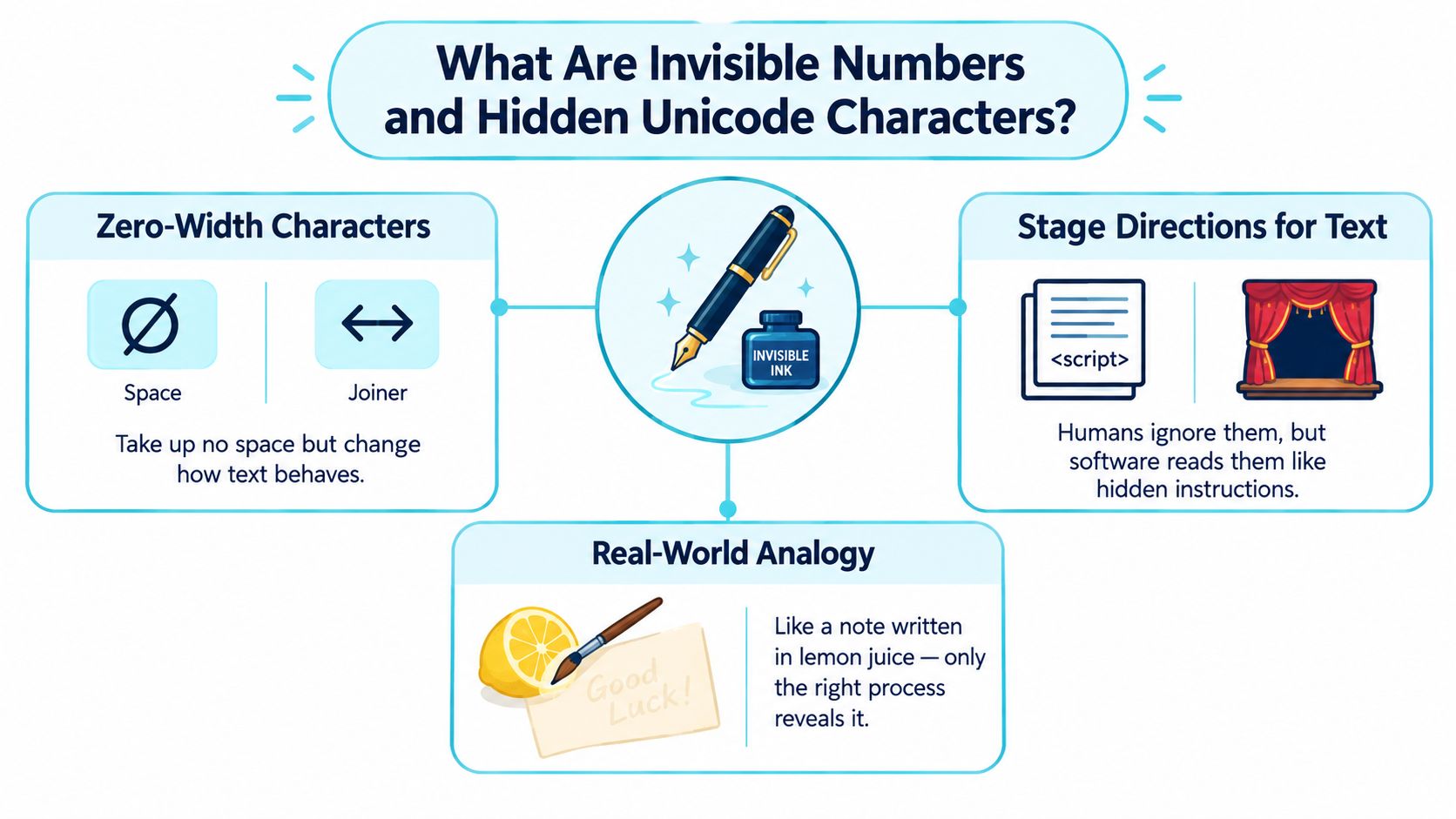
The core idea starts with zero-width characters. They exist in the text stream but take up no visible space. Some mark line-break opportunities. Some affect joining behavior in scripts. Some control text direction.
One of the most important examples is U+200B ZERO WIDTH SPACE. It was added in Unicode version 1.1 in 1993 and later became part of the General Punctuation block, where it serves as an invisible line-break opportunity rather than a visible glyph, as described in Jukka Korpela's Unicode space reference.
Quick definition: Invisible numbers are usually invisible Unicode format characters that affect how text behaves without showing up as visible letters or normal spaces.
Why they render as blank
Some Unicode code points are treated as formatting controls rather than printable symbols. If a system doesn't visibly render them, they still remain part of the string.
That confuses people because a normal space is visible as separation between words. A zero-width character isn't. It can sit between letters, inside a word, at the start of a line, or next to punctuation without any obvious visual clue.
A few common categories matter most:
- Zero-width spacing controls: Used to suggest breaks without drawing a glyph.
- Joiners and non-joiners: Used in scripts where character shaping matters.
- Direction marks: Used to guide left-to-right and right-to-left rendering.
- Word-joining controls: Used to prevent breaks where they shouldn't happen.
Why this exists in the first place
These characters weren't created for social media tricks. They solve real language and layout problems.
Scripts don't all behave like English. Some don't separate words with visible spaces. Some require joining behavior that changes character shape. Some mix left-to-right and right-to-left text in the same line. Invisible control characters help software render that correctly.
That matters because it changes the tone of the conversation. These aren't fake characters. They're legitimate Unicode features that can become a mess when they end up in the wrong workflow.
| Character type | What humans see | What software may do |
|---|---|---|
| Zero-width space | Nothing | Treat it as a break opportunity |
| Joiner or non-joiner | Nothing | Change shaping or connection behavior |
| Direction mark | Nothing | Influence reading order |
| Word joiner | Nothing | Prevent line breaks |
The blank-looking character that can break a form is real. You just aren't being shown it.
How Invisible Characters Encode Metadata and Watermarks
Once you stop thinking about invisible numbers as a party trick, the next question gets sharper. What are these characters doing inside the text?
Sometimes the answer is harmless. A pasted paragraph picked up a formatting mark from another app. Sometimes the answer is operational. The text now carries hidden metadata-like state that affects validation, matching, moderation, or provenance review.
The same string can look identical and still differ
Unicode classifies several code points as default-ignorable, which means they can be rendered as completely invisible and zero-width when unsupported. That group includes U+200B ZERO WIDTH SPACE, U+200C ZWNJ, U+200D ZWJ, U+200E LEFT-TO-RIGHT MARK, U+200F RIGHT-TO-LEFT MARK, U+2060 WORD JOINER, and U+FEFF ZWNBSP/BOM, according to the Unicode FAQ on unsupported characters.
The practical consequence is brutal and simple. Two strings can look the same to a person while still differing at the byte level and tokenization level. That's enough to break comparison, search, and security-sensitive parsing.
Three different hidden jobs
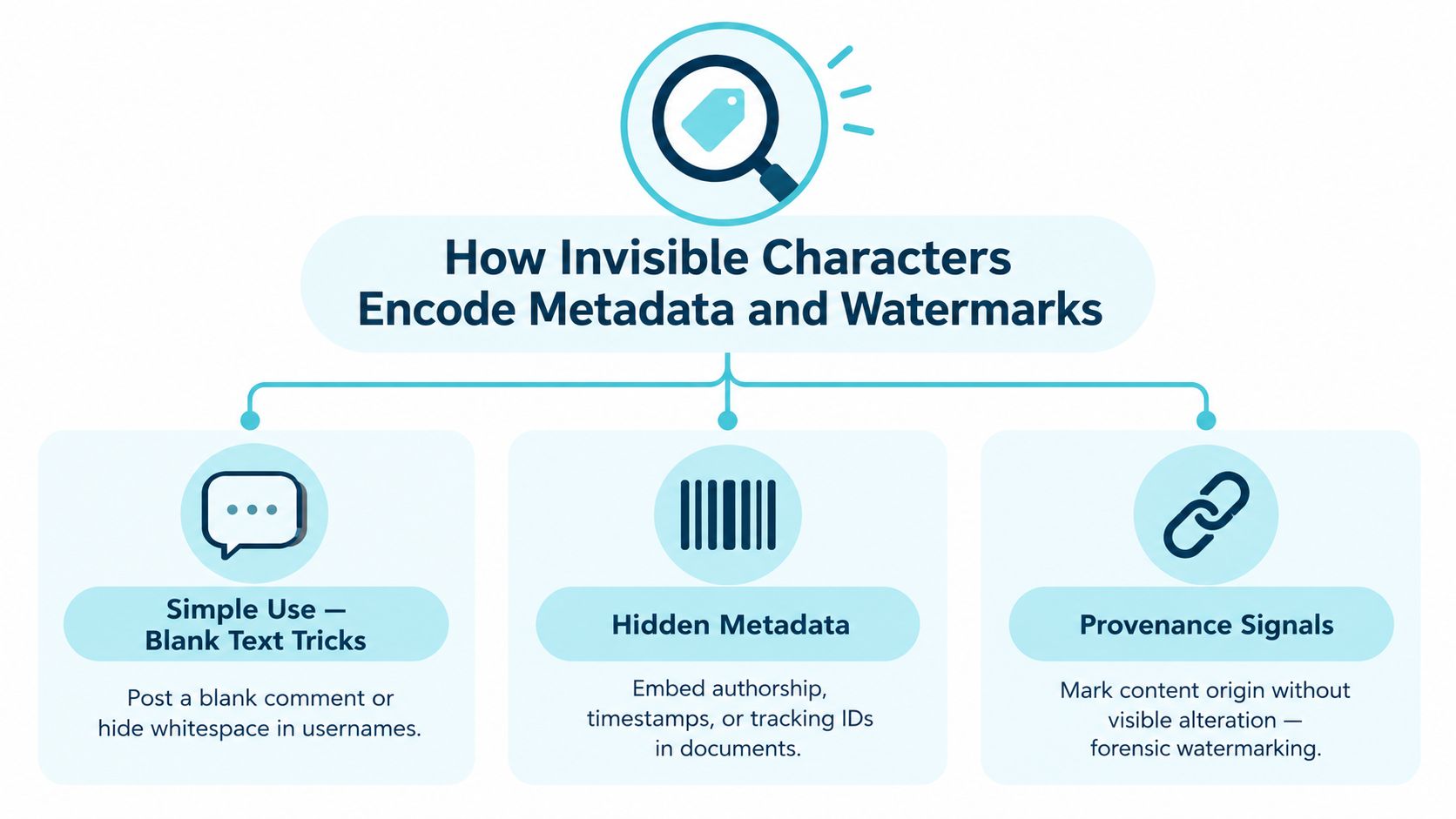
People often mash everything together under "watermark" or "hidden text." That's sloppy. There are at least three different uses.
- Blank-text tricks: A user inserts zero-width characters so a message appears empty while still containing content.
- Hidden metadata: A system or workflow preserves invisible marks that distinguish one text instance from another.
- Provenance signals: A process marks content origin or handling history in ways users don't see directly.
Those aren't identical mechanisms. A hidden Unicode artifact is not the same thing as a probabilistic AI text watermark based on token-choice patterns. One lives in explicit characters. The other can live in statistical patterns across word selection. If you want a plain comparison, this guide on hidden Unicode versus statistical watermarks lays out the distinction clearly.
Invisible doesn't mean undetectable
This is the part many guides miss.
An invisible character may be hidden from readers, but it isn't necessarily hidden from systems. A parser can count it. A validator can reject it. A moderation rule can flag it. A tokenizer can split around it.
If software inspects code points instead of screen appearance, invisibility stops helping.
That's why hidden semantic state matters more than the screen view. You can delete a visible extra space and still leave the actual problem behind. You can also preserve visible wording perfectly while changing the hidden structure underneath.
For editors and developers, the lesson is practical. Don't ask only, "Can a person see this?" Ask, "What does the receiving system ingest?"
Why Copy Paste Breaks and How Detection Really Works
Most public explainers stop too early. They tell you invisible characters exist, then jump to copy-paste tricks. The headache starts after that, when text moves between apps.
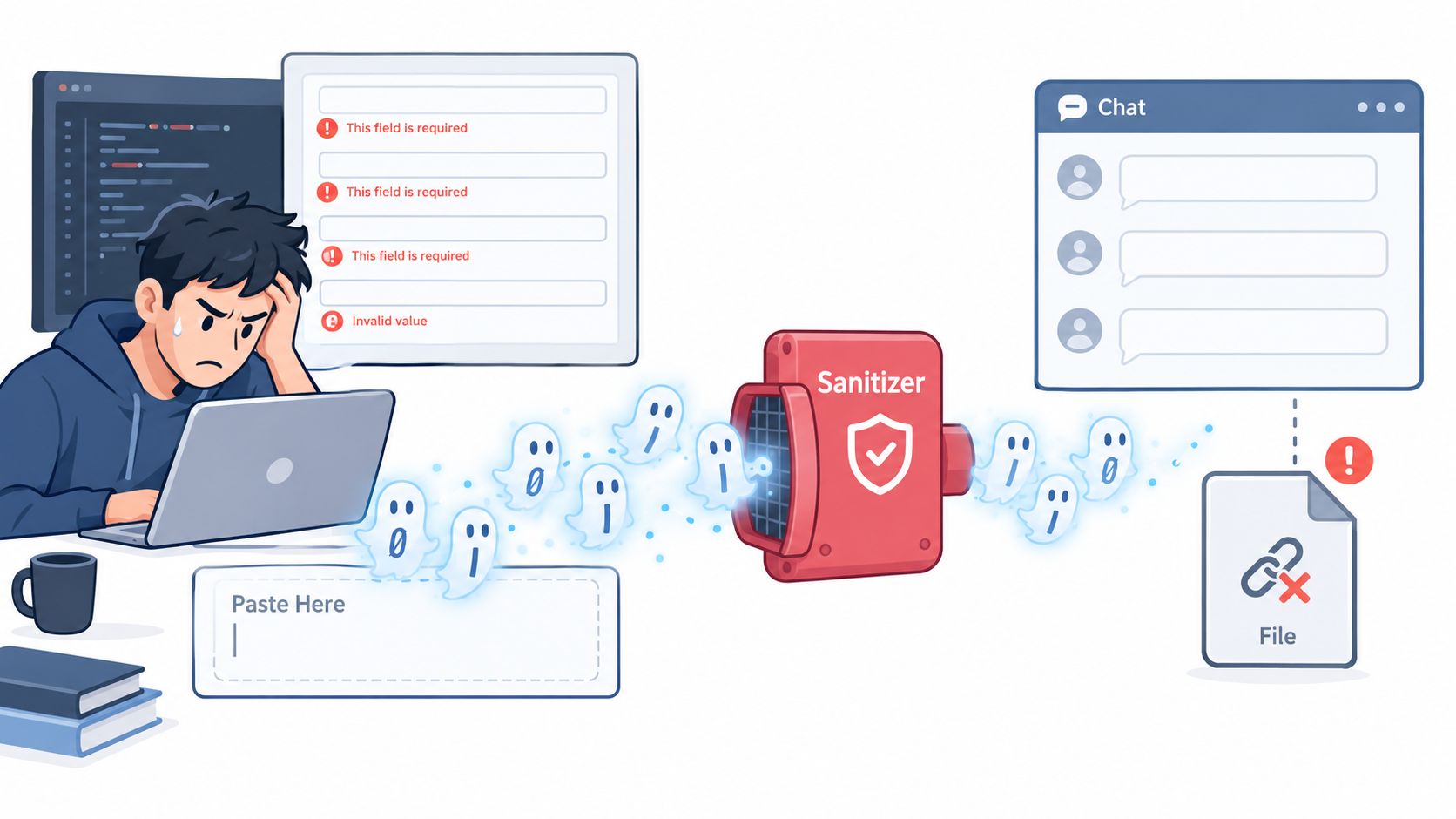
A hidden character can survive from a model output into a note app, then into a CMS, then into a spreadsheet export. At each step, one tool may preserve it, another may strip it, and a third may interpret it differently. That's how ordinary text turns unreliable.
What you see versus what the parser sees
A human reviewer sees glyphs on a screen. A parser sees a sequence of code points in order. Those two views usually align. Hidden Unicode is where they drift apart.
That drift causes familiar failures:
| Human view | System view | Result |
|---|---|---|
| Text looks empty | Field contains zero-width characters | Form accepts or rejects unexpectedly |
| Two names look identical | Strings differ internally | Match fails |
| Search phrase looks exact | Index and query tokenize differently | Search misses |
| Word count looks stable | Hidden controls affect processing | Counts shift across tools |
This is why visible editing alone isn't enough. You can backspace through a line and still miss a control mark if your editor doesn't reveal it.
Bidirectional controls are the sharpest example
Some invisible controls don't just sit there. They can change displayed reading order while leaving the logical token sequence intact.
Unicode bidirectional controls became a source-code security issue in CVE-2021-42574, also known as Trojan Source. The core problem is that controls such as U+202E RIGHT-TO-LEFT OVERRIDE and isolates U+2066 to U+2069 can reorder what reviewers see while compilers or parsers still consume the original logical sequence, as documented in the NVD entry for Trojan Source.
A reviewer can read one thing while the software executes another.
That example comes from code, but the lesson applies to text operations too. Display order and logical order aren't always the same. If your workflow depends on visual review alone, you're exposed.
How detection usually works in practice
Detectors and sanitation pipelines don't rely on your eyes. They inspect text structurally.
Common checks include:
- Character-level scanning: Looking for known control code points and direction marks.
- Normalization checks: Comparing how text changes after standard cleanup.
- Boundary analysis: Inspecting odd breaks, joins, or unexpected token boundaries.
- Policy rules: Rejecting or flagging hidden format controls in sensitive fields.
The boring answer is also the useful one. Reliable detection comes from explicit rendering, linting, stripping, or normalization policies. It doesn't come from squinting at the pasted text and hoping nothing's there.
How to Detect and Remove Invisible Characters Step by Step
If your text is breaking, don't start by retyping everything. Start by checking whether hidden Unicode is present.
The useful workflow is deterministic. You want to find the actual code points, remove the ones that don't belong, and verify the cleaned text in the place where it failed.
Start with quick checks
First, test whether the problem follows the text or the app.
- Paste into a plain-text editor. If odd behavior disappears, rich formatting or hidden characters may have been part of the original paste.
- Delete and retype one suspect word. If matching or validation changes, the original likely contained a hidden mark.
- Compare string length. If a "blank" field still has content, something invisible may be present.
Those checks won't identify every character, but they tell you whether to keep digging.
Use tools that reveal structure
Unicode defines several invisible format characters that matter for pasted AI text cleanup. U+200B ZERO WIDTH SPACE has no intrinsic width and marks a break opportunity, while U+200E LEFT-TO-RIGHT MARK, U+200F RIGHT-TO-LEFT MARK, and U+061C ARABIC LETTER MARK are also invisible zero-width characters with strong directionality, as noted in this research summary on invisible format characters in pasted text.
That means your cleanup tool should do more than remove visible extra spaces. It should inspect invisible format controls too.
Use a method that shows or strips:
- Default-ignorable characters
- Bidirectional controls
- Unexpected spacing variants
- Marks inserted during app-to-app paste
If you're also reviewing other kinds of messy inputs, it's useful to compare data standardization tools because text cleanup often sits beside broader scrubbing work such as normalization, formatting repair, and duplicate handling.
Strip, then verify
One practical option is the Simple Unmark invisible character remover. It uses a paste-clean-copy flow and scans for hidden Unicode so you can remove invisible characters while leaving visible wording unchanged.
After cleaning, verify three things:
- Search behavior: Can you now find the exact phrase?
- Field acceptance: Does the destination form or editor accept it?
- Comparison stability: Do identical-looking strings now match?
Practical rule: Strip the full family of hidden format and bidi controls before downstream processing. Don't rely on visible edits alone.
Common cleanup mistakes
People usually make the same errors.
- Only fixing what they can see: That misses zero-width marks.
- Cleaning in the wrong app: Some editors preserve hidden state instead of exposing it.
- Skipping the destination test: A string isn't "clean" until the receiving system agrees.
- Confusing cleanup with rewriting: Removing hidden Unicode won't change every detection outcome tied to statistical patterns.
If all you need is copy-safe text, invisible-character removal may be enough. If the issue goes beyond explicit characters, the job changes.
Cleaning AI Watermarks and What Rewriting Can and Cannot Do
Unicode cleanup solves one class of problem. It removes explicit hidden characters and formatting controls. That matters. But it doesn't erase every kind of watermark or provenance signal.
Some AI watermarking approaches work through probabilistic token-choice patterns rather than hidden Unicode. In plain English, the wording itself carries the signal. If that's the mechanism, stripping invisible numbers won't fully address it.
Where rewriting fits
A 2026 forensic study found that meaning-preserving paraphrase eliminated watermark detection in 100% of initially detected texts for KGW and Unigram systems, and 98.3% for SynthID, according to the forensic study on paraphrase and watermark detection. That's the strongest clear finding in this space. Rewriting is a direct way to weaken text watermarks.
That doesn't mean "change a few words" and call it done. It means preserving meaning while altering the token-choice pattern that detectors rely on.
The limits matter too. The European Parliament's 2023 briefing says current AI watermarking has hard limitations, including limited ways to add a marker to text without changing meaning, lack of standardization across systems, and detectors that can produce false positives, including against non-native English writing, as summarized in this overview of SynthID text limitations.
Unicode cleanup versus rewriting
| Cleaning Method | What It Fixes | When to Use It |
|---|---|---|
| Unicode cleanup | Hidden format characters, zero-width marks, direction controls, odd pasted spacing | When text fails validation, search, matching, or safe copy-paste |
| Rewriting | Probabilistic token-choice patterns that may contribute to watermark-style detection | When the text itself needs meaning-preserving rephrasing beyond character stripping |
| Both together | Explicit hidden characters plus wording-level signals | When you need cleaner interoperability and lower provenance signal risk |
There's also evidence that some text watermarks can be defeated by simple edits such as character perturbations or short-form paraphrasing, and that there is still no standardized evaluation protocol for effectiveness, according to this review of text watermark robustness limits. That's why any honest workflow avoids guarantees.
For teams that need rewriting rather than just cleanup, the Simple Unmark AI watermark remover is built around that distinction. It rewrites passages to reduce statistical watermark signals while preserving meaning, facts, numbers, proper nouns, tone, and intent. Use that kind of approach when hidden Unicode isn't the whole problem.
Choosing the Right Cleanup for Your Workflow
A common failure looks trivial at first. You paste text into a form, it looks fine, then the form rejects it, search misses it, or another system treats it as different text. The visible words are not the whole payload.
That is the decision point.
Choose cleanup based on the kind of hidden state you need to remove. If the problem is copy-paste behavior, validation, matching, or export consistency, strip the invisible Unicode first. If the text is already character-clean but you still care about provenance signals, detector triggers, or AI watermark workflows, cleaning alone will not cover the whole job.
A practical decision rule
Use Unicode cleanup only when the issue is operational:
- a form rejects the text
- search does not find an exact phrase
- two strings should match but do not
- pasted text changes behavior across apps or platforms
Use rewriting after cleanup when the issue includes provenance or forensic review. In that case, the problem is not just hidden characters. It can also be wording patterns, token choices, or other signals that survive after character stripping.
Start with the smallest fix
This works like washing mud off a label before deciding whether the label itself is wrong. Remove the hidden marks first. Then test the plain text in the system that matters.
A simple routine is enough:
- Paste into a controlled tool first: Do not rely on the destination app to show hidden state.
- Remove invisible controls deterministically: Focus on zero-width marks, direction controls, and other non-printing format characters.
- Retest in the target system: That is where interoperability either holds or fails.
- Escalate only if needed: If cleanup fixes the issue, stop. If the text is clean but provenance concerns remain, move to rewriting.
Earlier research and product notes in this article already showed an awkward truth about watermark-related detection. Small edits can change outcomes, and there is still no standard way to measure reliability across tools and conditions. That is why honest workflows avoid promises and use verification instead.
The key idea is simple. Invisibility is only the symptom. Hidden state is the problem. Once you frame invisible numbers that way, the workflow gets clearer. Clean for interoperability first. Rewrite only when provenance risk is part of the job.
Simple Unmark covers both cases in one workflow. It can remove hidden Unicode from pasted text and, when needed, rewrite text to reduce probabilistic watermark signals while preserving meaning and key details. If that matches your process, visit Simple Unmark.
- invisible numbers
- hidden Unicode characters
- AI watermark remover
- text cleaning guide
- Unicode invisible text
More posts
AI Text Humanizer Explained and How to Use It Right
Learn what an AI text humanizer does, how rewriting and Unicode cleanup reduce watermark signals, and how to humanize AI text without losing meaning.
Word Count Limit Rules at Simple Unmark
Simple Unmark word count limit rules explained. Up to 5,000 words per clean, 0.1 credit per started 100 words, rounded to the next 100.
How to Use Watermark Tools and Reduce AI Signals
Learn how to use watermark tools to detect, clean, and reduce AI text watermarks like SynthID while keeping meaning intact.