
How to Use Watermark Remover Without Losing Meaning
Learn how to use watermark remover tools to clean AI text quickly. Practical steps, settings, and honest tips for better results with Simple Unmark.
You're usually here for one of two reasons. You pasted a draft from ChatGPT, Gemini, or Claude into a detector and the score jumped. Or you copied text into a CMS, doc, or form and something felt off. Weird spacing, broken search, failed paste, random formatting hiccups.
That's the point where a watermark remover stops being a curiosity and becomes an editing tool. Not a magic button. An editing tool. If the text already says what you need, your job is to clean the fingerprints without wrecking the meaning.
Table of Contents
- The Moment You Realize Your AI Text Needs Cleaning
- Guest Mode vs Signed-In Account
- Preservation Settings That Keep Your Meaning Intact
- How Credits and Word Limits Actually Work
- Tailoring Settings to Gemini, ChatGPT, and Claude
- Troubleshooting When the Output Still Looks Marked
- Setting Honest Expectations After a Clean
The Moment You Realize Your AI Text Needs Cleaning
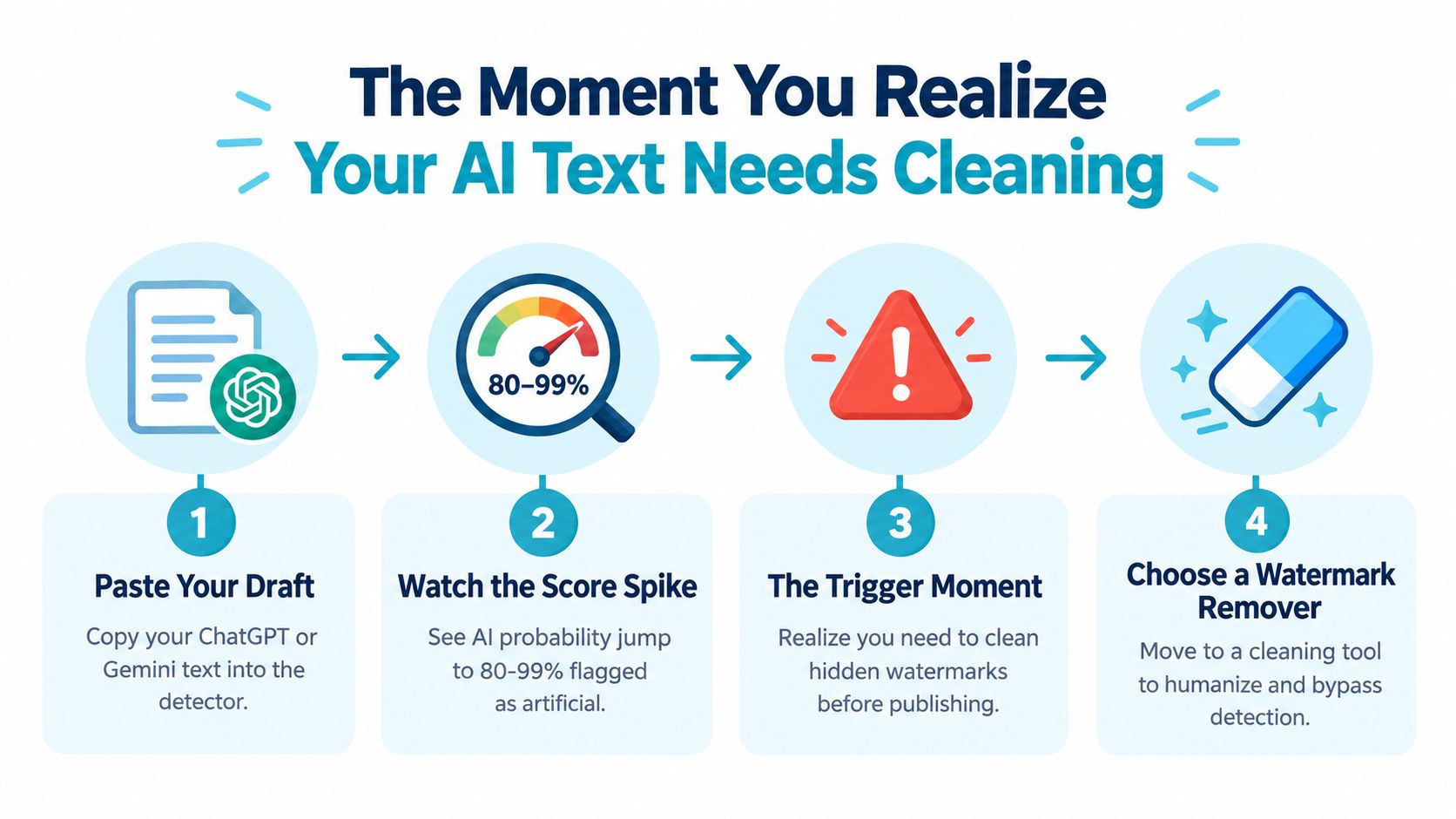
You paste a draft into a detector, get a score you do not like, and now you have to decide what kind of cleanup this is. Good. Start there. Watermark removal is an editing decision, not a magic button. Sometimes the text is carrying hidden junk. Sometimes the wording pattern is what keeps getting flagged. Those are different problems, and they need different fixes.
I run this check the same way every time. If the draft reads fine but behaves badly, I suspect invisible characters first. A zero-width space like U+200B can break search, regex, equality checks, and copy-paste while staying invisible in the editor, as shown in this zero-width space reference. If the draft behaves normally but still gets flagged, I stop hunting for hidden characters and treat it like a wording problem.
The paste clean copy loop
Paste the suspect text into the tool and use the first scan as diagnosis. Do not start rewriting blind. If you want a fast browser workflow for that, an AI text watermark remover gives you the basic loop needed. Paste, scan, clean, compare.
Then read the result like an editor.
- Check invisible characters first: If the scan points to zero-width spaces or odd Unicode, remove those before touching the wording.
- Check where the flags cluster: Marked spans usually tell you where the pattern problem lives.
- Ignore the urge to rewrite everything: A few contaminated sections often cause most of the trouble.
Practical rule: If copy-paste behavior is broken, start with Unicode cleanup. If the text looks normal but still triggers AI suspicion, paraphrasing is usually the effective fix.
What the scanner is telling you
A local scanner helps because it separates cleanup into two jobs. One job is removing invisible characters. The other is changing phrasing patterns that detectors score.
That split matters. A 2026 study on AI text watermarking found that detection improves as passages get longer, which means short snippets can be noisy while longer blocks give detectors more to work with (study details). So when a scan says the issue is statistical, stop expecting a tiny cosmetic edit to rescue a long draft.
Google's SynthID for text also works through statistical identification of AI-generated writing, using scoring methods described in its public research overview (SynthID paper overview). That is why deleting one odd character often changes nothing in a flagged article or essay. If the scanner points to patterning rather than hidden text artifacts, full paraphrasing is the better move.
What to do next
Run the cleaner. Then compare the before and after with a cold eye. You are not chasing dramatic rewrites. You are checking whether the marked passages now read like deliberate human editing instead of the same pattern with a few words swapped.
After that, paste the cleaned version back where it will be used and test it there. CMS. Application form. Client doc. Anywhere the text has to survive copy-paste and review.
Keep the workflow blunt and repeatable. Paste, scan, clean, compare, copy back. If a tool makes this feel complicated, the tool is the problem.
Guest Mode vs Signed-In Account
If you only clean text once in a while, guest mode is enough. If you do this every week, sign in and stop repeating yourself.
Guest Mode vs Signed-In Account at a Glance
| Feature | Guest Mode | Signed-In Account |
|---|---|---|
| Local scan and cleaner | Yes | Yes |
| Privacy during scan | Text stays local during scan | Text stays local during scan |
| Best use case | One-off or short jobs | Repeat work and larger projects |
| Run size | Shorter runs | Full 5,000-word jobs |
| Saved presets | No | Yes |
| Recent scan history | No | Yes |
| Credit tracking | Limited convenience | Visible across jobs |
Guest mode is the fast lane. Paste, run, copy, leave. That works if you're cleaning a short email, a paragraph block, or a one-time draft and you don't care about saving settings.
A signed-in account makes sense when you keep cleaning the same kind of material. Sales emails, essays, client blog drafts, product copy. You save your preferred preservation setup once and stop fiddling with toggles every time.
- Use guest mode if: you're testing a tool, cleaning a small draft, or you care more about speed than setup.
- Use an account if: you run repeat jobs, want your presets saved, or regularly hit larger paste sizes.
Don't overthink this choice. Pick based on job size and repetition, not ideology.
Preservation Settings That Keep Your Meaning Intact
Ruin output here by chasing a heavier rewrite, turning everything loose, and then wondering why the draft comes back flatter or slightly wrong.
The useful settings are the preservation toggles. Facts, numbers, proper nouns, and tone. These are not cosmetic. They decide what the cleaner is allowed to touch.
What each setting protects
| Setting | What It Protects | Best For | Risk When Off |
|---|---|---|---|
| Facts | Core claims and relationships | Research, product copy, summaries | Meaning can drift |
| Numbers | Figures, quantities, dates in your draft | Reports, coursework, analytics copy | Numeric details may change or get reframed |
| Proper nouns | Names of people, brands, tools, places | Case writeups, resumes, client work | Names may be swapped or generalized |
| Tone | Voice, formality, cadence | Professional copy, personal writing | Draft may sound generic |
Here's how to think about them at sentence level.
What changes when toggles are on or off
With numbers on, a line like “The team shipped 3 updates in Q1” stays anchored to that count. With it off, the cleaner may recast the sentence more loosely and shift how the detail is framed.
With proper nouns on, “Google” stays “Google.” With it off, the tool may generalize or restructure around the reference, which can make the sentence safer statistically but less precise.
With tone on, a blunt sentence usually stays blunt. Turn it off and the same sentence may come back smoother but less like you.
If you want a straightforward place to test those tradeoffs, an AI watermark remover built around preservation controls makes more sense than a generic paraphraser.
- For client work: keep tone and proper nouns on.
- For research or product text: keep facts and numbers on.
- For most users: start with all four on, then loosen one setting only if the first pass stays too close to the original.
Check the scan badge after each run. If the wording changed but the meaning slipped, your settings were too aggressive for the job.
How Credits and Word Limits Actually Work
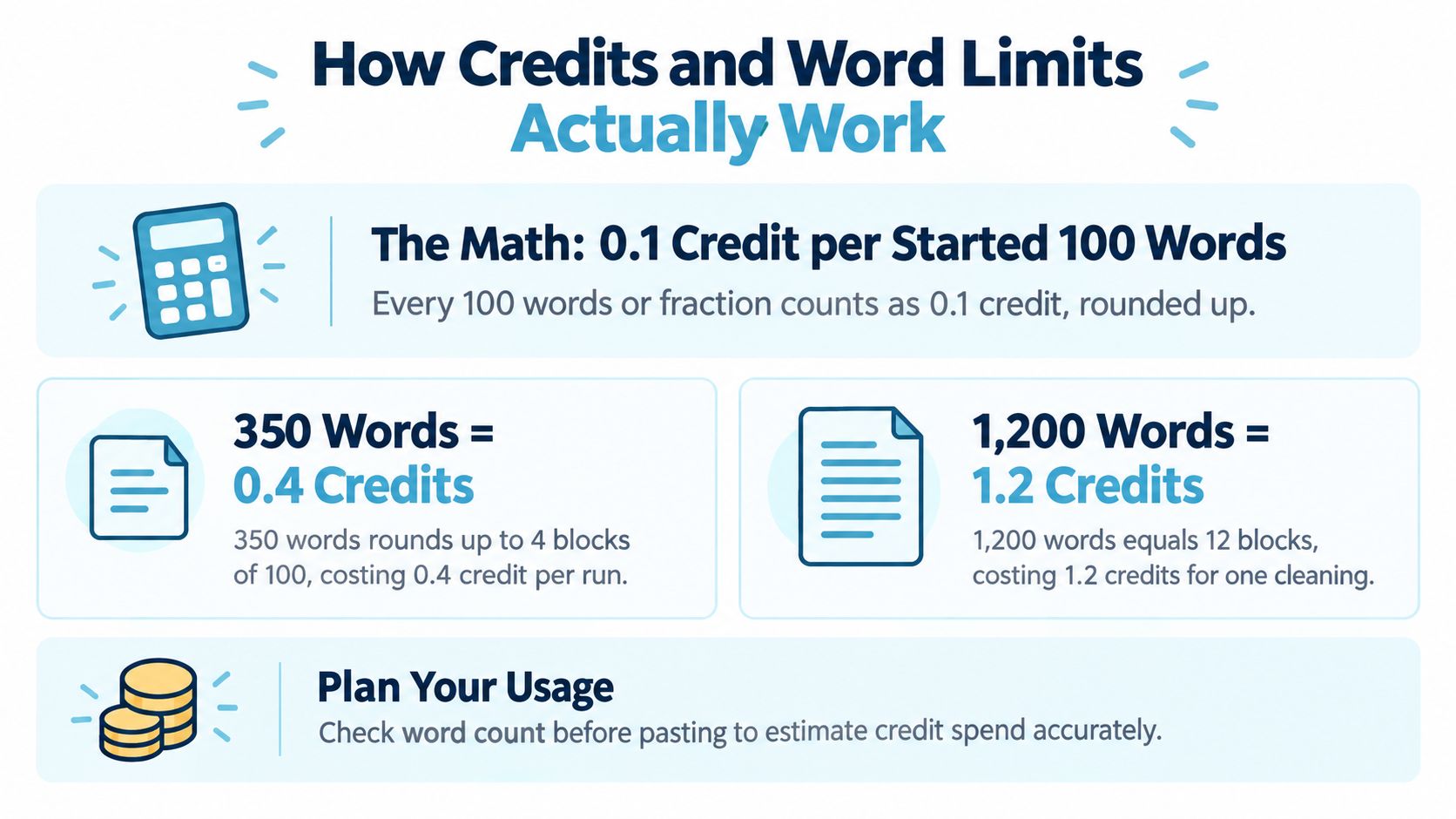
This part is simple. The cleaner charges by word count, rounded to the next block.
Each run costs 0.1 credit per started 100 words. That means a 350-word paste costs 0.4 credit, and a 1,200-word draft costs 1.2 credits. The cap is 5,000 words per request.
Quick math for normal jobs
- 150 words: starts a second 100-word block, so it costs 0.2 credit
- 800 words: eight 100-word blocks, so it costs 0.8 credit
- 3,500 words: thirty-five 100-word blocks, so it costs 3.5 credits
The useful thing is that the initial scan doesn't consume credits. Credits are used when you confirm the rewrite. So you can inspect the text, see where the problem areas are, and decide whether the pass is worth it.
Why splitting long drafts often works better
Even if a tool lets you paste up to 5,000 words, I wouldn't dump a huge document in one shot unless the prose is already pretty uniform. Chunking gives you better control.
- Cleaner diagnostics: You can see which section needs heavier intervention.
- Less drift: Shorter runs usually preserve meaning better.
- Easier retries: If one block needs another pass, you don't touch the whole document again.
If you're signed in, the visible credit counter makes this easy to manage. If you're not, just count words before you paste and avoid guessing.
Tailoring Settings to Gemini, ChatGPT, and Claude
Different model outputs need different handling. Treating them the same is lazy and it shows in the result.
Recommended Settings by AI Source
| Source | Word Limit | Toggles On | Why |
|---|---|---|---|
| ChatGPT | 1,000 words | Facts, proper nouns | Entity-heavy drafts need precise preservation |
| Gemini | 600 words | Tone | Uniform phrasing benefits from lighter rewrites |
| Claude | 1,200 words | Facts, numbers, proper nouns, tone | Cleaner baseline prose gets damaged by heavy paraphrase |
For ChatGPT, start around 1,000 words and keep facts and proper nouns on. That output often packs in named entities, product labels, or structured examples. If you let the cleaner get too loose, it starts sanding down useful detail.
For Gemini, use a tighter 600-word chunk and keep tone on. Gemini text often sounds smooth but a little uniform. It usually responds better to lighter lexical swaps than to a full rewrite. If you want context on why people focus on Gemini here, this guide on whether Gemini watermarks text is worth reading.
For Claude, keep all four toggles on and allow up to 1,200 words. Claude often starts closer to human-readable prose, so over-editing it is the fast path to flattening nuance.
These aren't magic presets. They're starting points. The first scan tells you whether to tighten the chunk size, raise rewrite intensity, or do a manual pass after cleaning.
Troubleshooting When the Output Still Looks Marked
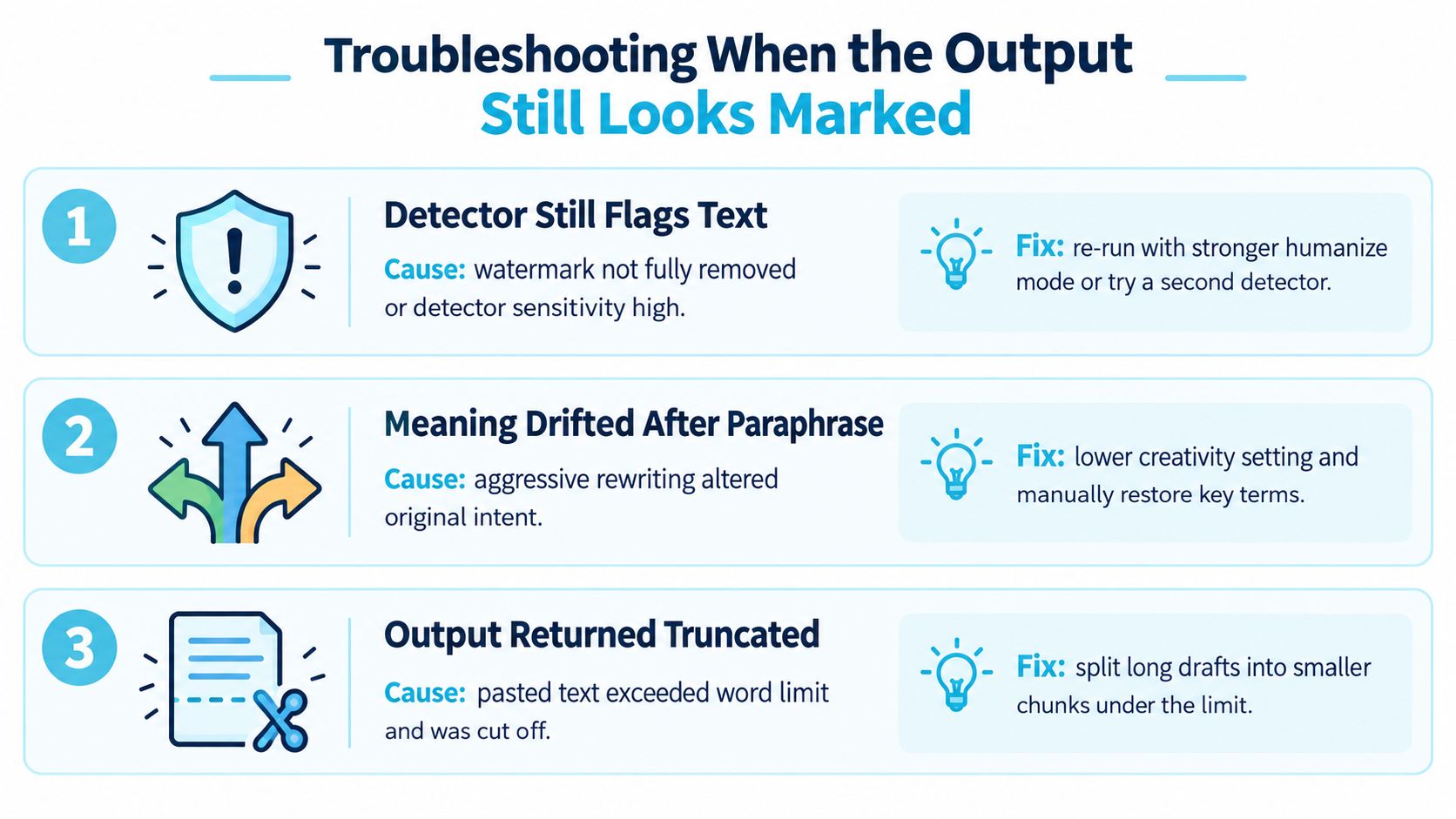
If the result still looks marked, one of three things usually happened. The detector still flags it, the paraphrase drifted, or the output got cut.
Detector still flags the text
This usually means the rewrite was too gentle for the statistical pattern that was there.
Independent research found that meaning-preserving paraphrase can be enough to erase detection signals. One study reported 100% conditional removal for KGW and Unigram watermarks on 846 valid paraphrase runs, plus 98.3% removal for a SynthID configuration, while also reporting a 5.4% false-positive rate on clean text for SynthID (paraphrase removal results). The point isn't “you're guaranteed clean.” The point is that real paraphrasing matters more than cosmetic edits.
Try this:
- Lower the word limit: Shorter chunks let the cleaner hit marked zones harder.
- Relax one preservation setting: If you locked the text too tightly, it may not have moved enough.
- Split the draft in half: Some sections carry more patterning than others.
Meaning drifted after paraphrase
That's usually self-inflicted. You pushed the rewrite too hard or gave the tool too much text at once.
A more technical removal workflow for n-gram-style marks is to estimate watermark strength with black-box probing, identify likely biased token regions, then paraphrase or rewrite those spans. The De-mark paper says random selection probing is used to infer watermark strength and recover hidden list structure before removal, and reports effective removal and exploitation against popular LLMs in experiments on Llama3 and ChatGPT (De-mark workflow). Translation for normal users: target the suspicious spans. Don't bulldoze the whole page.
Output came back partial
That's usually input junk. Hidden whitespace, broken paste fragments, or a draft that should've been chunked before submission. If you keep running into this, read the breakdown of hidden Unicode vs statistical watermarks. It helps you diagnose whether the problem is text contamination or detector-facing phrasing.
Run this checklist before you call the clean a failure:
- Recount the words
- Remove obvious formatting junk
- Retry with a smaller chunk
- Verify names and numbers survived
- Compare only the flagged region, not the whole draft
Setting Honest Expectations After a Clean
A watermark remover can reduce signals. It cannot promise invisibility.
That matters because people keep asking the wrong question. “Can this guarantee I won't be detected?” No. A 2026 forensic-readiness study found that meaning-preserving paraphrase eliminated detection in 100% of initially detected texts for KGW and Unigram and 98.3% for SynthID, while the same paper reported a 5.4% false-positive rate on clean text for SynthID (forensic-readiness study). So the honest target is risk reduction, not certainty.
The European Parliament's briefing on generative AI also says watermarking techniques are not standardized, which means one system may not read another's mark, and it warns that AI-text detectors can produce false positives, including on human writing (European Parliament briefing). That should kill the fantasy that one detector score tells the whole truth.
Cleaned text is still a draft. Read it aloud. Fact-check anything factual. Put your own voice back into the final layer.
Use the tool for what it's good at. Strip hidden characters. Break repetitive token patterns. Make the prose easier to reuse. Then do the human part yourself.
And keep the practical limits in mind. You're working inside a 5,000-word ceiling, credits only matter when you confirm a rewrite, and local-first scanning is the sane option when the draft is sensitive.
Simple Unmark gives you a straightforward way to clean hidden Unicode and rewrite text enough to reduce watermark-style signals without throwing away the original point. If you're trying to figure out how to use watermark remover tools as part of a real editing workflow, not as a gimmick, visit Simple Unmark.
- watermark remover
- AI text cleaner
- Simple Unmark
- remove SynthID
- ChatGPT watermark
More posts
Invisible Numbers Explained and How to Remove Them
Learn what invisible numbers and hidden Unicode characters are, how they watermark text, and how to detect and remove invisible numbers safely.
AI Text Humanizer Explained and How to Use It Right
Learn what an AI text humanizer does, how rewriting and Unicode cleanup reduce watermark signals, and how to humanize AI text without losing meaning.
Word Count Limit Rules at Simple Unmark
Simple Unmark word count limit rules explained. Up to 5,000 words per clean, 0.1 credit per started 100 words, rounded to the next 100.