
AI Blog Writer Guide: Edit Drafts Without Losing Facts
Learn how to use an AI blog writer well: prompt for sources, edit drafts, clean hidden characters and keep facts, numbers and your voice intact.
A finished-looking draft is open in the CMS. The introduction reads cleanly, the subheads line up, and the word count matches the brief. Then one figure has no report behind it, a product name is spelled two ways, and the paste from the chat window carries characters you cannot see. That is the ordinary state of work with an AI blog writer: fast prose, unfinished evidence.
Treat the model as a drafting stage inside an evidence-preservation process. The job after generation is to prove the edited article still says what the sources say. Prompt polish and detector scores do not do that job. Claim checks, retained source links, and a note of what changed do.
Table of Contents
- The Five-Stage AI Blog Workflow
- Writing Prompts That Produce Drafts Worth Editing
- Cleaning Hidden Characters Before You Edit
- Checking Facts, Numbers and Names After Drafting
- What Cleaning and Rewriting Cannot Guarantee
- Final Review Checklist Before Publishing
The Five-Stage AI Blog Workflow
A publishable AI-assisted post passes five stages in order. Each stage has an output and a pass check. The next stage does not start until that check is met.
| Stage | What You Do | Output | Pass Check |
|---|---|---|---|
| Brief | Define search intent, target reader, required claims and approved sources | One-paragraph brief | Every required claim names a source type |
| Source retrieval | Collect primary documents and authoritative links before drafting | Source list with links and dates | Each source is primary or clearly authoritative |
| Outline | Map each planned claim to a source in the outline | Outline with claim-to-source map | No section makes a claim without a mapped source |
| Section drafting | Generate one section at a time against the outline | Draft sections | Drafted claims match the mapped sources |
| Verification and editing | Check every fact, number, name and quotation, then edit for voice | Reviewed draft with change notes | Human editor signs off on facts and tone |
Say a polished draft arrives with one market figure and no report, plus a product name missing a letter. Source retrieval blocks the unsourced figure before anyone drafts around it. Verification blocks the misspelled name before publish. Generation never clears either gate.
The FELM factuality benchmark found a 31.8% response-level error rate across 817 samples. Retrieving reference documents before drafting is a measurable quality layer, not a nicer prompt. In that benchmark, retrieval-augmented references raised ChatGPT's segment-level F1 by 6.4 points and GPT-4's by 5.5 points.
Practical rule: Stop publication when a statistic, date, quotation, product specification, or named entity lacks a primary or authoritative source.
What the gates are built to catch
Unsupported specificity. A precise percentage appears with no dataset behind it.
Outdated information. A feature is described from a help page that has since changed.
Fabricated citations. A paper title or author line cannot be found.
Fluent stacks of guesses. Several plausible sentences were never checked as a set.
Two signs the workflow is working: every claim traces to a source, and each edit records what changed and why. If the paste also arrives with broken wraps, a line break remover can clear stray breaks before the fact pass. That step does not verify a single claim.
Writing Prompts That Produce Drafts Worth Editing
A one-line request hands the model every gap it can fill with plausible text. A prompt that works is a brief with fixed fields, so the editor inherits claims that can be checked instead of a smooth page of guesses.
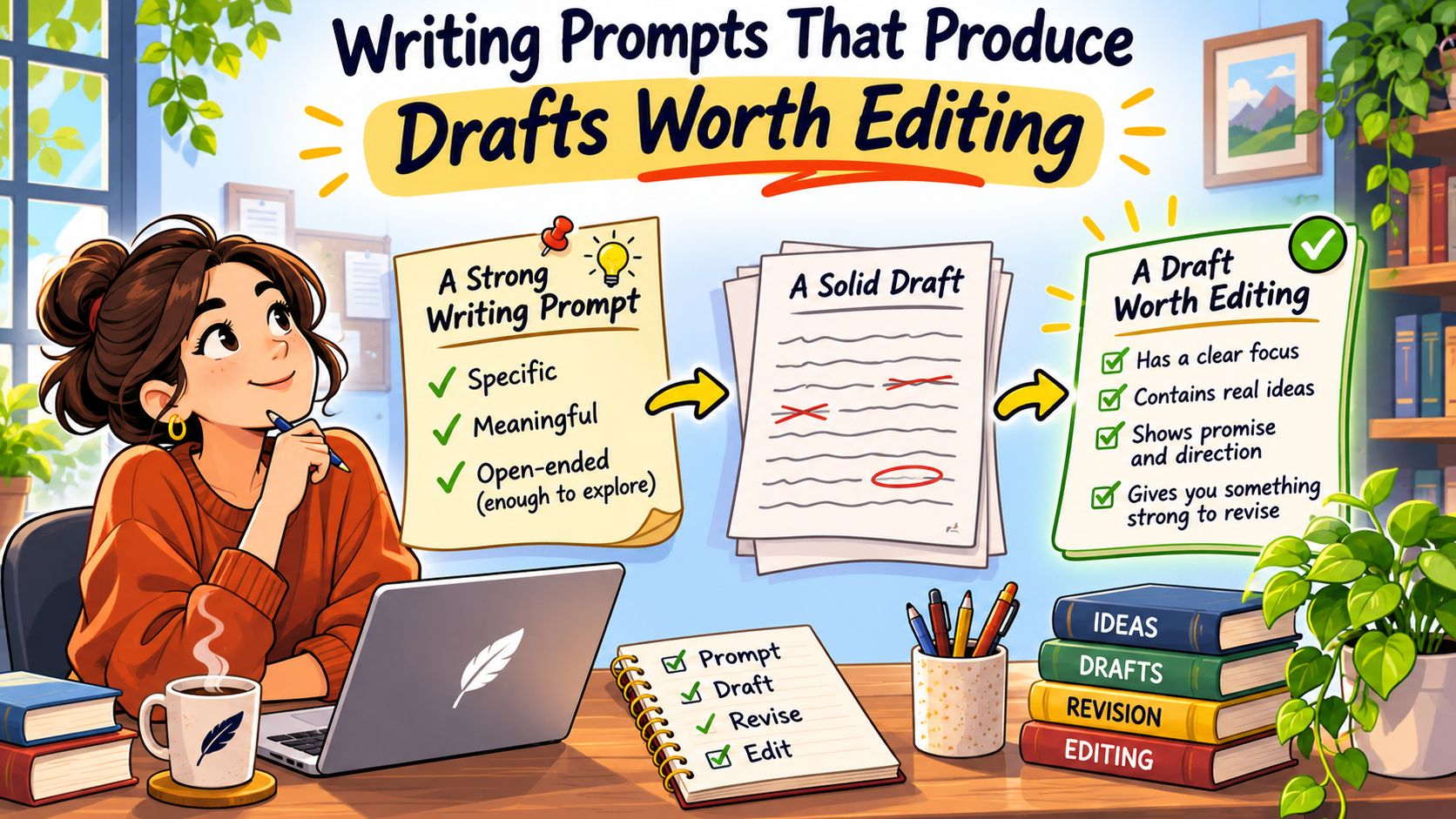
Include these fields every time:
- Audience and level. Who is reading, and what they already know.
- Search intent. The question the post must answer, in one sentence.
- Required claims. Three to five statements the post must make, each tied to a named source. Leave the numbers as placeholders until those sources are in the file.
- Approved sources. Links or document titles the draft may rely on, and a ban on any other citation.
- Structure and length. Heading list and a word range per section.
- Banned phrasing. Stock openers and words the brand does not use.
- Voice sample. One or two sentences of real writing, not an adjective like "friendly."
A short prompt that leaves less to invent
"Write one section for editors who already use an AI blog writer. Intent: show how to turn on export logs for this software feature. Required claims, using only the placeholders below: [claim from vendor docs], [claim from the release note dated YYYY-MM-DD]. Structure: what the control does, who should turn it on, what breaks if it is off. About 180 words. Do not invent numbers, dates, or product names. Match this voice: 'Turn the log on before the first export. The file should list the account, the time, and the row count.'"
Each field blocks a known failure. Audience and intent cut generic phrasing. A fixed structure cuts the same three-part shape on every post. Placeholders for sourced facts stop invented numbers. A real voice sample cuts drift toward a default marketing tone.
Draft several angles and headlines, then pick one against intent and against what competing posts already say. That selection is cheaper than rewriting a full article that aimed at the wrong reader.
Speed is the reliable gain, and it is not the same thing as quality. A global B2B marketing survey reported by the Content Marketing Institute put AI's leading contributions at speed (78%), efficiency (59%), and volume (44%), while quality improvement was cited by only 17%, performance by 12%, and growth by 9%. The same research found 54% ran into accuracy problems, 54% into quality-control problems, and 52% into brand-voice problems. Ask the model for explicit claims an editor can verify. If the prompt does not name the sources, the model will fill the gap, and the editor will check every line.
Teams that publish blog content consistently with AI inside WordPress still need that source list in the prompt. A steady publishing cadence does not replace it.
Cleaning Hidden Characters Before You Edit
Text pasted from a chat window can carry a zero-width joiner, a direction control, or odd spacing. None of it shows on screen. Search snippets, copy-paste, and CMS formatting still break.
The Unicode Standard says the zero-width joiner (ZWJ) and zero-width non-joiner (ZWNJ) are drawn as invisible zero-width glyphs. They can sit in copied text with no visible mark. Finding or removing them is character-level cleanup. It is not evidence the text was generated by AI. Keep that pass separate from Unicode normalization, which only standardizes equivalent characters, and from rewriting, which changes words.
Seven steps before any wording edit
- Paste the draft into a plain-text field. Do not apply styles, smart quotes, or CMS blocks yet.
- Run an invisible-character scan and note the code points. A direction mark and a zero-width joiner are different problems.
- Remove the hidden characters and keep a copy of the original paste.
- Convert rich text to plain text, then confirm headings and lists still exist as markdown.
- Remove stray line breaks inside paragraphs. Keep the paragraph breaks you meant to keep.
- Run Unicode normalization on its own so quotes, dashes, and accented letters match the style guide.
- Read the output for changed meaning before you touch wording. Cleanup should not alter a number or a name.
Simple Unmark's free utilities at its tools page do the first part of this in the browser. The invisible-character remover, line-break cleanup, and plain-text converter need no signup, no credits, and no upload. You paste into one box, and the browser scans for hidden characters as you type. The inspector lists supported characters by code point. Line-break cleanup can keep paragraph breaks. The plain text converter accepts rich paste or HTML and can download a .txt file. None of these three rewrites wording, and none of them checks a statistical watermark.
A clean file has no hidden code points, uses one style of quotes and dashes, and contains the same words as the source paste. If a sentence changed during this pass, stop and compare it to the original before any editor rewrites it.
Checking Facts, Numbers and Names After Drafting
A polished article with altered facts is worse than visibly AI-assisted prose that stays accurate. The editing metric is claim-level accuracy, not how natural the sentences sound. Detector scores do not answer whether the revision still matches the sources.
Rewrites most often disturb three things: numbers, proper nouns, and attributions. A rounded figure, a dropped middle initial, or a citation moved to the wrong organization can survive a read-aloud. Build a claim list from the original draft. Mark the source for each line. Check the revised version against that same list, not against your memory of it.
| Claim Type | Check Against | Block Publication If |
|---|---|---|
| Statistic | Original report or dataset | No source, or survey year missing |
| Date | Official announcement or dated document | Date differs from the source by any year |
| Quotation | Original speaker or publication | Words cannot be traced to the source |
| Product specification | Vendor documentation | Specification differs from current official page |
| Named entity | Official website or registry | Name, title or spelling differs between sources |
| Medical, legal or financial claim | Qualified human reviewer | Any statement lacks reviewer approval |
Google's SynthID documentation notes that watermarking is less effective for factual responses, because changing token choices can reduce accuracy, and that detector confidence can fall substantially after thorough rewriting or translation. That is a reason to protect facts during an edit, not a reason to chase a detector result.
Where a source is not enough
Medical, legal, financial, and scientific statements need a qualified human reviewer as well as a source. A linked paper does not approve a dosage, a contract term, or a tax conclusion.
Keep the source link beside the claim in the working file. When someone changes a figure, the revision note should name the old number, the new number, and the edit that did it. Voice comes after the fact pass. Compare each edited paragraph with the brand's sample paragraphs and banned-phrase list. Flag any edit that changes claim strength, such as turning "may" into "will." A tone pass can alter a fact without looking like a fact change.
If an editor cannot point to the source of every number, name, and quotation in the final text, the draft is not ready.
What Cleaning and Rewriting Cannot Guarantee
A cleaned draft can look finished: invisible marks gone, line breaks tidy, sentences smoother. The statistical watermark, if the model ever applied one, still lives in the token choices. Only a rewrite touches that pattern. A rewrite cannot promise the signal is gone, and it can also move a sentence away from what the source said.
| Operation | What It Changes | Removes Statistical Watermark? |
|---|---|---|
| Hidden character removal | Invisible code points such as zero-width marks | No |
| Unicode normalization | Equivalent character representations | No |
| Plain-text conversion | Rich text and HTML formatting | No |
| Line-break cleanup | Stray line breaks inside paragraphs | No |
| Rewriting wording | Word and token choices | Can reduce the signal, cannot guarantee removal |
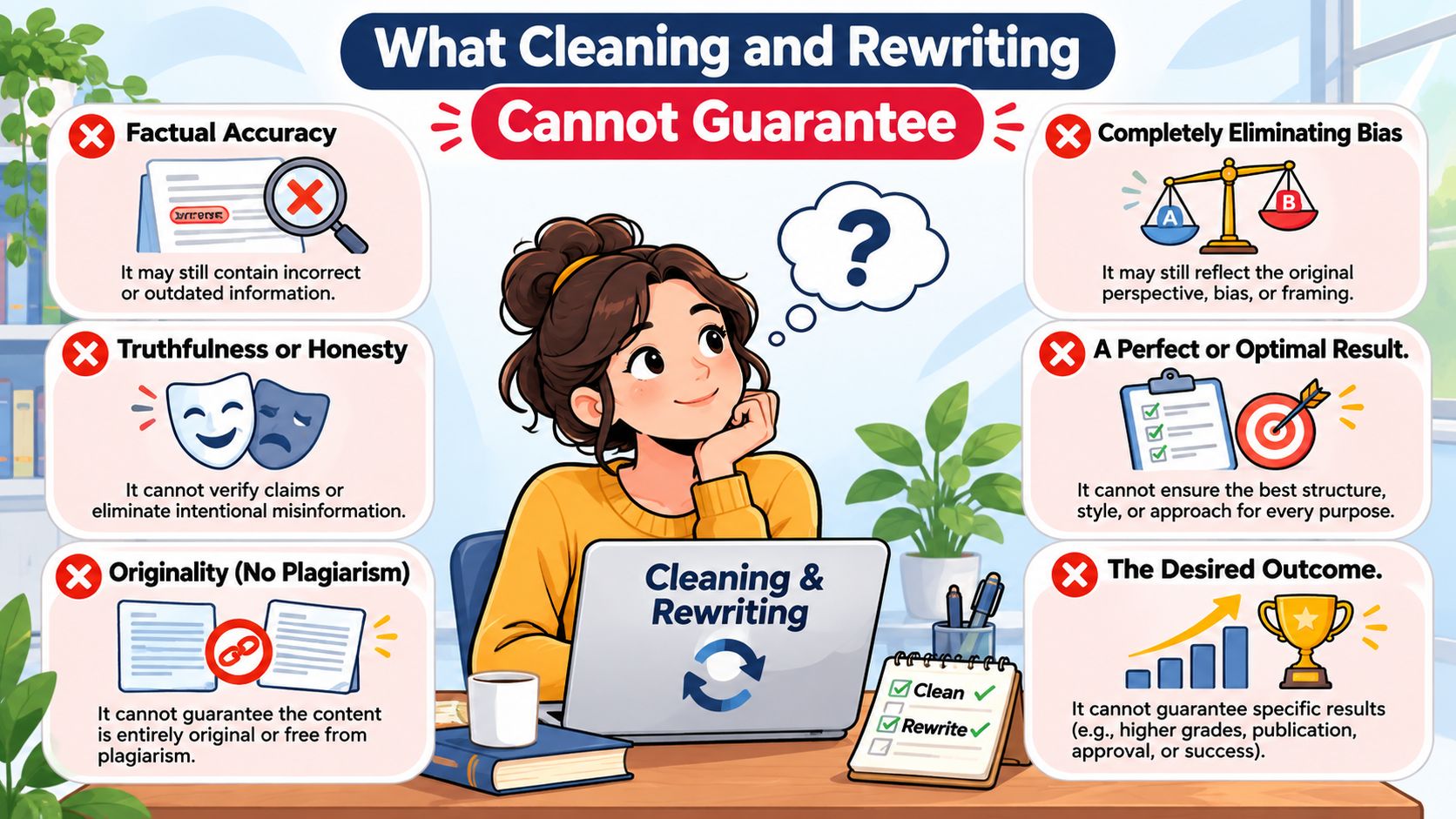
Statistical watermarking biases how a model samples tokens, then tests the sequence with statistical metrics. The signal sits in word choices and probability patterns, not in hidden Unicode marks, as described in watermarking research on token-choice patterns. Plain-text conversion, line-break cleanup, and zero-width removal leave that signal in place. Reducing it means changing enough wording to move the statistic. That same change is how a number, a name, or a hedge can drift.
What the measurements actually show
Rewriting can lower a score. It does not issue a verdict. One empirical study found a PEGASUS paraphraser cut a soft-watermark detector's accuracy from 97% to 80%, while a T5 paraphraser cut a zero-shot detector's AUROC from 96.5% to 25.2% (paraphrase tests on watermark detectors). A later statistical analysis finds that in its heavy-edit regime, no test based on the observed watermark statistics can reliably detect the signal, regardless of the token-distribution model (Journal of the Royal Statistical Society). Outcomes still depend on the watermark design, how much text changed, how long the passage is, and which detector is used.
A detector result is not a definitive authorship judgment. A rewrite cannot promise an undetectable result, plagiarism removal, or a pass-fail verdict.
I would treat the rewrite as a wording pass inside the source check, not as the check itself. After the AI watermark remover changes token choices, compare the new sentences with the working notes: same numbers, same names, same claim strength. Simple Unmark aims to keep meaning, facts, names, and tone. A person still has to confirm that match.
DeepInfra reads submitted text to perform the rewrite. Text and output are not stored in the Simple Unmark database or analytics. Do not treat every ChatGPT output as watermarked. A clean that leaves the claims intact is the useful result. A lower detector score is not.
Final Review Checklist Before Publishing
A post stays unpublished until the working file can show which source supports each number, and whether the last wording change left that number intact. A detector score does not answer that. Keep provenance notes, the disclosure policy, and version history with the draft so a later dispute is not settled by a score.
Run six checks, in this order. Scan for hidden characters first. Zero-width marks and odd spacing survive an ordinary copy. Complete the fact pass by hand against the source list. Rewrite only passages whose wording needs to change, then repeat the number-and-name check. A rephrase can move a figure or a proper noun while the paragraph still sounds right. Plain-text conversion and line-break removal run in the browser as you paste, with nothing to set up. The wording rewrite still needs a person comparing the output to the sources.
- Sources in the file. Every statistic, date, quotation, and named entity traces to a source kept beside the claim.
- Last-edit match. Numbers and names still match those sources after the latest wording change.
- Clean text. Hidden characters are gone, and the plain-text copy matches the reviewed draft word for word on facts.
- Voice. Edited paragraphs match the brand samples, and banned phrases are gone, without stronger claims than the source allows.
- Regulated lines. Medical, legal, and financial statements have qualified reviewer approval.
- Revision notes. The file records who changed what, and why, including any rewrite.
Without an account, Simple Unmark allows 3 free cleans of up to 100 words each. Accounts can clean up to 5,000 words or 60,000 characters per text clean and start with 10 starter credits. Private cleaning costs 0.1 credit per started 100 words, with partial blocks rounded up. Credits never expire and there is no subscription, so each clean costs a predictable amount. Save this checklist as the template for the next draft so the same six checks happen before anyone hits publish.
Simple Unmark cleans AI-assisted blog drafts as text only: it strips hidden Unicode and rewrites passages to reduce statistical watermark patterns while aiming to keep meaning, facts, numbers, names, and tone. Use it after the source check, not instead of one, and review every rewrite before the post goes live. Start with a paste at Simple Unmark.
- AI blog writer
- AI blog writing
- AI draft editing
- hidden characters
- AI content review
Related articles
AI Essay Rewriters: Editing, Sources and Review
Understand what essay rewriters do, where meaning can drift, and how to review permitted edits while preserving attribution and assignment rules.
AI Content Humanizers: Editing Without False Promises
Learn how humanizers revise wording, how Unicode cleanup differs, and what to check so a smoother paragraph does not change the original claim.
Choosing a Paraphrasing Tool: 10 Options
Compare paraphrasing tools by task and review burden. Check facts, qualifications and privacy before choosing a rewriting workflow.