
Word Count Limit Rules at Simple Unmark
Simple Unmark word count limit rules explained. Up to 5,000 words per clean, 0.1 credit per started 100 words, rounded to the next 100.
Every clean at Simple Unmark is capped at 5,000 words and billed at 0.1 credit per started 100 words, rounded up to the next 100. Paste a 4,200-word draft and you'll pay 4.2 credits. Paste 4,201 words and you'll pay 4.3.
You're probably here because a long draft is sitting in your clipboard, and you want a straight answer before you submit it. Will the tool accept it? How many credits will disappear? The rules are simple, but the rounding catches people who estimate casually. Treat the limit as an operating constraint, not a suggestion, and you can price every clean before you click.
Table of Contents
- How Simple Unmark Word Count Limits Work
- The Next 100 Rounding Rule Explained
- Credit Cost Examples at Common Document Sizes
- Guest Cleans Versus Signed In Accounts
- Per Clean Credits Versus Subscription Pricing
- What Happens at the Edges of the Cap
- Choosing a Credit Pack That Fits Your Workload
- What You Actually Get for Each Credit
- Pre Submit Checklist for Sizing a Clean
- Quick Reference Table Words to Credits
How Simple Unmark Word Count Limits Work
The first rule is the hard ceiling: one clean can contain no more than 5,000 words. A submission at or below that limit can run. A submission above it must be trimmed or split before processing. The tool doesn't cut the excess, so a 5,001-word paste won't produce a partial result.
The second rule controls billing. Simple Unmark charges 0.1 credit for each started 100-word block, with the total rounded upward to the next full block. A 4,200-word draft uses 4.2 credits. A 4,250-word draft uses 4.3 credits because the words after 4,200 have started another 100-word unit.
Use the same check every time
Before submitting, run this sequence:
- Count the words. Use the count from your editor or a dedicated word counter.
- Check the cap. If the result is above 5,000, split the draft at a paragraph or section boundary.
- Round upward. Convert the word count into started 100-word blocks.
- Multiply by 0.1. That gives the expected credit cost.
The cap and billing unit apply to the clean itself. They aren't relaxed because the credits are promotional, and they don't change based on the kind of text being processed. The practical details of how text is handled are documented in Simple Unmark's methodology guide.
Practical rule: Never budget from the visible document length alone. Budget from the rounded length of every individual clean.
Academic publishers also show why a fixed limit matters. In a 2026 dataset covering 7,239 journals, 1,692 journals published a numeric limit for their primary research article type, with a median limit of 7,500 words. The distribution was broad, which reinforces the point: word limits are common, but they aren't globally standardized. Simple Unmark's limit is specific and predictable, so use it as a firm processing boundary.
The Next 100 Rounding Rule Explained
The phrase started 100 words matters more than the decimal price. Simple Unmark divides the word count into 100-word units, rounds any partial unit upward, then applies the 0.1-credit rate.
That creates sharp boundaries:
- 101 words becomes 200 billable words, costing 0.2 credit.
- 250 words becomes 300 billable words, costing 0.3 credit.
- 500 words stays at 500 billable words, costing 0.5 credit.
- 1,001 words becomes 1,100 billable words, costing 1.1 credits.
A document ending at 00 pays exactly for its displayed length. A document ending anywhere from 01 through 99 pays for the next hundred. This is why a draft just over a boundary costs more than a draft just under it, even when the actual difference is only one word.
Calculate it without guesswork
Use this mental formula:
Rounded billable words = the next 100-word boundary, unless the count already ends in 00.
Then:
Credits charged = rounded billable words × 0.001.
So, 2,400 words costs 2.4 credits. A 2,401-word document costs 2.5 credits. The extra word starts a new billing block.
The same rule applies to small tests and near-cap submissions. A 50-word test costs 0.1 credit because it starts one block. A 4,950-word draft costs 5.0 credits because it rounds to the 5,000-word boundary. The rounding doesn't make the service unpredictable. It makes boundary awareness necessary.
Academic submissions create a similar kind of confusion because institutions don't always define counts the same way. University of Worcester guidance notes that quotations and in-text citations may be included while footnotes, references, appendices, abstracts, and front matter may be excluded, depending on the rules. For Simple Unmark, use the text count the tool recognizes, not an academic institution's special counting convention.
Credit Cost Examples at Common Document Sizes
Worked examples are more useful than a vague promise to “estimate.” Apply the same calculation to each draft: identify the word count, round upward, then multiply by 0.1.
| Document size | Rounded billable size | Credit cost |
|---|---|---|
| 350-word email | 400 words | 0.4 credit |
| 1,000-word blog post | 1,000 words | 1.0 credit |
| 2,750-word article | 2,800 words | 2.8 credits |
| 4,999-word long-form draft | 5,000 words | 5.0 credits |
The 2,750-word example is the one that catches people. The draft is 50 words into the next block, so it pays for 2,800 words. The 4,999-word example stays within the cap and rounds to exactly 5,000, making it a 5.0-credit clean.
More sizes worth memorizing
- 1,500 words costs 1.5 credits.
- 2,000 words costs 2.0 credits.
- 2,001 words costs 2.1 credits, not 2.0.
- 3,200 words costs 3.2 credits.
- 4,201 words costs 4.3 credits.
The correction is important: 2,001 words rounds to 2,100, so the charge is 2.1 credits. The general pattern remains straightforward. Counts ending in 00 are exact. Counts ending in 01 through 99 move to the next hundred.
Don't split a document randomly just to chase a lower apparent count. Each chunk rounds separately, so careless splitting can create more partial blocks. Split at natural paragraph or section boundaries, then calculate each chunk independently before you submit.
Guest Cleans Versus Signed In Accounts
Guest access suits a one-off test. You can run three free cleans of up to 100 words, but guest work isn't saved for later retrieval. That makes it useful for checking a short passage, testing the workflow, or cleaning a small excerpt when you don't need a record.
Signing in changes the repeat-use experience. New accounts receive 10 starter credits, and signed-in work keeps a usable history. The account also tracks counts and credit activity rather than retaining submitted text, while guest submissions are not saved.
| Feature | Guest | Signed-In |
|---|---|---|
| Free access | Three cleans, up to 100 words each | Starter credits on first sign-in |
| Per-clean limit | Up to 100 words | Up to 5,000 words |
| Billing rule | Same 0.1 credit per started 100 words when applicable | 0.1 credit per started 100 words |
| History | Work disappears with the session | Usable clean history |
| Best fit | One-off short cleanup | Repeat work and longer drafts |
The word count rule doesn't improve or worsen based on account status. The difference is persistence and available starting capacity. If you're cleaning one short passage and won't return, guest mode is enough. If you're working through articles, research drafts, or recurring editorial batches, signing in avoids the dead end of an unsaved session and gives you credits to plan around.
Per Clean Credits Versus Subscription Pricing
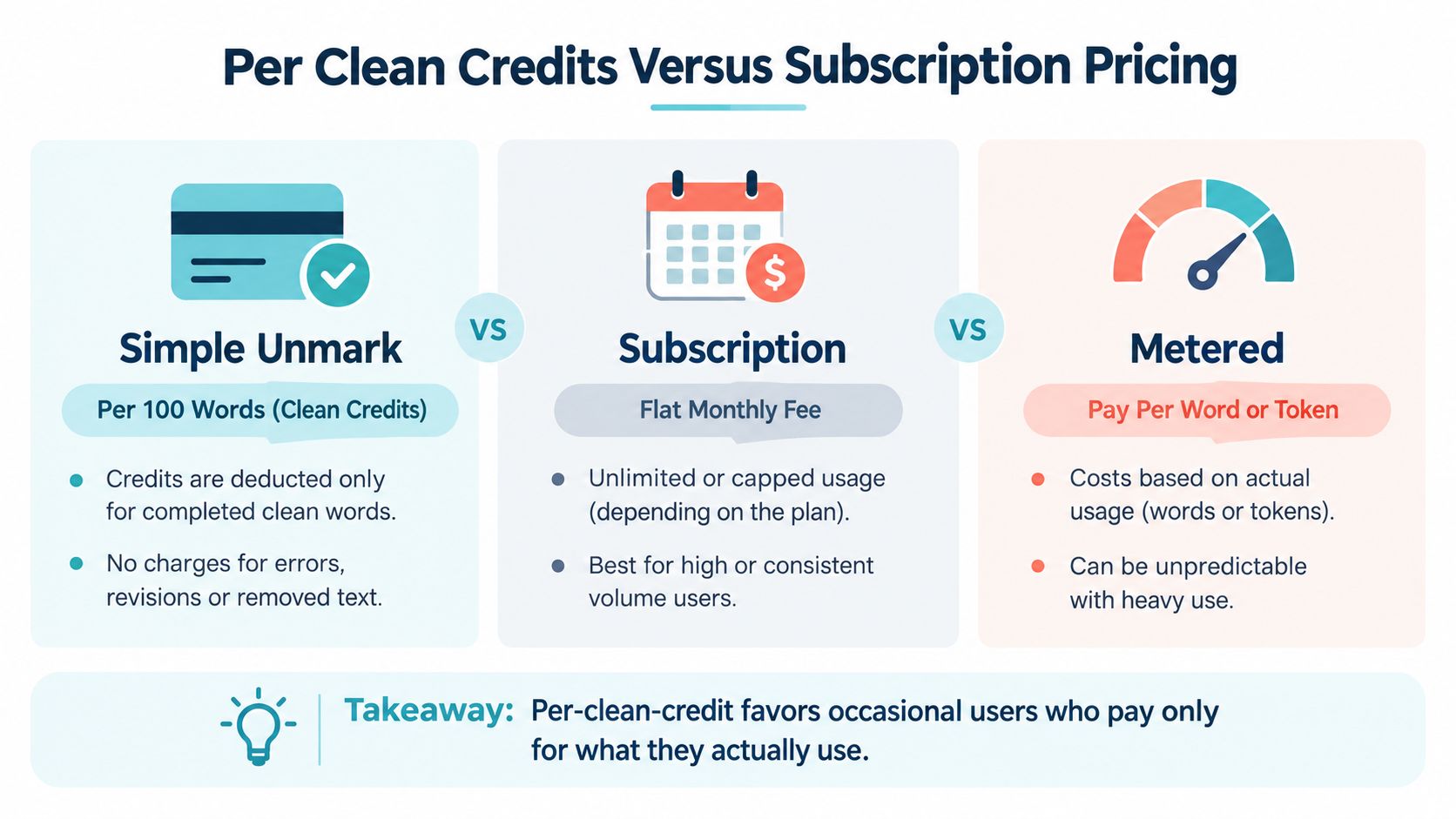
Per-clean billing and subscriptions reward different habits. A credit model suits occasional users because you pay for completed text instead of maintaining a recurring plan during quiet periods. A subscription can make more sense for someone who processes large volumes every day, but only after the monthly fee beats the equivalent usage cost.
At Simple Unmark's rate, a 2,000-word clean costs 2 credits. A 10,000-word workload split across two cleans costs 10 credits, because the workload has to be processed in separate requests. An unlimited plan would require a separate breakeven calculation against its monthly subscription cost. Without that comparison, “unlimited” is just a label, not proof of savings.
Match the billing shape to your workload
| Model | How you pay | Practical advantage |
|---|---|---|
| Per-clean credit | Credits follow processed word blocks | No recurring commitment for occasional use |
| Subscription | Flat monthly fee, usage may be unlimited or capped | Predictable cost for sustained volume |
| Metered | Payment follows words, tokens, or another usage unit | Direct alignment with consumption |
A writer cleaning a 500-word email once a week shouldn't automatically buy an unlimited plan. An agency batching long manuscripts every week should compare its actual monthly credits with the subscription alternatives.
For a broader comparison of how AI services package usage, review AI visibility pricing tiers, then compare the structure rather than the headline price. Simple Unmark's own pricing information is most useful when you already know your expected word volume.
What Happens at the Edges of the Cap
A 5,001-word paste exceeds the cap. The submission is rejected with a size error, and you need to trim or split it. The correct fix is to remove unnecessary material or divide the draft at a clean paragraph boundary. Don't rely on silent truncation, because the tool doesn't process only the first 5,000 words.
A 100,000-word manuscript also can't go through as one request. It must be divided into 20 separate cleans of 5,000 words, assuming every chunk reaches the maximum without exceeding it. Each request is priced independently, so calculate the rounded cost for each chunk rather than treating the manuscript as one uninterrupted job.
Invisible characters need a separate check
Zero-width spaces and related Unicode marks can remain inside copied text even though they don't display. Unicode U+200B ZERO WIDTH SPACE has no visible width, but it still exists in the text string and can affect processing, comparison, wrapping, and downstream handling, as described by Unicode Explorer's U+200B reference.
Simple Unmark's word counter measures whitespace-separated tokens it recognizes as words. Invisible characters can inflate raw character counts without necessarily creating additional billable words. That distinction matters when a document looks overbuilt in a character counter but still sits below the word cap. Tools that inspect invisible characters explain why these marks can survive copy-paste and influence later handling, even when the screen looks normal, as shown by this zero-width space reference.
Pre-trim to 5,000 words or less, remove hidden formatting where practical, and submit the complete intended text. Never assume the system will rescue an oversized paste.
Choosing a Credit Pack That Fits Your Workload
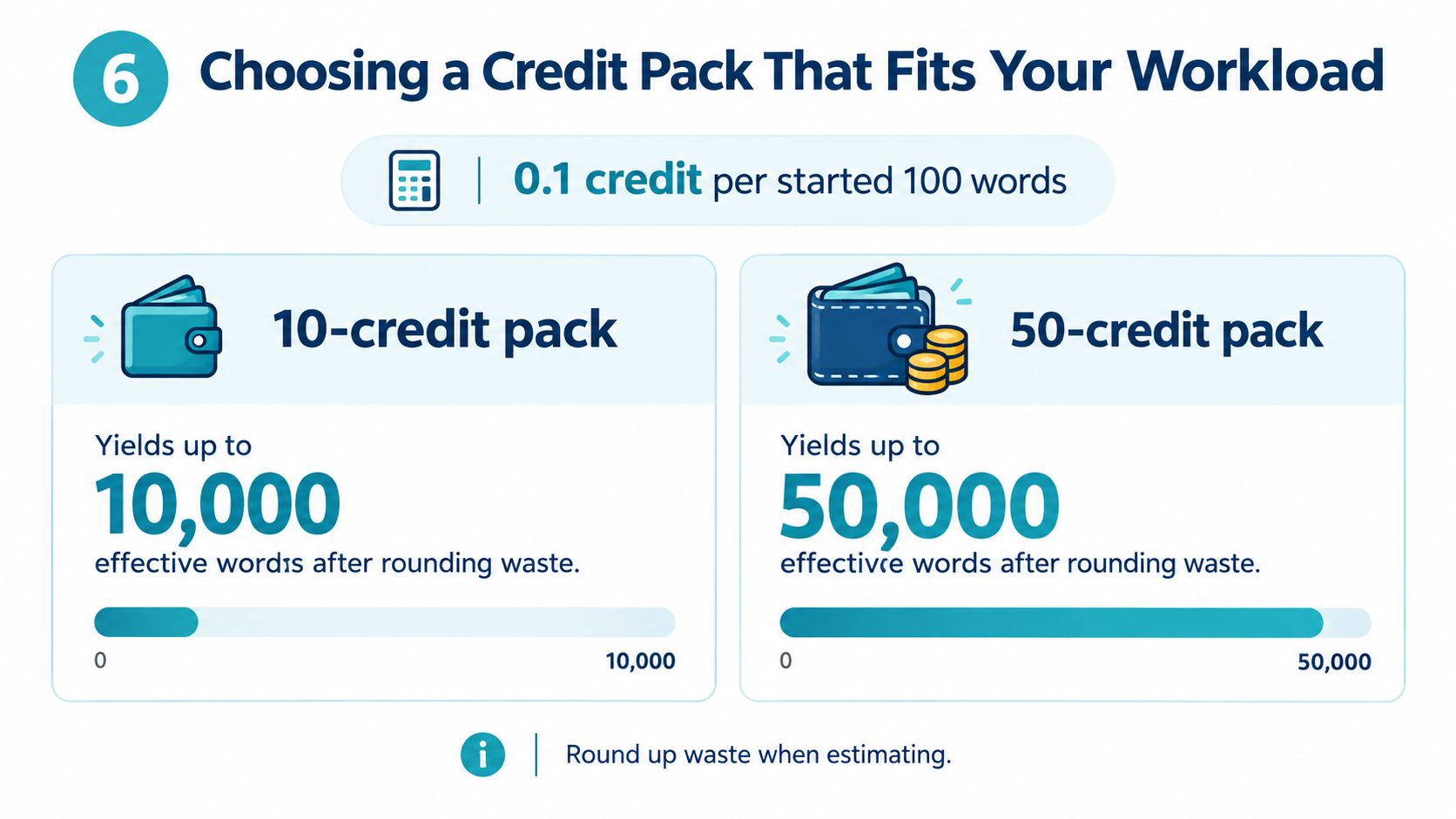
Start with the constant rate, not the pack label. At 0.1 credit per started 100 words, 10 credits correspond to up to 10,000 effective words before rounding waste, while 50 credits correspond to up to 50,000 effective words. Those are planning ceilings, not guarantees that every real batch will use every word efficiently.
Forecast a month, not a single draft
Estimate the words you expect to clean over the next 30 days. Then divide by 100, round each request upward, and multiply by 0.1. Leave room for partial-block waste, especially if you process many short documents instead of a few long ones.
A 2,000-word draft needs 2 credits. Ten 4,500-word manuscripts per week create a much heavier recurring workload than one isolated article. The right pack depends on that pattern, not on the largest file currently open in your editor.
Don't treat the often-repeated 5 to 15 percent allowance as a verified Simple Unmark rule. Rounding waste varies with how your individual documents end, so calculate from actual chunk sizes. For broader budgeting comparisons, you can also inspect subscription costs for video detection, but don't transfer another product's pricing assumptions to a word-processing workflow.
What You Actually Get for Each Credit
A credit pays for a cleaning pass, not an open-ended creative rewrite. The process targets AI-related artifacts and hidden formatting while preserving the source's facts, numbers, proper nouns, tone, and intent.
That includes removal of invisible Unicode marks such as zero-width spaces and wording changes intended to reduce probabilistic watermark signals. Google's SynthID text system works by modifying token-generation likelihoods during generation rather than adding a visible label, according to MIT Technology Review's explanation of SynthID. Independent research describes SynthID-Text as a production-ready LLM watermarking system and a large-scale deployment, but no cleaning workflow can promise a particular detector outcome, as the SynthID-Text research paper makes clear in its technical context.
The output should remain usable
The intended result is a copy-ready version with:
- Markers removed: Rephrasing targets statistical patterns associated with AI watermarks.
- Invisible text cleaned: Zero-width spaces and unusual Unicode controls are stripped.
- Meaning preserved: Numbers, names, dates, and factual content stay intact.
- Voice retained: Sentence rhythm can be tightened without turning the draft into a new argument.
For the specific removal workflow, see the Simple Unmark AI watermark remover. Treat the output as a cleaned transformation that still deserves normal editorial review, particularly when the source contains citations, technical notation, or formatting-sensitive material.
Pre Submit Checklist for Sizing a Clean
Run this checklist before you paste. It takes less time than recovering from a rejected request or an unexpected credit deduction.
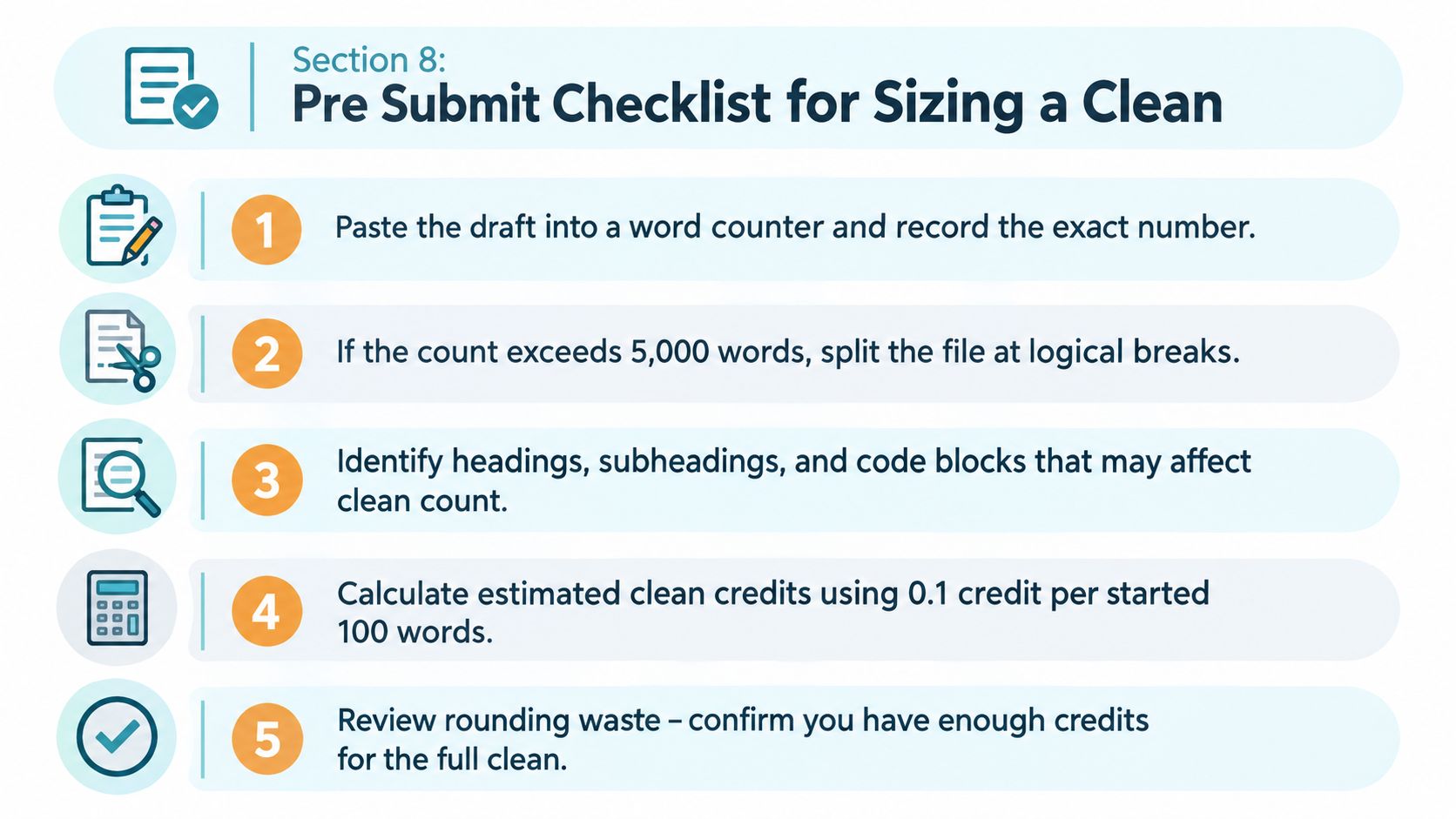
- Record the count. Paste the draft into a word counter and write down the exact number.
- Split oversized text. If it exceeds 5,000 words, divide it at paragraph or section boundaries.
- Calculate each chunk. Round every chunk up to its next 100-word block, then multiply by 0.1 credit.
- Check your balance. Add the chunk costs and confirm your account can cover the total.
- Inspect hidden characters. Scan pasted text for zero-width spaces and other invisible Unicode marks before processing.
The fifth step needs a precise distinction. Invisible characters can affect raw character handling and downstream comparisons, but don't assume they automatically become extra billable words. The counter's recognized word tokens determine the clean size. Scan them because they can make copied text behave differently across editors and platforms, not because every hidden mark necessarily changes the credit total.
For academic work, check the destination's own definition of “word count” separately. Journal abstracts and conference submissions may use very different limits, including character caps, as summarized in this academic word-limit review. Simple Unmark's calculation is a processing rule, not a substitute for your institution's submission policy.
Quick Reference Table Words to Credits
Use this grid when you need a fast estimate. Every count at or below 5,000 follows the started-100 rule. The final row marks the cap failure, not a payable clean.
| Word Count | Rounded Bucket | Credits Charged |
|---|---|---|
| 50 | 100 | 0.1 credit |
| 100 | 100 | 0.1 credit |
| 250 | 300 | 0.3 credit |
| 500 | 500 | 0.5 credit |
| 1,000 | 1,000 | 1.0 credit |
| 1,500 | 1,500 | 1.5 credits |
| 2,000 | 2,000 | 2.0 credits |
| 3,000 | 3,000 | 3.0 credits |
| 4,000 | 4,000 | 4.0 credits |
| 4,999 | 5,000 | 5.0 credits |
| 5,000 | 5,000 | 5.0 credits |
| 5,001 | Exceeds cap | Split required |
The fastest habit is to watch the last two digits. 00 means exact billing. Anything from 01 through 99 rounds upward. Then check that the full request remains within the 5,000-word limit.
Simple Unmark removes hidden Unicode characters and cleans AI-assisted text while preserving meaning, facts, numbers, proper nouns, tone, and intent. Check your draft against the cap and rounding table, then visit Simple Unmark to run a clean with a predictable credit cost.
- word count limit
- Simple Unmark
- AI text cleaning
- credit pricing
- SynthID
More posts
How to Use Watermark Remover Without Losing Meaning
Learn how to use watermark remover tools to clean AI text quickly. Practical steps, settings, and honest tips for better results with Simple Unmark.
Invisible Numbers Explained and How to Remove Them
Learn what invisible numbers and hidden Unicode characters are, how they watermark text, and how to detect and remove invisible numbers safely.

AI Text Humanizer Explained and How to Use It Right
Learn what an AI text humanizer does, how rewriting and Unicode cleanup reduce watermark signals, and how to humanize AI text without losing meaning.