
Watermark Removal Tool: What It Does and How It Works
Learn what a watermark removal tool actually does, how it tackles probabilistic marks like SynthID, and where Simple Unmark's approach stands out.
The most popular advice about a watermark removal tool is also the least accurate: “Remove the hidden characters and the watermark is gone.” That only works when the problem is hidden text formatting. AI watermarking can also involve file metadata or a statistical pattern spread across token choices. Those are different problems, and a one-click character scrubber can't solve all three.
A useful cleaner therefore needs a strict order of operations. It should sanitize invisible Unicode first, strip relevant formatting or metadata residues where applicable, then perform a meaning-preserving rewrite that changes enough wording and sentence structure to weaken a probabilistic signal. Anything less is superficial editing dressed up as removal.
Table of Contents
- What People Actually Mean by Watermark Removal Tool
- How Probabilistic AI Watermarks Like SynthID Work
- The Two Stages a Real Cleaner Has to Run
- How Simple Unmark's Approach Differs From Superficial Editors
- What a Rewrite Pass Looks Like on a Real Passage
- Risks, Limits, and the Honest Trade-Offs
- When Running a Cleaner Is Worth It and When It Is Not
What People Actually Mean by Watermark Removal Tool
Searchers usually describe three separate jobs with one phrase. Treating them as identical leads to bad recommendations and unrealistic expectations.
Invisible characters are a mechanical problem
Copy-pasted AI text can contain zero-width spaces, zero-width joiners, zero-width non-joiners, byte-order marks, bidirectional controls, tag characters, and variation selectors. These characters have no visible glyph, but they remain in the raw character stream and can affect parsing, counting, rendering, tokenization, and string matching. A technical overview of zero-width Unicode explains why human review alone misses them and why software must inspect the underlying characters directly (how zero-width Unicode affects text processing).
The fix is deterministic. A character map identifies unwanted code points and removes or normalizes them. No paraphrasing is needed, and changing the wording would be pointless.
Metadata is a file-level problem
A document or image can carry provenance and editor information outside its visible text. Depending on the format, that may include document properties, embedded metadata, or other format-level residues. Removing those fields is a file sanitation task, not a text rewrite.
That distinction matters because metadata can be stripped without touching the words. Conversely, a clean-looking text passage may still carry a statistical mark even after it has been copied into a plain-text editor.
Statistical watermarking is a generation problem
A probabilistic text watermark doesn't sit inside one character or one removable field. It is distributed across the model's word choices. Reducing it requires a rewrite that changes enough lexical and structural decisions to disturb the underlying pattern.
That makes resources such as AI writing tips from Prompt Builder useful for improving the quality of the rewrite itself, but writing advice isn't the same as watermark sanitation. The cleaner must preserve the text's factual load while changing its statistical shape.
Practical rule: Identify the layer before choosing the tool. Use sanitation for characters, metadata stripping for files, and rewriting for token-choice signals.
How Probabilistic AI Watermarks Like SynthID Work
A probabilistic watermark is closer to a loaded die than to a stamp. A language model still chooses a word that fits the sentence, but the generation process nudges the random selection so some acceptable token choices occur more often than others. One choice tells you nothing. A long enough sequence can leave a measurable statistical fingerprint.
Google DeepMind launched SynthID for AI-generated images in August 2023 and extended it to text and video in May 2024. By 2026, Google said SynthID had watermarked more than 100 billion images and videos and 60,000 years of audio, according to an overview of the system (SynthID's development and deployment).
The mark lives in distribution, not appearance
SynthID-Text modifies token selection during generation by changing logits after Top-K or Top-P sampling. It uses a pseudorandom function to influence which eligible tokens the model selects. The result doesn't create a visible label, unusual character, or fixed phrase that a user can search for and delete.
Google describes detection as probabilistic, with three possible outcomes: watermarked, not watermarked, or uncertain (Google's SynthID-Text documentation). That uncertainty is central. A cleaner isn't deleting a known object. It's changing the text enough that a detector may assign less confidence to a pattern it was looking for.
A single synonym swap won't normally accomplish that. The signal is distributed across many decisions, so the rewrite has to alter sentence openings, clause construction, connective words, vocabulary, and sometimes the order in which ideas appear. The text must remain accurate, but it can't remain a near-copy of the original token path.
Why the field keeps changing
Statistical text watermarking is recent. Modern statistical approaches appeared in 2022, the influential red-list and soft-red-list method followed in 2023, and Google's production SynthID text watermark arrived in 2024 (history of AI watermarking methods). A tool built around one detector's assumptions can become less useful when vendors alter generation or detection methods.
For a plain-language explanation of the specific mechanism, see what SynthID-Text is and how it works. The important takeaway is simple: there is no byte to erase from a token-choice watermark. Rewriting is the practical lever, and rewriting always introduces a quality trade-off.
The Two Stages a Real Cleaner Has to Run
A serious text-cleaning pipeline should run Unicode sanitation before semantic rewriting. The order isn't cosmetic. It separates exact cleanup from probabilistic transformation and prevents invisible characters from contaminating the input that the rewrite engine receives.
Stage one removes mechanical noise
The first pass scans the raw character stream. It should identify and remove unwanted non-printing characters, including zero-width spaces, zero-width joiners, zero-width non-joiners, zero-width no-break spaces, bidirectional controls, BOM markers, tag characters, and problematic variation selectors. A cloud security research note identifies the fully invisible Unicode Tags block as U+E0000 to U+E007F and gives examples such as zero-width space U+200B, zero-width non-joiner U+200C, zero-width joiner U+200D, and zero-width no-break space U+FEFF (code-point risks in invisible Unicode).
This stage can also normalize stray spacing and formatting residues where the product supports them. The output should be copy-safe text that behaves consistently in editors, parsers, and comparison tools.
A character scrubber can finish this stage well. It can't complete the second one.
Stage two changes the wording pattern
The rewrite pass needs to do more than replace a few verbs. It should restructure clauses, vary sentence openings, change predictable connectors, redistribute emphasis, and select different vocabulary where the meaning allows it. That process changes the token-choice pattern left by the original sampler.
The failure mode is predictable: Skip sanitation and invisible artifacts remain. Skip rewriting and the statistical pattern remains, even if the passage looks perfectly clean to a person.
A practical rewrite must protect the elements that carry meaning. Facts, numbers, proper nouns, URLs, code, quoted material, and technical terminology should be preserved unless the user explicitly asks for editorial changes. The system should also flag passages where the input is too short or too rigid to rewrite safely.
This is why a combined AI watermark remover workflow is more credible than a synonym-only editor. The first operation is exact and mechanical. The second is interpretive and best effort. Neither should be marketed as a guaranteed verdict changer.
How Simple Unmark's Approach Differs From Superficial Editors
Most tools in this category fall into two basic groups. The first strips invisible characters. The second spins synonyms or makes small wording substitutions. Both can be useful, but neither should be confused with a full statistical rewrite.
| Capability | Invisible-Char Stripper | Synonym Spinner | Simple Unmark |
|---|---|---|---|
| Removes zero-width and control characters | Yes | Usually limited | Yes |
| Changes metadata or formatting residues | Sometimes | Rarely | Text-focused cleanup |
| Rebuilds sentence and clause structure | No | Limited | Yes |
| Alters token-choice distribution | No | Inconsistently | Intended through semantic rewriting |
| Preserves facts, numbers, and proper nouns | Usually untouched | Can damage them | Designed to preserve them |
| Suitable for long pasted passages | For sanitation only | Often uneven | Built for a full cleaning pass |
| Guarantees a detector result | No | No | No |
Why strippers stop too early
An invisible-character stripper can remove zero-width joiners, soft hyphens, format characters, and other code points. That solves a real problem when copy-paste introduced hidden content. It doesn't change the ordinary words in the passage, so a detector based on token-choice bias has nothing new to evaluate.
A synonym spinner goes further, but often not far enough. Replacing “important” with “significant” or moving one adverb preserves most of the original token graph. Perplexity screens, burstiness checks, and watermark detectors may still see a passage that is structurally close to its source.
What a deeper rewrite changes
The approach documented in Simple Unmark's methodology combines sanitation with a fuller paraphrase. It can alter clause structure, sentence-length patterns, connective choices, and lexical selection while retaining the argument's load-bearing details.
That matters for a pasted Gemini or ChatGPT passage. The result should not be a lightly edited copy with a few words swapped. It should be a reconstructed version that a reader can still follow, while a statistical system sees a substantially different sequence of choices.
There are clear boundaries. This kind of cleaner isn't a plagiarism checker bypass, it isn't useful for every short factual line, and it doesn't replace a human review of technical material. A specialist should still verify equations, citations, legal language, product names, and claims after the rewrite.
What a Rewrite Pass Looks Like on a Real Passage
Consider a representative AI-written paragraph:
AI tools can help writers create content more efficiently. They can generate ideas, organize information, and improve the clarity of a draft. However, writers should review AI-generated content carefully to ensure that it is accurate, relevant, and consistent with their intended tone.
The paragraph is competent, but its construction is predictable. The sentences are evenly balanced, the vocabulary is closed and familiar, and the three-part rhythm repeats the same pattern. A superficial editor might replace “efficiently” with “quickly” and “carefully” with “thoroughly.”
A deeper rewrite could read like this:
AI can give a draft momentum, but it doesn't remove the writer's responsibility. Use it to develop an angle or impose order on scattered notes. Then check every factual claim, cut generic phrasing, and adjust the final copy until it sounds like the publication and the person behind it.
What changed
The revised version opens more tightly and breaks the original rhythm. It combines a short contrast with longer instructions, changes the order of ideas, replaces the repeated “They can” construction, and uses more direct verbs. It preserves the central meaning, namely that AI can support drafting but the writer must review the result.
The rewrite should deliberately leave some elements alone. URLs, code blocks, proper nouns, citation names, numbers, quoted source material, and short enumerations often carry precision that paraphrasing would damage. The cleaner's job isn't to make every string different. It's to change the flexible language around the fixed information.
For more practical guidance on how to improve robotic AI content, focus on rhythm, specificity, and editorial judgment rather than random synonym replacement. A useful output should read like a human edit, not like a thesaurus passed over every sentence.
A good rewrite preserves the argument's identity while discarding the source passage's exact route through it.
Short, formulaic inputs expose the limits. A single sentence with a proper name and a hard fact may have no safe room for meaningful transformation. In that case, forcing a rewrite can create more risk than leaving the sentence alone.
Risks, Limits, and the Honest Trade-Offs
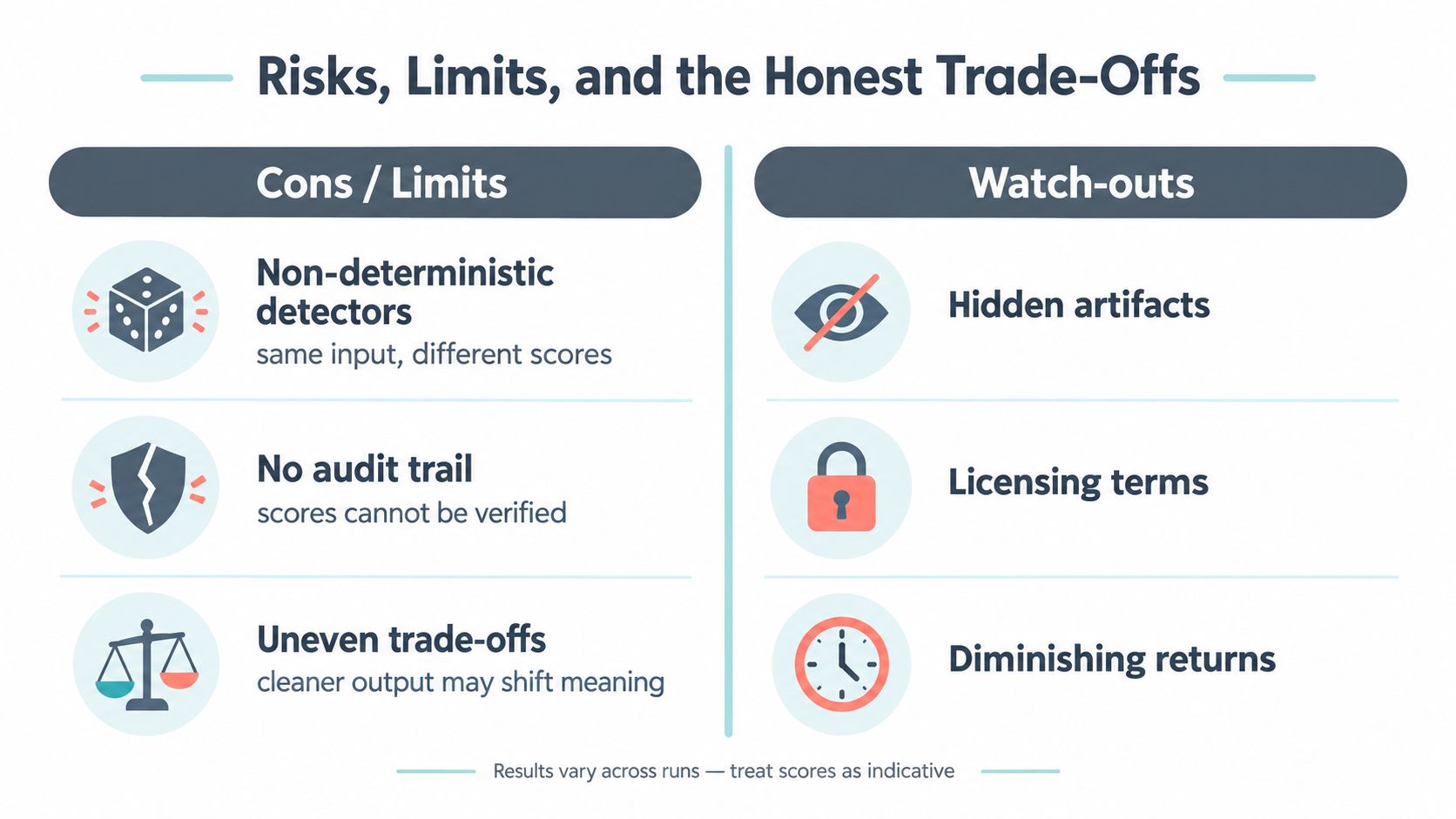
Marketing language often treats watermark cleaning as a binary operation. Real systems don't support that confidence. A rewrite can reduce a statistical signal, but it can't certify how every commercial detector will classify the result.
Detector scores aren't a final authority
Detector outcomes can vary across systems and runs, and many commercial tools don't provide an auditable explanation for their score. Research and technical discussion increasingly focus on reliability, adaptive detection, and cross-lingual manipulation rather than a permanent clean-versus-marked divide. One classroom study reported AI submissions as “undetectable” in 94% of cases, illustrating why a detector result should be treated as an indication, not proof (research on inconsistent detection).
The attack and defense cycle also remains active. Independent research reports that paraphrasing, copy-paste modifications, and back-translation can reduce SynthID-Text detectability while measuring an average 11.1% improvement in F1 for a proposed defense over SynthID-Text (research on attacks and defenses for SynthID-Text). That finding cuts both ways. Rewriting is a real mechanism, but detection is also responsive.
Meaning drift is the cost of stronger intervention
A rewrite aggressive enough to disrupt a watermark pattern can shift emphasis, remove a qualifier, flatten a distinction, or make a technical statement less precise. The risk grows with passage length and subject specificity. Human review isn't optional for medical, legal, scientific, financial, or policy content.
Adversarial settings favor the detector over time because watermarking methods can be retrained and detection strategies can adapt. A cleaner makes a best-effort change against a moving target. It doesn't see a vendor's private key, internal threshold, or future model update.
The legal and policy question is separate from detection. Passing AI-generated material off as original work can conflict with course rules, platform terms, employment policies, or disclosure expectations even if no detector flags it. A responsible tool can claim that it removes hidden characters and rewrites text to reduce a modeled statistical signal. It can't claim guaranteed erasure, guaranteed human authorship, or guaranteed acceptance by a particular institution.
When Running a Cleaner Is Worth It and When It Is Not
Use a cleaning pass when the text has a concrete problem that justifies changing it. Don't run every sentence through a rewrite engine just because the words came from an AI assistant.
Six signals justify the effort
- The draft triggers a detector repeatedly: A second check that produces the same concern is a practical reason to inspect and rewrite the passage, though it still isn't proof of provenance.
- Copy-paste introduced suspicious characters: Strange spacing, broken matching, inconsistent counts, or unexplained rendering issues justify Unicode sanitation.
- The passage is being republished: Clean, predictable plain text reduces avoidable problems when content moves between editors, CMSs, documents, and messaging tools.
- The passage is long: Manual restructuring takes time when a substantial draft needs a consistent editorial pass.
- More than one review raises concerns: Different detector outputs aren't definitive, but repeated signals deserve investigation rather than blind trust.
- Voice matching matters less than structural change: A rewrite is more acceptable when preserving the exact original style isn't the primary goal.
The final test is meaning. If the cleaned output changes a qualification, number, name, or technical relationship, reject it and edit manually.
Skip it in these cases
A short snippet under a paragraph is usually faster to rewrite yourself. Text you've already substantially edited may gain little from another transformation. Creative writing with a distinctive voice can lose more than it gains, and institutional rules may prohibit altering AI-assisted work to conceal its origin.
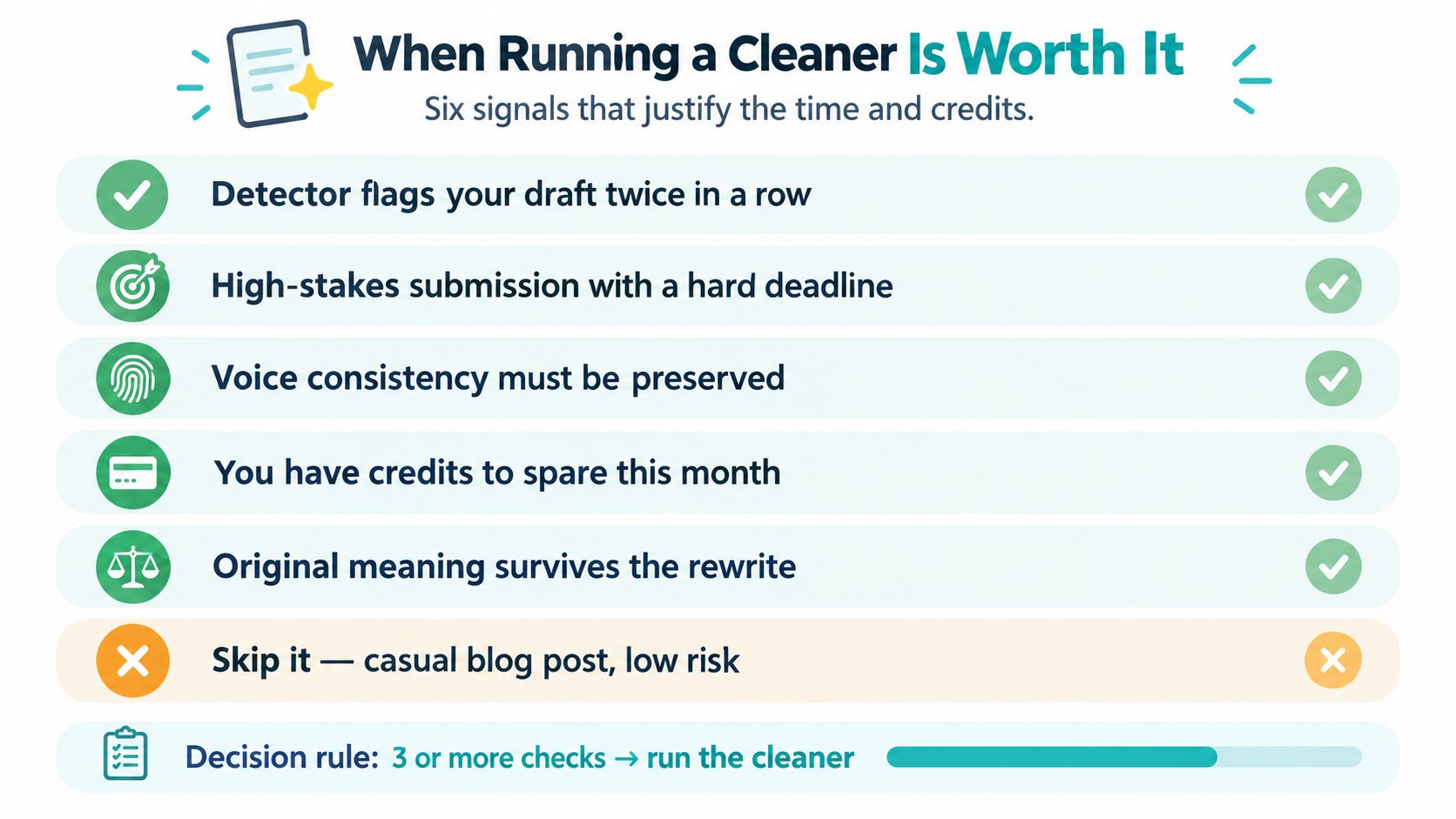
Decision rule: Clean when you need mechanical sanitation or a substantial rewrite. Skip it when the input is short, already human-edited, highly personal, or governed by a disclosure policy.
Cleaning is a lever, not a guarantee. Decide what you're optimizing for first: copy-safe text, lower exposure to a modeled watermark signal, preserved voice, or compliance with a rule that may require disclosure rather than concealment.
Simple Unmark removes hidden Unicode characters and rewrites AI-generated passages to reduce probabilistic watermark signals while preserving key meaning, facts, numbers, and proper nouns. If that matches your use case, test the workflow with a representative passage at Simple Unmark, then review the output yourself before publishing or submitting it.
- watermark removal tool
- AI text
- SynthID
- AI detection
- text cleanup
More posts
AI Paraphrasing Tool: What It Is and How It Works
Learn what an AI paraphrasing tool does, how it works, and when to pair it with cleanup tools like Simple Unmark for clean, human-ready text.
10 Best Paraphrasing Tools for Better Writing
Compare the best paraphrasing tools by features, pricing, use cases, limitations, and text-preservation concerns to choose the right fit.
How to Clear Copy and Paste Text Without Losing Meaning
Learn how to clear copy and paste text by removing hidden formatting, invisible Unicode, and AI watermark signals while keeping meaning intact.