
Undetectable AI Content Without the False Promises
Undetectable AI Content. Learn how to reduce AI-detection signals in text through rewriting, Unicode cleanup, quality checks, and honest limits—without
The popular advice is to keep rewriting AI text until a detector calls it human. Don't make that your publishing standard. A better-looking score won't rescue a distorted claim, an inaccurate citation, or a breach of your organization's AI policy.
Treat undetectable AI content as signal reduction with quality controls, not a promise of invisibility. Improve the text, protect its meaning, and keep evidence of how you produced it.
Table of Contents
- What Undetectable AI Content Actually Means
- Why Detector Results Are Unreliable
- Clean the Text Without Losing Its Meaning
- Compare Rewriting and Cleanup Methods
- Use Tools Without Treating Them as Proof
- Verify the Result Before You Publish
What Undetectable AI Content Actually Means
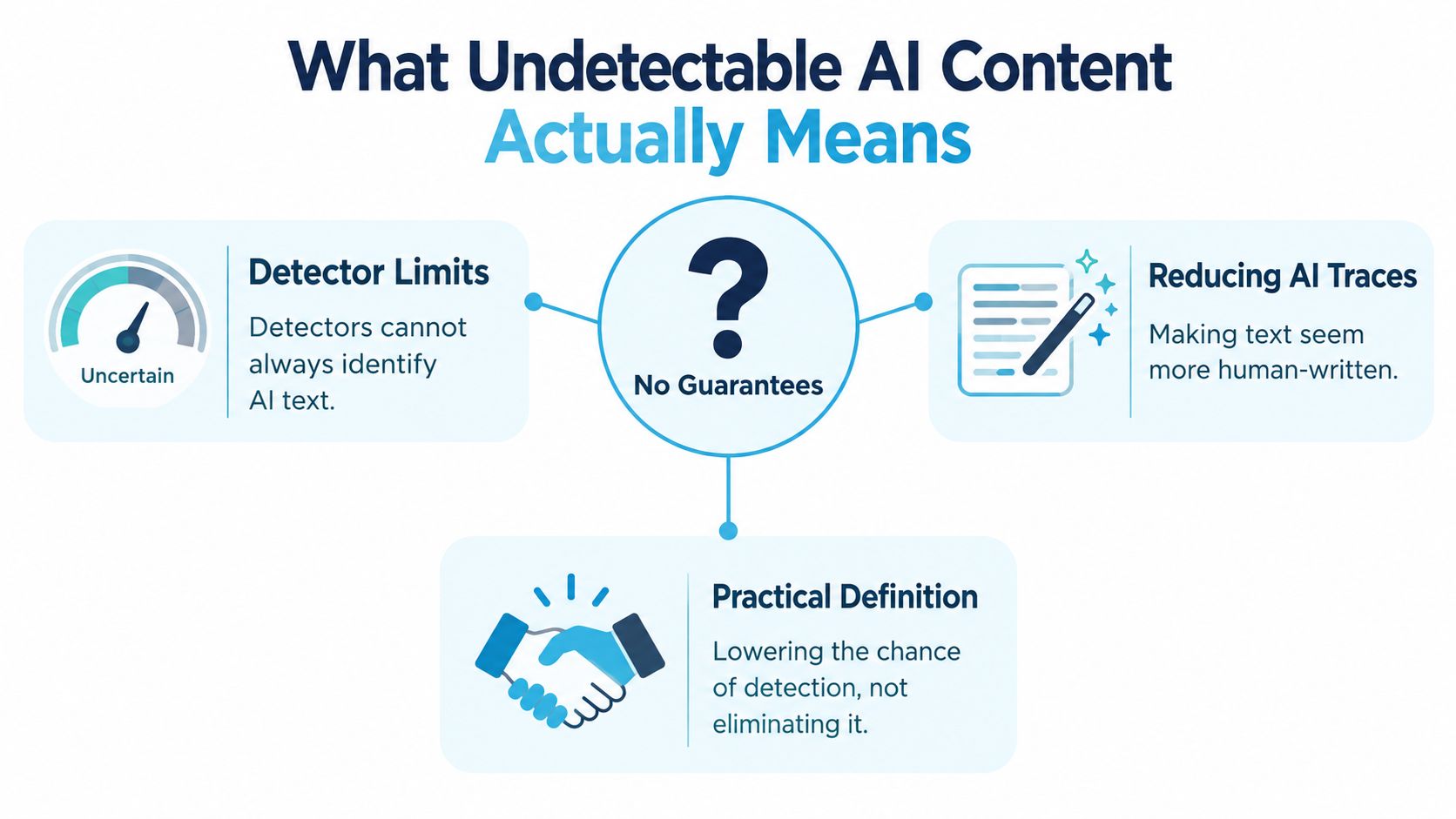
No editing method can guarantee that every detector will label a passage human-written. Even strong results leave room for mistakes. In an evaluation of STEM-student essays, the strongest detectors had a 6.1% ± 2.4% false-negative rate and a 1.3% ± 0.7% false-positive rate, meaning they missed some AI writing and incorrectly flagged some authentic writing (STEM essay detection study).
In practical terms, people searching for undetectable AI content usually want to change wording, remove hidden formatting artifacts, or weaken statistical watermark signals. Those are different jobs. None establishes that a person originally wrote the passage.
Separate the problems before editing
Hidden-character cleanup concerns the characters contained in a document. Statistical watermark rewriting concerns patterns in word and token choices. An authorship detector makes a further judgment about likely origin, which isn't the same task as checking for a particular watermark.
The distinction matters when deciding how AI text watermarks work. Don't assume an invisible character is proof of AI authorship, or that removing it removes a statistical watermark.
Decision rule: Identify the legitimate editing problem before choosing a tool. A detector score isn't a substitute for that decision.
Cleaning unusual spacing from a pasted Gemini draft is a formatting task. Revising an approved AI-assisted draft for clarity is an editorial task. Disguising prohibited assistance before submitting an assessment is a policy problem, and rewriting doesn't resolve it.
Set your acceptance criteria first: accurate claims, intact meaning, suitable voice, and permitted use. Treat any detection result as additional evidence about a particular test, not certification of human originality.
Why Detector Results Are Unreliable
A flagged passage isn't an authorship verdict. Detectors can make errors in both directions, and their performance depends on the writing population, subject matter, editing history, and decision threshold.
The fairness problem is particularly important. A Stanford-affiliated study reported that detectors classified more than half of authentic TOEFL essays by non-native English speakers as AI-generated, while recognizing comparable writing by U.S.-born eighth-grade students as human at nearly flawless rates (research on detector bias and generalization).
A score needs context
Predictable phrasing and restrained vocabulary aren't exclusive to machines. Don't tell a writer to make clear English less predictable merely to satisfy software.
Also distinguish AI watermarks from AI detectors. A watermark test looks for a particular embedded statistical signal. A general detector estimates likely authorship from its own learned criteria. Disagreement between tools doesn't establish which conclusion is correct.
If someone flags your writing, ask for the passage, tool, threshold, and review procedure. Then provide evidence that addresses authorship directly:
- Draft history: Share earlier versions and tracked revisions.
- Research records: Supply notes, source annotations, and outlines.
- Process explanation: Explain how you developed the argument and used any permitted assistance.
- Human review: Request an assessment of the evidence rather than automatic acceptance of the label.
Don't rewrite authentic work just to make an unreliable accusation disappear. Preserve the original before changing anything.
Editors should apply the same discipline. Where testing is appropriate, compare the disputed passage with human-written material from a similar domain and language background, rather than unrelated benchmark text.
Keep the response proportional, too. A questionable label should trigger a closer review, not an immediate accusation. For writers, the strongest practical defense is a documented process. For reviewers, it's a fair procedure that allows the author to explain that process.
Clean the Text Without Losing Its Meaning
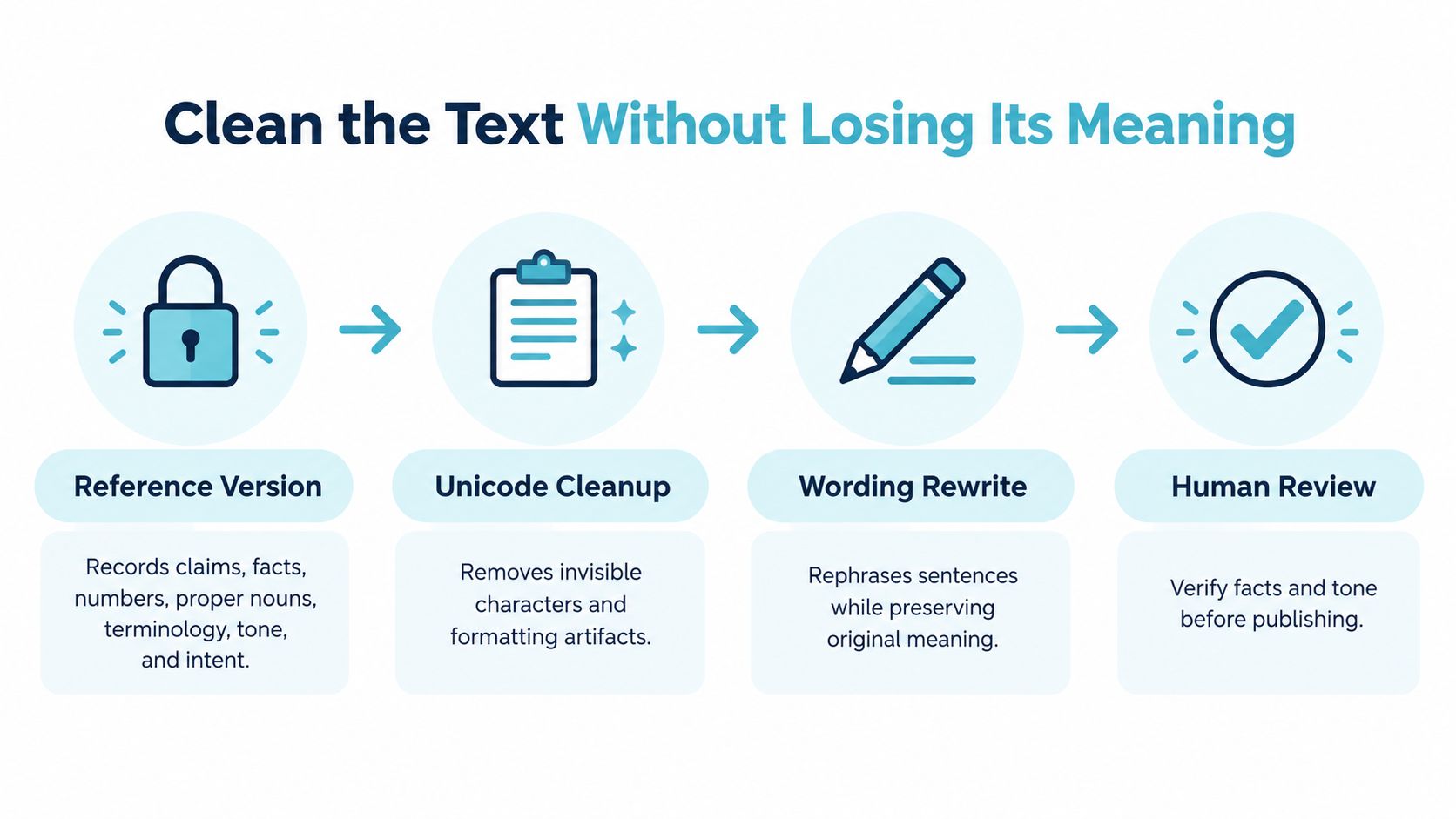
Start with a reference copy you won't overwrite. Record what the finished text must preserve: claims, numbers, names, terminology, tone, and intent.
Don't begin by asking how aggressively you can rewrite. Ask what must remain unchanged and whether the proposed editing is allowed.
Lock the reference and clean the characters
Keep the original text alongside its supporting sources. Mark quotations and any language that requires exact reproduction, including legal wording and technical definitions.
Then inspect for zero-width marks, direction controls, and unusual spacing. Remove unwanted artifacts selectively rather than treating every invisible character as disposable. Check the displayed result, particularly in multilingual material.
Rewrite ideas rather than swapping synonyms
If wording changes are appropriate, revise sentences for a clear editorial purpose. Remove repetition, make relationships explicit, and replace awkward phrasing with language you'd use.
Don't substitute words randomly. A sentence can retain its general topic while changing its claim. In particular, protect distinctions such as possibility versus certainty, intention versus commitment, and association versus causation.
A survey of AI-text detection techniques identifies rewording as a vulnerability in watermark-based methods. That supports treating rewriting as a possible change to a detection signal, not proof that the resulting content is accurate or human-authored.
For a controlled comparison, change one category at a time. Keep character cleanup separate from sentence restructuring so you can identify which edit introduced a problem.
Review a realistic editorial risk
Consider a hypothetical product brief containing a fixed launch deadline and a legal claim approved only under specified conditions. You can shorten the introduction or reorganize the benefits without changing either protected element.
You can't turn a planned launch into a guaranteed launch, remove the conditions from the legal claim, or strengthen a statement merely because the rewrite sounds smoother.
Before accepting the revision:
- Compare obligations: Check who must do what, and under which conditions.
- Protect exact language: Restore approved terminology and quotations where necessary.
- Check emphasis: Make sure the rewrite hasn't turned a minor benefit into the main promise.
- Reject drift: If an edit changes the claim, undo it rather than rationalizing it.
Copy the cleaned version only after that comparison. Keep the reference and revision together so another reviewer can see what changed and why.
Compare Rewriting and Cleanup Methods
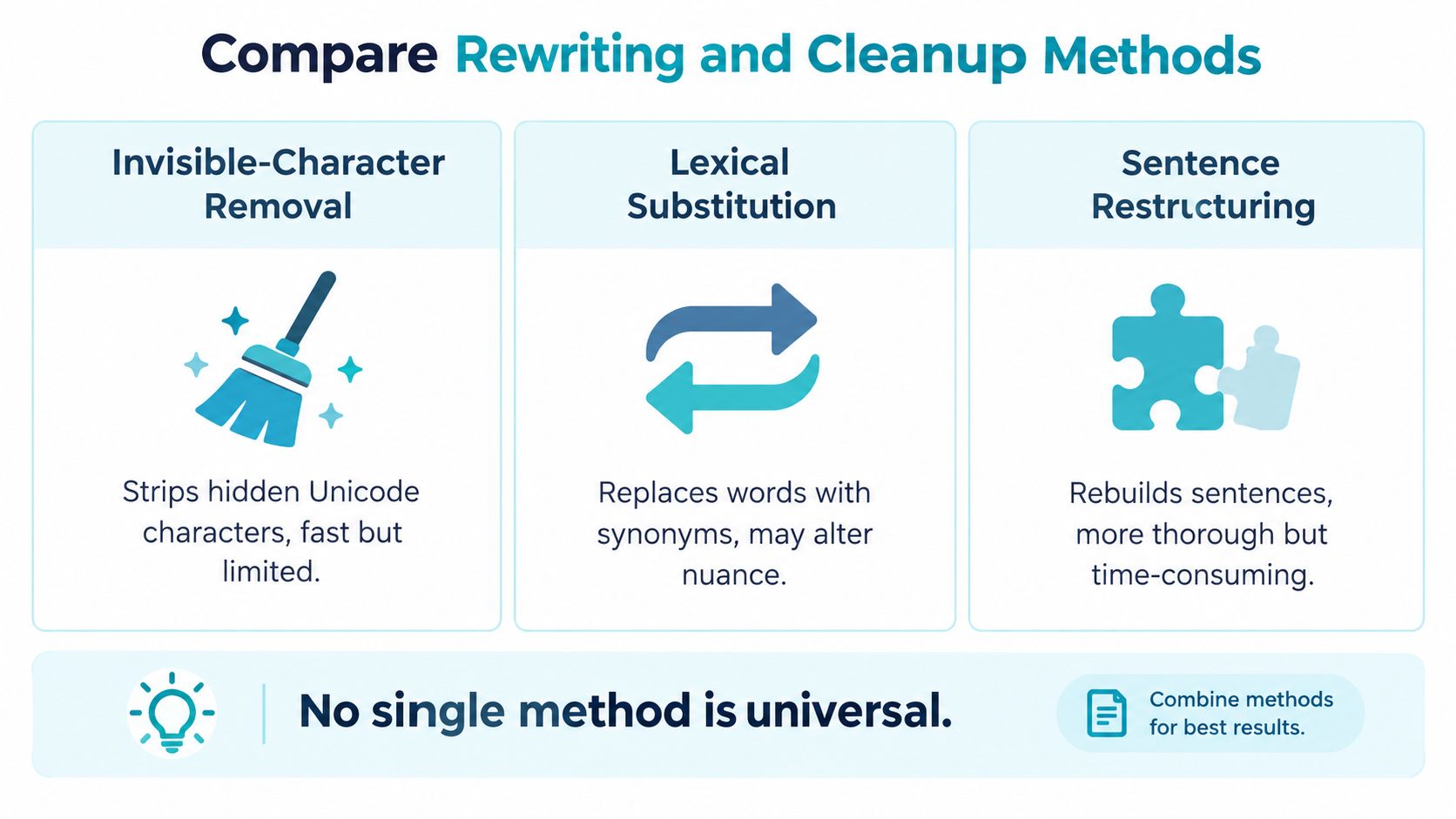
Start from the defect in front of you. If pasted text carries odd spacing or invisible characters, clean the characters and stop. If the concern is statistical wording, rewrite selectively. Detector invisibility is the wrong target: the job is reducing avoidable signals while keeping meaning, facts, and policy intact.
Watermark strength also varies by transformation. SynthID documentation describes resilience to cropping, limited word changes, and mild paraphrasing, while thorough rewriting or translation can greatly reduce detector confidence (SynthID watermark documentation). Treat that as a limit on expectations: edits can shift confidence, yet they do not certify authorship.
Approach comparison for AI-generated text
| Method | Main target | Preserve carefully | Limit |
|---|---|---|---|
| Unicode cleanup | Unwanted hidden characters and spacing | Required controls and intended layout | Leaves token-choice patterns unchanged |
| Lexical substitution | Individual word choices | Nuance and technical terms | Doesn't establish watermark removal |
| Sentence restructuring | Syntax and information order | Logical relationships and emphasis | Requires close comparison |
| Semantic paraphrase | Wording across a passage | Every substantive claim | Broad meaning alone isn't enough |
| Human revision | Clarity, argument, and voice | Evidence and authorial intent | Isn't an authorship guarantee |
| Translation | Language and phrasing | Meaning, register, and specialist terms | Adds a cross-language review burden |
Match the method to the document
For a pasted draft, inspect formatting first. Compare removed characters and rendered output before touching word choice.
For a short social post, protect the intended message and voice. A small passage gives an unnecessary rewrite little room to hide ambiguity, and a result from a longer document may not transfer.
For a long article, edit by argument and paragraph purpose. After restructuring, reread transitions so the revised sections still support the same conclusion.
For terminology-sensitive text, protect defined terms and approved claims. Human editing around those terms beats indiscriminate substitution.
Run fact and policy checks before detector checks. Use the practical guide to removing AI watermarks from text as a starting point for method selection, then apply document-specific judgment to each case.
Use Tools Without Treating Them as Proof
A web cleanup tool can handle repetitive processing. You still decide whether the output is acceptable.
For pasted Gemini, ChatGPT, or Claude text, keep the same discipline: retain the source copy, process an authorized passage, compare the revision, and copy only the reviewed result. A tool's label or product category tells you nothing about whether your particular input carries a watermark.
Check the scope before processing
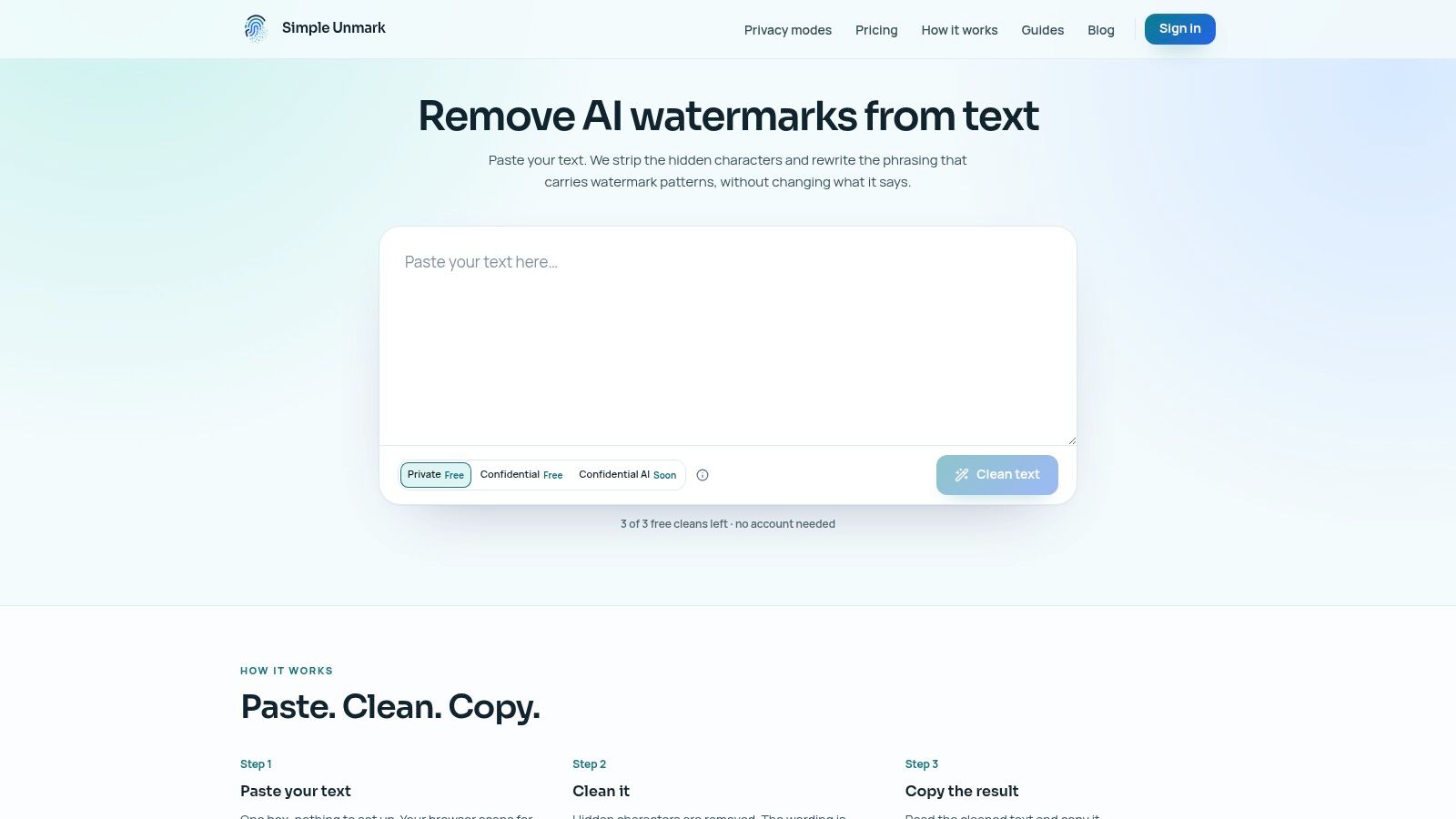
Simple Unmark is one option alongside manual cleanup and human editing. It combines Unicode cleanup with wording rewrite in a single pass, accepts full drafts per request, uses credit-based processing, and states plainly that detector outcomes can't be guaranteed. Sign-in is optional.
That combination matters. Hidden-character removal and statistical rewriting are different operations, so even if your original concern was unusual spacing, compare the resulting wording with the source as carefully as you check the formatting.
Keep responsibility outside the interface
Different users need different records:
- Writers and editors: Keep the source draft, approved revision, and editorial sign-off.
- Students and researchers: Retain drafting history and document permitted AI assistance.
- Compliance and legal teams: Confirm authorization before submitting sensitive text to an external service.
- Publishers: Record who verified claims and approved the final copy.
Confidential material stays out of any web tool until your organization's requirements and the service's current terms allow it. Convenience is not authorization.
Preserve provenance outside the tool as well. Your working folder should make the document's development understandable without depending on an interface history or a detector report.
Judge a tool by the editing work it performs and the limits it admits. The useful output is a reviewed document that meets your own requirements; a reassuring badge adds nothing. Final approval belongs to a person who can compare the revision against the source, so keep that decision outside the process that changed the text.
Verify the Result Before You Publish
Read the final version against the locked reference, not just in isolation. A fluent paragraph can still misstate the source.
Check the underlying evidence as well as the wording. If the original draft contains an unsupported claim, preserving it perfectly doesn't make it publishable.
Run the pre-publication checks
- Names and dates: Verify people, organizations, products, deadlines, and chronology.
- Numbers: Compare values, units, ranges, and qualifiers with the original evidence.
- Claims: Check certainty, scope, exceptions, and causal language.
- Quotations and citations: Preserve exact quotations and confirm that each citation supports its attached claim.
- Terminology: Restore any specialist term that a rewrite weakened or changed.
- Tone and intent: Look for accidental promises, awkward transitions, and misplaced emphasis.
- Formatting: Inspect spacing, punctuation, and rendering in the destination application.
- Policy: Confirm permission, disclosure requirements, and any required recordkeeping.
Test detectors only with a defined purpose
If you're evaluating detection performance, use matched human controls and documented settings. Record the tool, threshold, document version, and transformation applied so the comparison is interpretable.
A NAACL evaluation found that some detectors achieved an AUROC of 0.89 yet delivered less than 20% true-positive detection at a 1% false-positive rate, illustrating why an impressive aggregate measure can conceal weak performance at an operational threshold (detector evaluation at fixed false-positive rates).
A useful test report states its conditions and limitations. It doesn't turn a favorable result into an authorship certificate.
For ordinary publishing, don't let repeated detector testing displace source verification. Stop editing when the document meets the substantive requirements, not when you've found software willing to approve it.
Finally, ask why you made the changes. Improving clarity within the rules is defensible. Concealing prohibited assistance isn't made acceptable by cleaner prose. Publish only when the content and the process can withstand review.
Simple Unmark offers Unicode cleanup and wording rewriting for AI-assisted text, without guaranteeing detector outcomes. Visit Simple Unmark to clean an authorized draft, then compare the result with your original before publishing.
- undetectable AI content
- AI detection
- AI watermarking
- content rewriting
- Unicode cleanup
More posts
10 AI Essay Checker Tools for Detection and Cleanup
Compare 10 AI essay checker tools for detecting AI-generated text, reviewing flagged passages, cleaning watermarks, and managing false positives.
Unicode Text Converter: What It Does and Why It Matters
Learn what a unicode text converter actually does, why pasted AI text behaves strangely, and how to remove invisible characters without breaking real content.
AI Rewriter Free Online: 10 Tools Worth Trying
Compare the 10 best AI rewriter free online tools, including features, limitations, use cases, and where Simple Unmark fits your editing workflow.