
10 Text Formatter Online Tools Worth Using
Compare 10 text formatter online tools for spacing, line breaks, Unicode cleanup, normalization, counting, and paste–clean–copy workflows.
You paste a draft into a CMS and the result looks wrong. Line breaks appear in the middle of sentences, spaces multiply, copied PDF text carries strange characters, and an AI-generated passage needs a careful wording review before anyone publishes it. A basic formatter can fix some of that, but it won't diagnose every problem.
The best text formatter online depends on the cleanup job. You may need simple normalization, line sorting, duplicate removal, Unicode diagnosis, word counting, or AI-text cleanup that goes beyond changing fonts and spacing. Hidden characters can affect how software interprets text without visibly changing it. Unicode documentation identifies zero-width spaces, zero-width joiners, and related format controls as invisible formatting marks, while technical cleaners increasingly inspect directionality controls, non-breaking spaces, tag characters, and homoglyphs as well. Unicode's core specification explains the role of these invisible characters.
This list compares tools by the problem they solve, not by the length of their feature pages. The recommendations focus on workflow, limits, privacy, reporting, and the point where a specialty cleaner such as Simple Unmark makes more sense than a general formatter.
Table of Contents
- 1. Simple Unmark
- 2. Online Text Formatter
- 3. Text Mechanic
- 4. Online Text Tools by Browserling
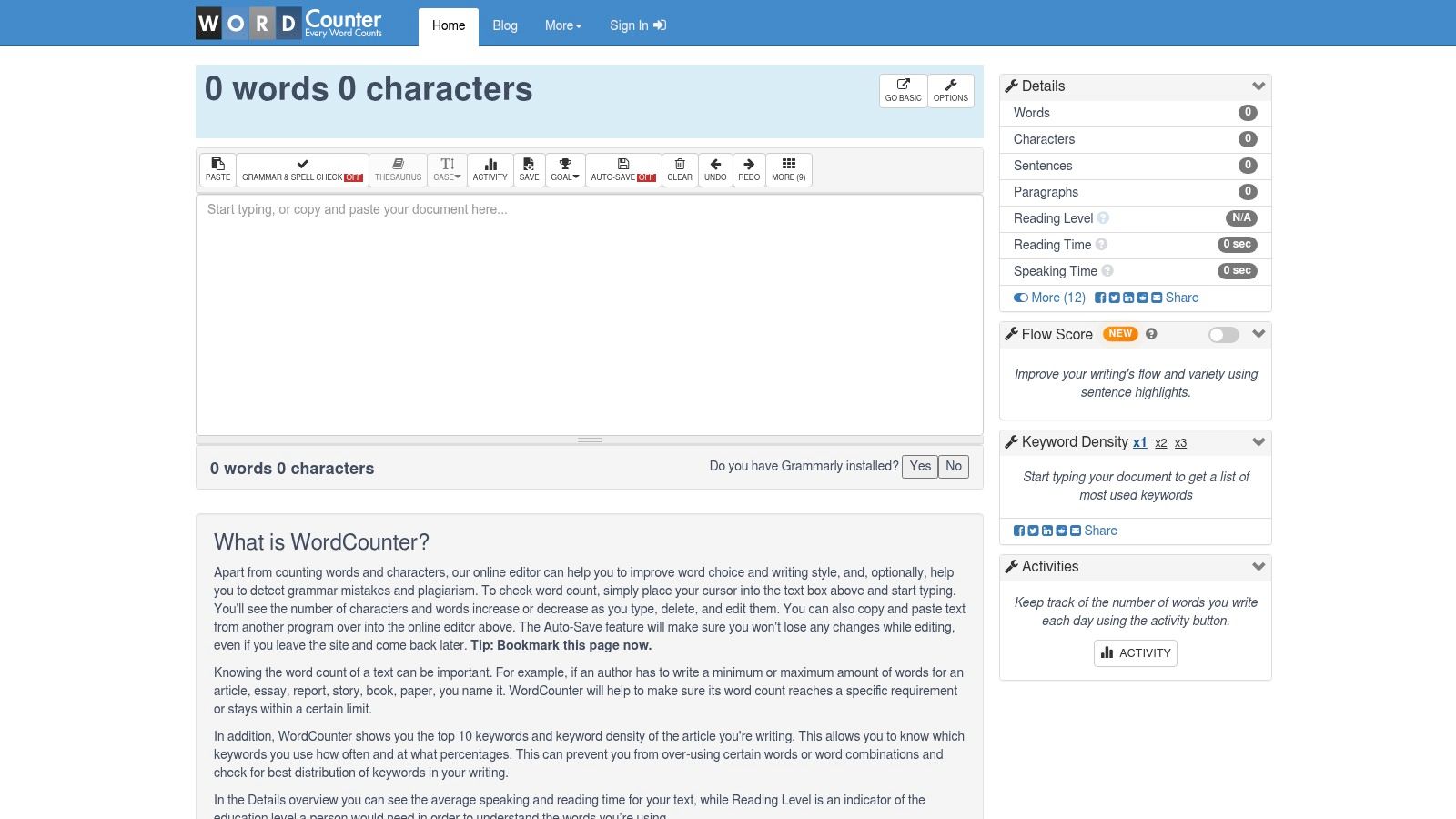
- 5. WordCounter with Clean Text
- 6. Formatter.org Text Formatter
- 7. Unicode Text Cleaner by UnicodeNow
- 8. Textidy Invisible Character Remover
- 9. Text Format Tool
- 10. RealUtil Text Tools
- Top 10 Online Text Formatter Comparison
- Choose the Smallest Tool That Works
1. Simple Unmark
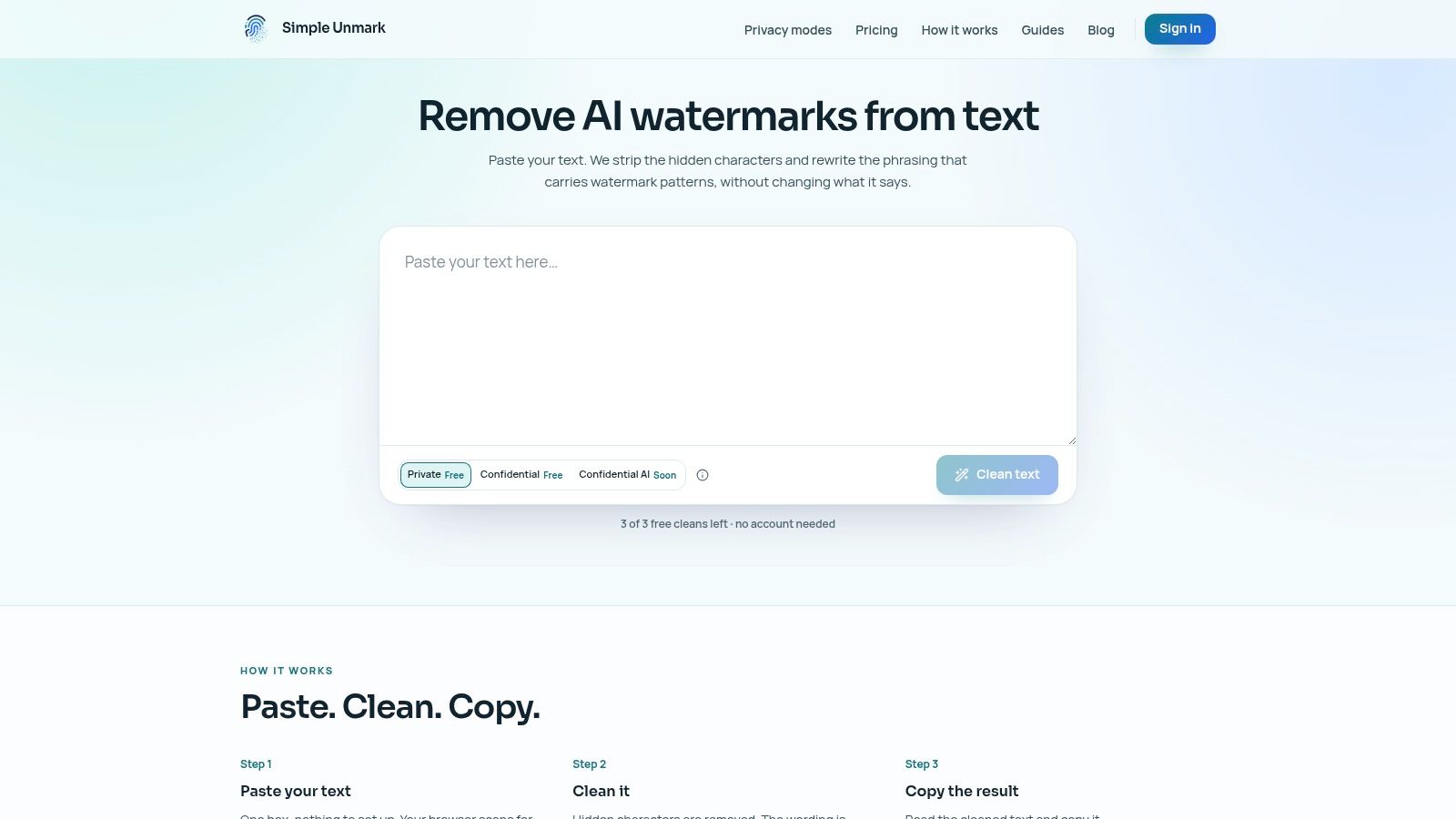
AI-generated copy can look clean while still containing invisible Unicode marks, awkward phrasing, or both. Simple Unmark targets these two cleanup problems in one workflow. Paste the text, run the cleanup, review the rewritten passage, then copy the result. That is more practical than moving between a general formatter and a separate rewriting tool.
Its Unicode scan removes zero-width marks, directionality controls, and unusual spacing. These characters may not show on screen, yet they can affect search, rendering, moderation, code, and publishing systems. TextPurify's invisible-character reference documents zero-width characters, format controls, bidirectional controls, tag characters, and variation selectors, and explains why local browser removal can be useful for privacy.
The rewrite handles a separate issue. Statistical watermarking is not the same as a font choice, file property, or hidden character. Google's SynthID documentation describes text watermarking as part of AI safety work. The Nature paper on SynthID-Text explains how Tournament sampling biases token generation during creation. Simple Unmark therefore changes wording rather than merely swapping visible formatting or superficial tokens.
Review every rewrite against the source. Meaning-preserving edits can change emphasis or phrasing, and no tool guarantees a particular detector result. The 2025 study reports that meaning-preserving edits can reduce SynthID-Text detectability, but those findings do not make detector outcomes predictable.
What Simple Unmark does well
- Combines cleanup tasks: Each run includes Unicode cleanup and a wording rewrite.
- Retains editorial details: The service aims to preserve meaning, facts, numbers, proper nouns, tone, and intent.
- Handles substantial passages: A request can contain up to 5,000 words, with processing rounded to the next 100 words.
- Uses a simple credit model: You get three free cleans of up to 100 words without an account. New accounts include 10 starter credits, and usage costs 0.1 credit per started 100 words. Credits are one-time purchases and do not expire. The pricing page lists credits from $5.
- Provides targeted guidance: Dedicated pages cover Gemini and SynthID, ChatGPT, Claude, and standalone invisible-character removal.
Privacy and limitations
Private mode is the default. Simple Unmark says it does not store submitted text or results. Account records track usage counts and credit activity rather than the text itself. Rewriting is processed through the app and its AI provider, DeepInfra. A Confidential mode, designed to encrypt text and keep rewriting inside a protected environment, is listed as coming soon with registration available for interest.
Practical rule: Choose Simple Unmark when you need copy-safe text and a substantive rewrite together. Compare the output with the original before publication.
2. Online Text Formatter
For a quick paste with no login, Online Text Formatter is a practical choice. It handles everyday jobs such as changing case, trimming whitespace, and encoding or decoding HTML, Markdown, and BBCode. Use it when text needs basic normalization before moving into a CMS, email, forum, or editor.
Its strongest point is client-side processing. The listed transformations run in your browser, so the text is not sent to a server for those operations. That suits private drafts, internal notes, source snippets, and copied material that should remain on your device. Privacy still depends on the service and workflow you choose, so avoid pasting sensitive content without checking the tool's current behavior.
The interface keeps the process simple: paste the text, select a transformation, and copy the result. There is no project setup or account requirement, and the markup options are grouped in one place. That makes it useful when the same content moves between HTML, Markdown, and BBCode.
Where it stops
This is a lightweight formatter, not a document-production system. It is a poor fit for very large documents, batch processing, saved presets, or API automation. It also does not provide a per-character Unicode report, a line-level audit trail, or AI-assisted rewriting.
Choose it for case changes, whitespace cleanup, and markup conversion. Choose Simple Unmark when the problem includes hidden-character cleanup or a substantive rewrite, and use a more specialized cleaner when you need diagnosis rather than a direct transformation.
3. Text Mechanic
Text Mechanic is the right choice when the input is a list, dataset, or block of lines instead of polished prose. Its utilities remove or insert text, sort lines, delete duplicates, remove empty lines, and add prefixes or suffixes. Use it for editorial lists, keyword sets, URLs, IDs, and copied rows where line structure matters more than visual formatting.
The interface is utilitarian, with separate pages for separate operations. That creates extra clicks, but it also keeps each task clear. Select the needed utility, paste the text, run the change, and review the output before copying it elsewhere.
Text Mechanic handles repetitive line edits well. It can sort entries, remove repeated values, strip blank lines, or add the same text to every row without manual editing. It is also more practical than a prose formatter for long lists and logs, where paragraph-oriented tools provide little control.
The practical trade-off
The service focuses on direct transformations. It does not act as an AI editor, visual publishing tool, or Unicode inspection system, and it does not provide saved presets or a unified multi-step pipeline. If the cleanup requires several operations, run them one at a time and check the result after each pass.
Use Text Mechanic for line-level manipulation, deduplication, and repeated prefixes or suffixes. For broken paragraph spacing or hidden Unicode characters, choose a specialty cleaner such as Simple Unmark instead. General formatters are better for prose normalization, while Text Mechanic is more direct when every line represents a separate record.
If every line is a record, use a line tool. Do not force a prose formatter to handle list-processing work.
4. Online Text Tools by Browserling
Online Text Tools suits editors and developers who handle repeated, narrowly defined text cleanup. Its collection covers case conversion, line wrapping, line sorting or randomizing, find-and-replace, and other small transformations. The shared interface keeps recurring tasks familiar, so you can apply another operation without relearning the controls.
Choose it by cleanup problem. For reordered lists, changed separators, wrapped lines, or quick substitutions, the separate utilities are direct and easy to review. They also cover unusual one-off jobs that would take longer to fix manually. Run one transformation, inspect the preview, then copy the result into the working document.
The trade-off is a fragmented workflow. Each page handles one operation, and the collection does not diagnose the document as a whole. Discovery can also take time if you do not know the operation's name. It will not explain invisible Unicode characters, determine whether an AI watermark affects text, or preserve meaning through a rewrite.
Best fit
Use Browserling's collection for many small, repeatable text operations, especially when line order, separators, or casing are the problem. It works well as a utility shelf for technical writers, editors, and developers.
Choose a specialty cleaner such as Simple Unmark when copied text has broken spacing or hidden characters that need focused cleanup. Use Browserling when you already know the transformation required, and avoid it when diagnosis or a single multi-step document workflow matters more than breadth.
5. WordCounter with Clean Text
WordCounter fits drafts where counting plus light cleanup happen in one session. Its editor shows word and character counts, reading time, case conversion, and a Clean Text function for broken wrapping, stray newlines, and invalid characters. That combination suits students, writers, and content teams working under length limits.
A practical workflow is simple: paste the draft, check its counts, run Clean Text, then keep editing on the same screen. You can immediately see whether cleanup changed the passage enough to affect a word limit, without moving between a formatter and a separate counter.
This tool earns its place with copied AI output and PDF text whose visible problems are awkward line breaks or scattered newlines. Clean Text can restore readable paragraphs faster than manual repair. It does not provide the character-level evidence needed to identify exactly which Unicode character disappeared or where it occurred.
Choose it for combined editing
WordCounter sits between a general formatter and a specialist cleaner. It gives you a compact editing workflow, but fewer diagnostic controls than a Unicode-focused tool such as Simple Unmark. Use Simple Unmark when hidden characters require investigation, rather than treating a clean-looking result as proof that every character is safe.
Privacy also matters. Avoid pasting confidential drafts unless the service fits your organization's handling requirements. For ordinary material, use WordCounter when length checking is part of the job. If hidden characters could affect search, code, or moderation, switch to a Unicode-aware cleaner. For substantive AI rewriting, use a dedicated rewriting workflow instead.
6. Formatter.org Text Formatter
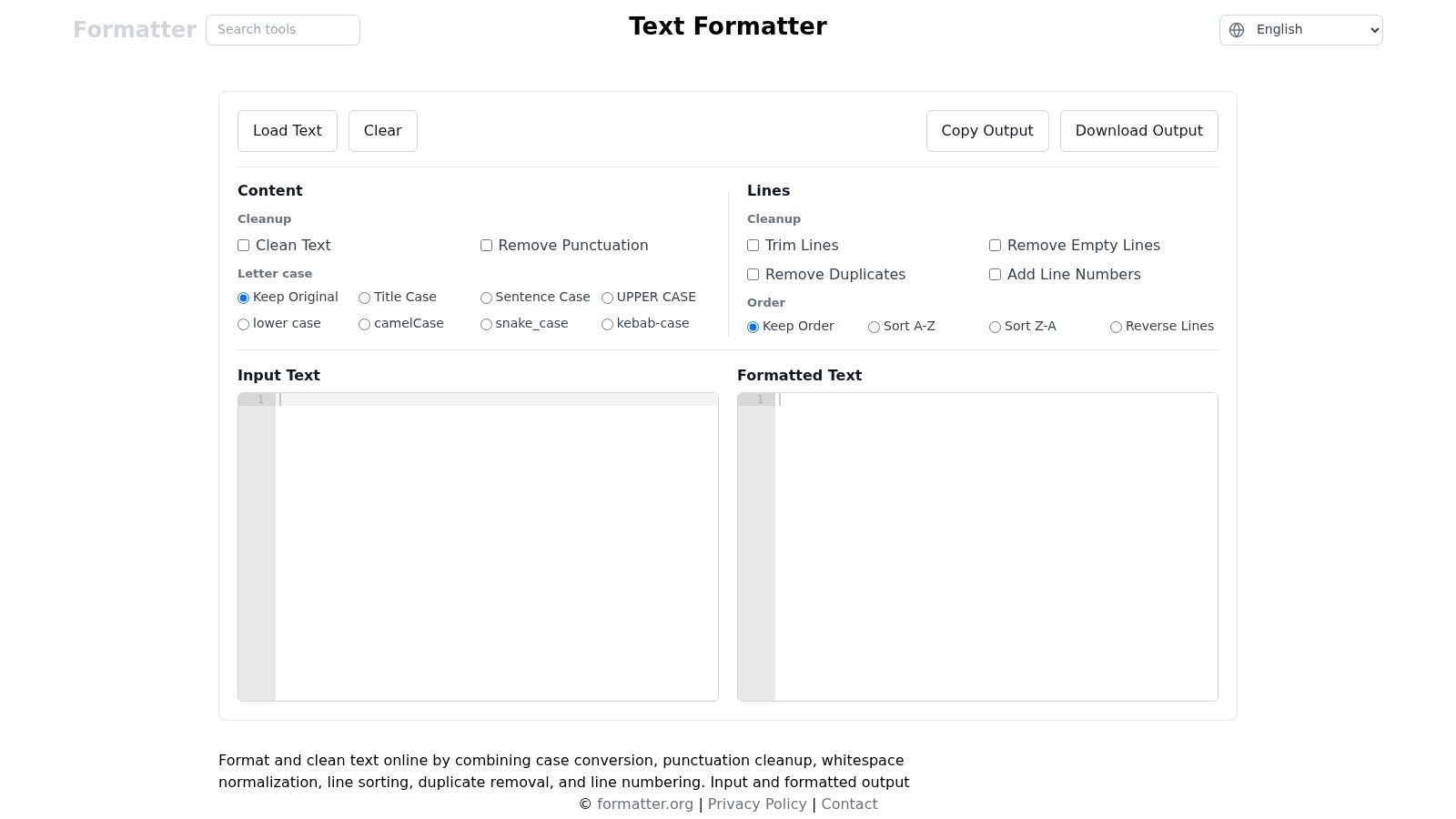
Formatter.org's Text Formatter suits ordinary text and lists that need several cleanup passes in one place. It can change case, normalize whitespace, clean punctuation, sort lines, remove duplicates, and add line numbers. Use it when a draft must be prepared for an editorial system or a list-based workflow without switching among separate utilities.
The one-page layout keeps the workflow compact. Paste the text, apply the needed operations, and inspect the output before copying it. This is faster than opening separate pages for case conversion, sorting, and deduplication, especially when the cleanup sequence is predictable.
The trade-off is limited explanation. Formatter.org shows the cleaned result, but it does not provide detailed per-character reporting, an API, or team integrations for repeatable processing. It cannot give you a defensible record of which characters changed. For suspicious Unicode, PDF extraction problems, or multilingual text that still behaves oddly, move to a specialist cleaner such as Simple Unmark.
Use it for routine multi-step cleanup
Choose it for multi-step cleanup on ordinary text and lists. It covers spacing, punctuation, case, ordering, duplicates, and numbering with little setup.
Do not treat a visually clean result as proof that hidden characters or directional controls were identified. For confidential drafts, check the service's handling requirements before pasting. For routine editorial preparation, Formatter.org is practical. For investigation or repeatable team processing, choose a tool with character-level reporting or integration support.
7. Unicode Text Cleaner by UnicodeNow
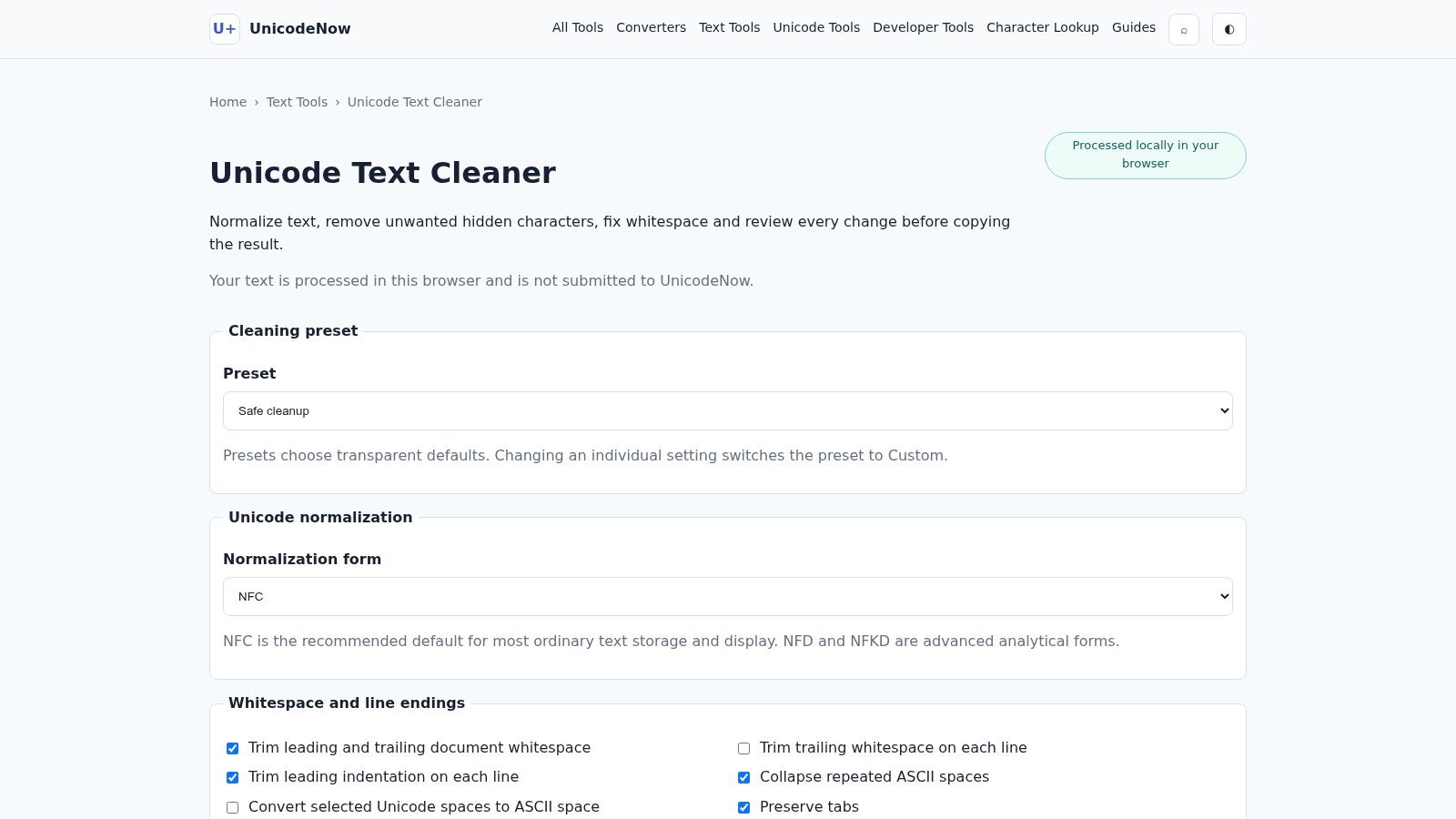
UnicodeNow's Unicode Text Cleaner suits text that looks normal but contains inconsistent or hidden Unicode. It can remove selected control and hidden characters, normalize representations and line endings, and create a transformation report. That record is more useful for editorial QA, compliance checks, and debugging than a formatter that only displays the input and output.
A zero-width-space filter will not cover every case. Invisible-character checks may need to examine zero-width joiners and non-joiners, byte-order marks, bidirectional overrides, non-breaking spaces, tag characters, and homoglyph substitutions. These characters can interfere with parsing, moderation, search, or copied text. Countflows' invisible-character detector records each character's code point, Unicode name, count, and position, making it suitable for investigating a suspicious paste.
UnicodeNow's main advantage is traceability. Its report shows what changed, so you can review the cleanup instead of trusting a visually improved result. The limit is scope. It is not a general layout formatter, AI rewriting tool, or batch workspace for unrelated transformations.
Use it before publishing or debugging
Choose UnicodeNow when text copied from an AI tool, PDF, word processor, or multilingual source behaves incorrectly downstream. If the question is whether hidden Unicode differs from statistical watermarking, read Simple Unmark's guide to hidden Unicode versus statistical watermarks. These require separate checks, so use a specialty cleaner for character analysis and a different workflow for rewriting concerns.
8. Textidy Invisible Character Remover
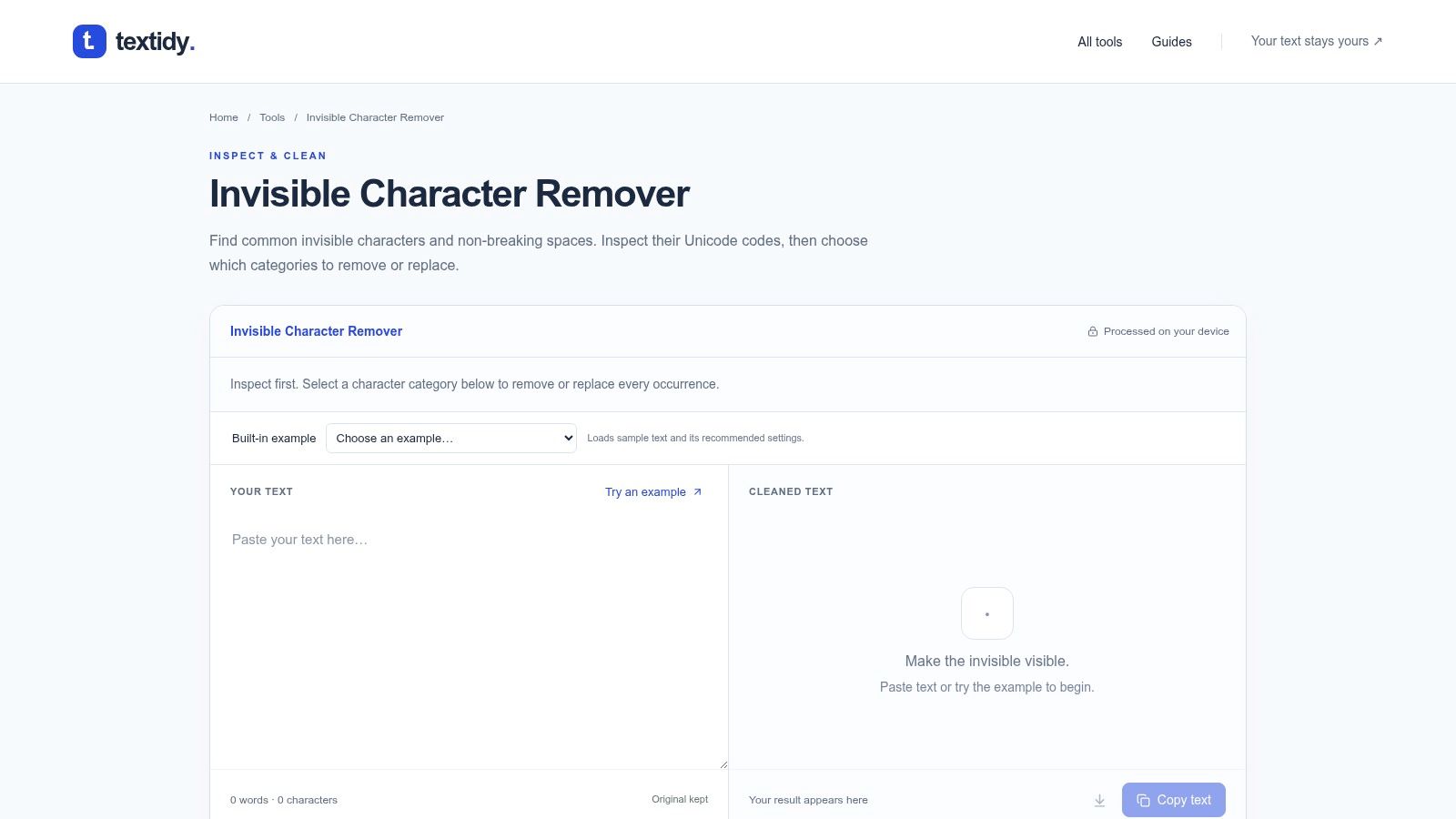
Copied text can look normal and still break sorting, code blocks, or spacing. Textidy's Invisible Character Remover targets that specific problem by detecting and removing invisible characters by category, including non-breaking spaces and zero-width marks. Because it runs in the browser, the workflow stays simple: paste the text, inspect the categories, remove the unwanted characters, then copy the result.
Textidy includes live examples and test cases, which make its controls easier to use correctly. Invisible characters are difficult to identify through visual inspection alone. Seeing how a non-breaking space or zero-width mark behaves helps you select the right cleanup instead of stripping every hidden character without checking its purpose.
The trade-off is narrow scope. Textidy does not count words, rewrite sentences, convert JSON, or provide broad editorial formatting. It also lacks batch and file modes, so it suits one-off inspection and cleanup rather than recurring production work.
Choose category-level cleanup
Use Textidy when the problem is invisible-character contamination and you need selective removal. That control matters for specialized scripts or technical text where some hidden characters may be meaningful.
If the text also needs statistical watermark analysis or wording changes, use a separate workflow. Simple Unmark's AI watermark remover is intended for that specialty task. A character cleaner removes hidden artifacts, while a watermark-focused tool addresses a different type of signal.
9. Text Format Tool
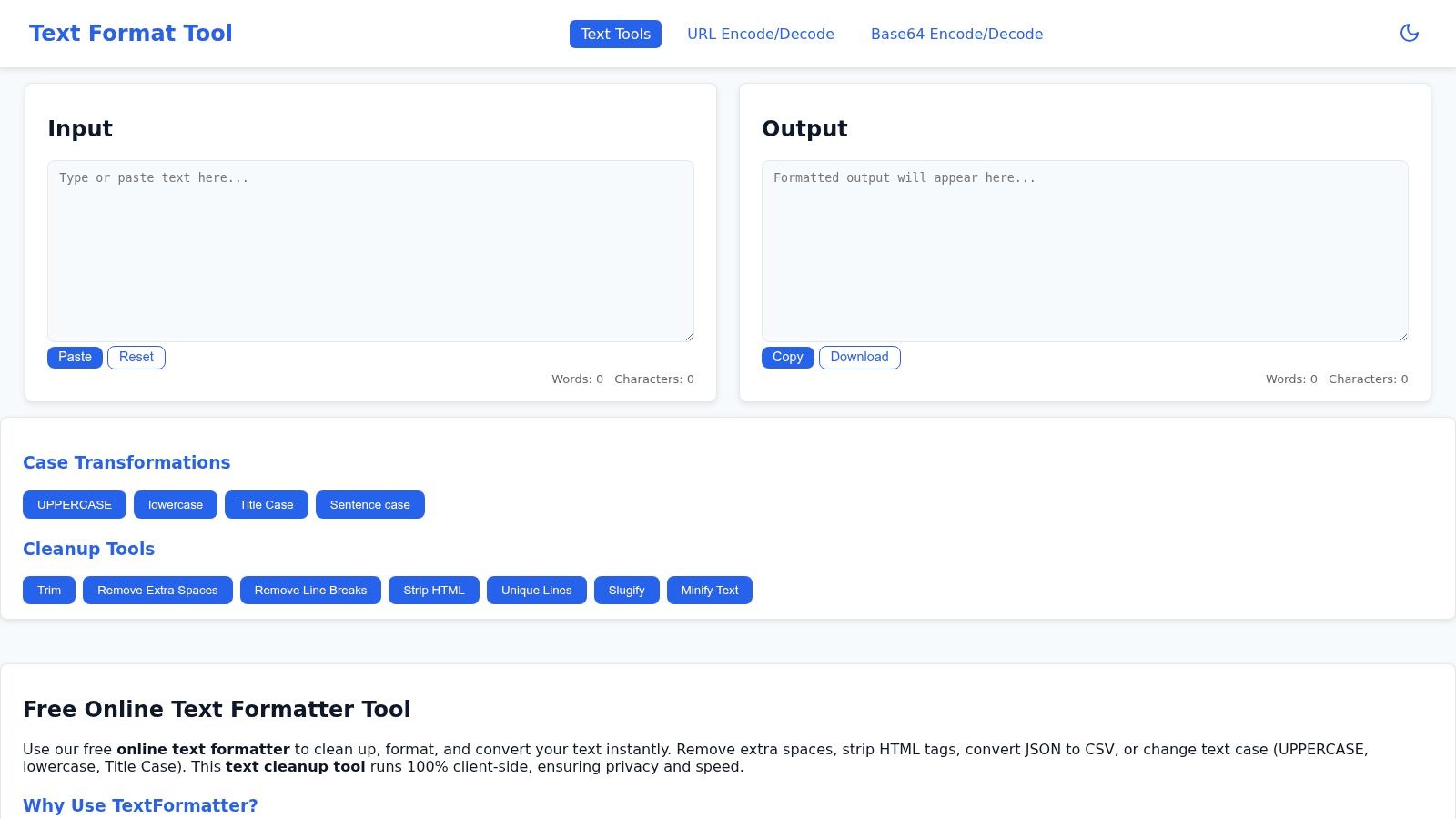
Text Format Tool is a practical generalist for editors who need prose cleanup and light data conversion on one page. It handles whitespace cleanup, HTML tag removal, case conversion, list utilities, and transformations such as JSON to CSV. That combination suits a workflow that starts with copy and ends with a spreadsheet or content system.
The interface keeps common jobs straightforward. You can remove extra spaces, strip markup, or convert a simple data block without configuring a complex sequence of tools. Its main advantage is accessibility, especially for occasional cleanup.
The limitation is transparency. The service returns the transformed text without explaining each change or providing a per-character report. Its tool range is also narrower than larger multi-tool suites, so unusual formatting problems may require a second service. Privacy should still guide the workflow: avoid pasting confidential material into any browser-based tool unless its handling practices meet your requirements.
A sensible generalist
Choose Text Format Tool for one approachable page for prose cleanup and light data conversion. It is a poor fit for forensic Unicode inspection, long batch workflows, or AI-assisted rewriting.
If the AI question is central, read Simple Unmark's guide to removing AI watermarks from text. Formatting, HTML stripping, and file conversion change presentation. They do not automatically change the word-choice patterns that statistical watermark systems may analyze.
10. RealUtil Text Tools
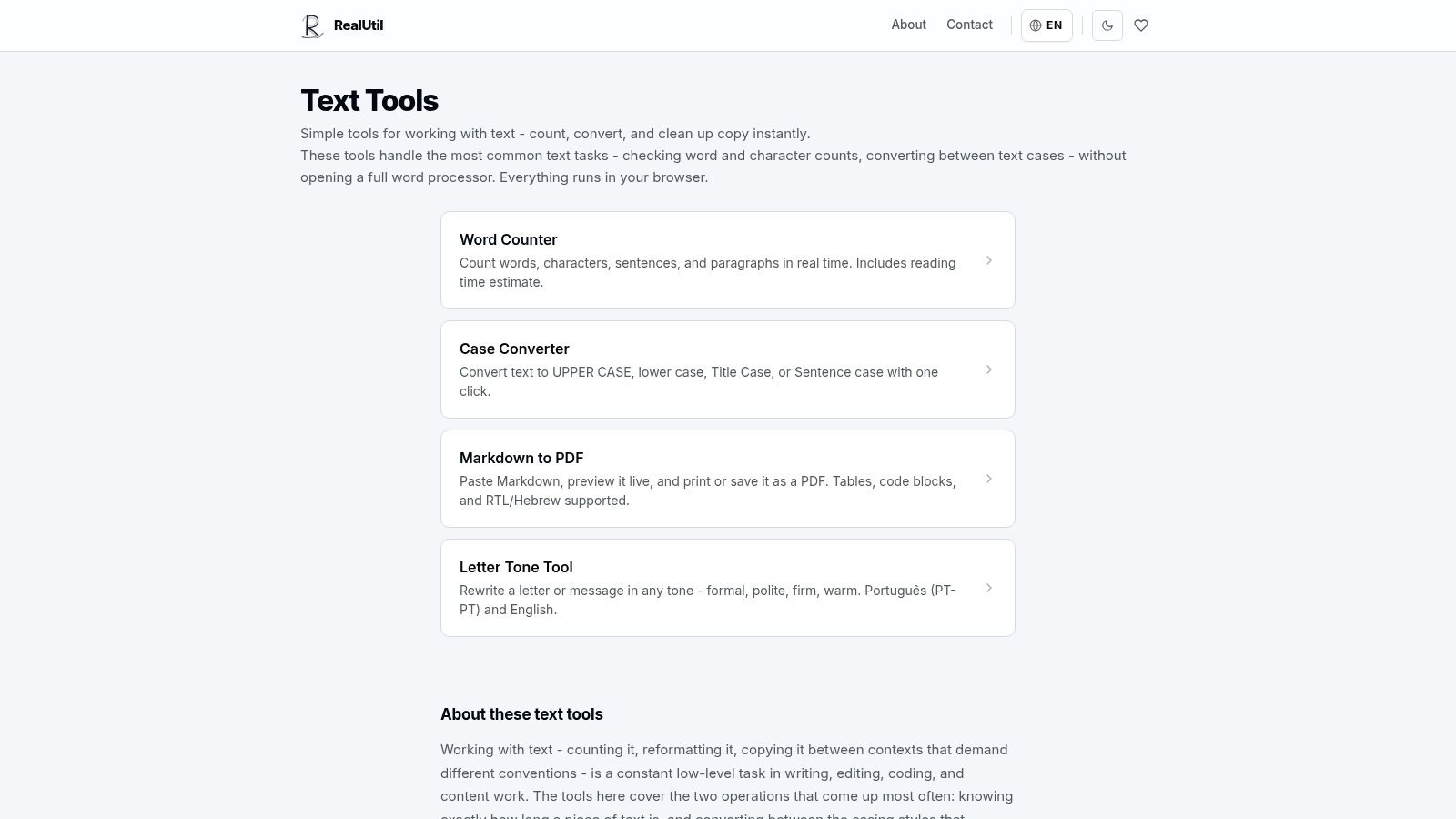
Use RealUtil's text tools when the cleanup job is limited to counting or case conversion. It provides word, character, sentence, and paragraph counts, plus title-case and sentence-case conversion. The pages load quickly and keep attention on the immediate edit.
A practical workflow starts with a short excerpt, heading, or metadata field. Paste the text, check its basic counts, change the case if needed, and copy the result. RealUtil suits a quick editorial check before publishing or a final pass after formatting elsewhere.
Its limits are clear. It does not provide advanced Unicode diagnostics, a detailed transformation report, or an AI cleanup workflow. Text containing hidden controls or unusual spacing may appear normal while the underlying characters remain unchanged. For that problem, a specialty cleaner such as Simple Unmark is a better choice than a general formatter.
The simple recommendation
Choose RealUtil for counting and basic case conversion. Use WordCounter when drafting and cleanup belong in one editor, Text Mechanic for line operations, and UnicodeNow when you need character-level evidence. RealUtil's advantage is speed and focus, not diagnostic depth.
Top 10 Online Text Formatter Comparison
| Tool | Core features | Unique selling point ✨ | Quality ★ | Price / Value 💰 | Target 👥 |
|---|---|---|---|---|---|
| 🏆 Simple Unmark | AI watermark rewrite, SynthID/ChatGPT/Claude cleaners, invisible‑char remover, up to 5,000w/run | Rewrites to reduce statistical watermarks + automatic Unicode cleanup | ★★★★★ | 💰 Pay‑as‑you‑go (0.1 cr / started 100w); starter 10 cr; credits never expire | 👥 Writers, editors, researchers, students, teams |
| Online Text Formatter | Case/whitespace, encode/decode, client‑side only | Quick, private in‑browser transforms | ★★★★ | 💰 Free, no server upload | 👥 Quick one‑off editors, privacy‑minded users |
| Text Mechanic | Dozens of line/list utilities (dedupe, sort, insert/delete) | Rich list/line operations at scale | ★★★★ | 💰 Free, browser‑based | 👥 Data editors, log processors, power users |
| Online Text Tools (Browserling) | Hundreds of micro‑tools, consistent UI, instant preview | Very wide coverage with predictable interface | ★★★★ | 💰 Free, large toolset | 👥 Frequent editors, repeat workflows |
| WordCounter (with Clean Text) | Live counts, Clean Text for wrapping/newlines | Combine drafting + cleanup in one editor | ★★★ | 💰 Free, in‑browser | 👥 Students, content teams, casual writers |
| Formatter.org – Text Formatter | One‑page multi‑ops: sort, dedupe, normalize | Efficient multi‑step cleanups on one page | ★★★★ | 💰 Free | 👥 Editors prepping lists or copy |
| Unicode Text Cleaner (UnicodeNow) | Remove zero‑width/control chars, normalization, reports | Detailed Unicode diagnostics & transformation reports | ★★★★ | 💰 Free / freemium | 👥 Compliance, editorial QA, devs |
| Textidy – Invisible Character Remover | Detect/remove invisible chars by category, live examples | Fine‑grained invisible‑char control in‑browser | ★★★ | 💰 Free | 👥 Developers, copy/paste troubleshooting |
| Text Format Tool | Case, HTML tag strip, JSON↔CSV, whitespace cleanup | Bridges prose cleanup and light data transforms | ★★★ | 💰 Free | 👥 Editors who handle occasional data tasks |
| RealUtil – Text Tools | Word/char/sentence counts, case conversion | Minimal, fast counters and simple formatting | ★★★ | 💰 Free | 👥 Quick checks, lightweight edits |
Choose the Smallest Tool That Works
Don't choose a text formatter online because it has the longest tool list. Choose it because it solves the actual failure in front of you.
For trimming, case changes, markup conversion, and straightforward spacing, start with Online Text Formatter or RealUtil. Both suit short, uncomplicated jobs where you want a quick result without a heavy workflow. Use WordCounter when word and character counts matter during cleanup, especially for drafts that need editing in the same window.
For sorting, deduplication, prefixes, suffixes, blank-line removal, or other line-based operations, choose Text Mechanic or Formatter.org. Browserling's Online Text Tools is the better utility shelf when you perform many small transformations and want a consistent interface. Choose Text Format Tool when the job crosses from prose cleanup into simple JSON, CSV, or HTML handling.
Use UnicodeNow or Textidy when the text looks normal but behaves incorrectly. Hidden characters can enter through AI output, word processors, PDFs, and copy-paste workflows. Unicode's documentation notes that invisible format controls may affect text handling without changing what readers see, so visual inspection isn't enough for technical or multilingual content. A reporting-oriented cleaner is the better choice when you need to understand what changed and where.
Choose Simple Unmark when AI-generated text needs both Unicode cleanup and rewriting-based reduction of statistical watermark signals. It removes hidden artifacts automatically, rewrites wording while aiming to preserve meaning and key details, supports passages up to 5,000 words, and uses credits rather than a subscription. The privacy trade-off is clear: Private mode doesn't store submitted text or results, but the rewrite is processed through the app and DeepInfra. Confidential encrypted processing isn't available yet.
Use a disciplined workflow every time: paste, inspect, clean, compare, then copy. Compare any rewritten output with the original for facts, numbers, proper nouns, tone, and intent. Formatting cleanup and statistical watermark reduction are different operations, and detector outcomes can't be guaranteed by any tool.
Simple Unmark combines automatic invisible-character removal with rewriting designed to reduce statistical watermark signals, while keeping the workflow to paste, clean, review, and copy. If your AI-assisted draft contains hidden Unicode artifacts or needs more than superficial formatting changes, visit Simple Unmark and run a passage through the cleaner before you publish or reuse it.
- text formatter online
- text cleaning tools
- Unicode cleaner
- AI text cleanup
- online text tools
More posts
Invisible Numbers Explained and How to Remove Them
Learn what invisible numbers and hidden Unicode characters are, how they watermark text, and how to detect and remove invisible numbers safely.

AI Text Humanizer Explained and How to Use It Right
Learn what an AI text humanizer does, how rewriting and Unicode cleanup reduce watermark signals, and how to humanize AI text without losing meaning.
Word Count Limit Rules at Simple Unmark
Simple Unmark word count limit rules explained. Up to 5,000 words per clean, 0.1 credit per started 100 words, rounded to the next 100.