
How to Use Watermark Tools and Reduce AI Signals
Learn how to use watermark tools to detect, clean, and reduce AI text watermarks like SynthID while keeping meaning intact.

You've pasted a Gemini, Claude, or ChatGPT draft into a client document, publishing system, academic submission, or content marketplace. The wording looks fine, but a platform may still flag it because the model left a statistical pattern in its token choices. Removing strange spacing or swapping a few obvious words won't reliably fix that.
The practical answer is to detect what kind of signal you're dealing with, rewrite the statistical surface without changing the substance, and review every factual detail before publication. This guide shows how to use watermark tools responsibly, with a hands-on workflow for reducing AI watermark signals in text you're authorised to reuse.
Table of Contents
- Why Watermarked AI Text Is a Real Problem
- How Modern Text Watermarks Actually Work
- Running a Watermark Cleanup in Simple Unmark
- Rewriting Versus Surface Edits for Watermark Reduction
- Keeping Meaning, Facts, and Tone Intact
- What Detectors Can and Cannot Catch
- Practical Checklist Before You Publish Cleaned Text
Why Watermarked AI Text Is a Real Problem
Text watermarks create a provenance problem because they can exist inside the model's word-selection process rather than in visible formatting. Google DeepMind's SynthID-Text was published in Nature in October 2024 and described as the first production-scale deployment of generative text watermarking. The system had already been used with Gemini and Gemini Advanced outputs at consumer scale, and a trial involving nearly 20 million watermarked and unwatermarked responses found no statistically significant difference in perceived quality. The SynthID-Text paper in Nature establishes why this matters: watermarking can operate in a live, high-volume language-model product.
That creates real friction for writers, editors, researchers, and compliance teams. A client deliverable can trigger a platform review. A submitted assignment can raise a provenance question. Marketing copy can be rejected by a marketplace that scores text automatically. The reader may see ordinary prose while a detector sees an unusual sequence of token choices.
The visible problem is usually the small one
Invisible characters still matter. Unicode includes non-printing characters such as U+200B ZERO WIDTH SPACE, which can create word-break opportunities, along with U+200C, U+200D, U+2060, and U+FEFF. These artifacts can interfere with copying, searching, text comparison, and downstream processing, but they're only one layer of cleanup. This Unicode inspector reference documents the characters commonly found in pasted text.
The harder signal sits in the wording itself. A watermark can bias token probabilities while keeping the result natural to readers, so cosmetic cleanup doesn't address the underlying distribution.
Practical rule: If the watermark lives in token selection, removing characters won't remove the signal. You need a controlled rewrite.
That's why a few synonym swaps, punctuation changes, or invisible-character tricks are weak solutions. To reduce a probabilistic watermark, you must change enough vocabulary, syntax, and token sequence to disrupt the pattern while protecting the text's meaning.
How Modern Text Watermarks Actually Work
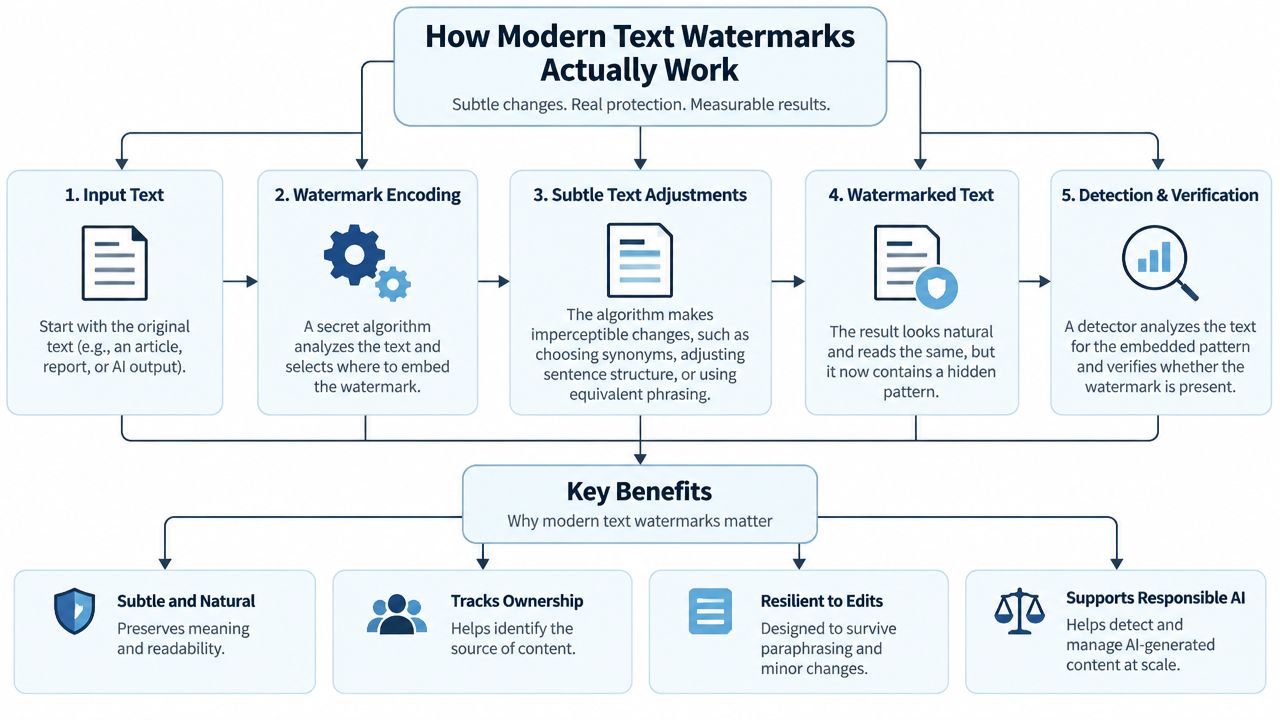
A modern text watermark generally operates during generation. Large language models produce text one token at a time, assigning probability scores to candidate tokens. A watermark adjusts those scores so the model favours a statistically selected subset of tokens, while keeping the output readable. Google DeepMind describes this probability-shaping approach in its SynthID technical overview.
The result isn't a hidden string inserted after generation. SynthID-Text works by shaping token choice, and detection aggregates a score across a text block. Removing the signal therefore usually requires rewriting the passage rather than stripping characters. An independent technical analysis also describes the process as sequence-dependent, with token scores influenced by preceding tokens, which explains why superficial edits can leave part of the pattern intact. This analysis of AI text watermarks is useful background for understanding that distinction.
Why token entropy changes the result
Detectors shouldn't treat every token equally. The ACL 2024 EWD method assigns greater weight to higher-entropy tokens and reports improved detection performance in low-entropy scenarios. That finding matters because templated language, deterministic phrasing, and short passages can weaken the usable watermark signal even when a watermark is present. The EWD research paper explains the role of entropy-aware scoring and the limits of uniform token weighting.
Common red-green-list detectors replay a token partition, count selected tokens, and compare the result with a null expectation. Heavy editing, paraphrasing, reordering, translation, or cross-lingual transformation can break token alignment and increase false negatives. For provenance work, preserve the exact sequence. For authorised reuse where you need to reduce the signal, rewrite the sequence itself.
Readers who need broader context on AI-generated identity and provenance can also consult this ChatGPT and AI identity guide. The practical workflow is documented in this guide to how AI text watermarks work.
Running a Watermark Cleanup in Simple Unmark
Start with the original draft, not a version that has already passed through several uncontrolled paraphrasers. Keep the source open in another window so you can compare the cleaned output against the material you're allowed to reuse.
Follow the paste, clean, copy workflow
Paste the draft: Put the text into the input panel. Multi-paragraph text is supported up to the documented word limit, and longer material can be handled in chunks. Don't paste a whole document blindly if it contains tables, citations, or formatting that must remain exact.
Choose the intensity: Use Low for a draft that has already received meaningful human editing. Use Aggressive for raw model output with little or no rewriting. The choice should reflect how much of the original wording remains, not how worried you are about a particular detector.
Run the cleaner: The rewrite changes sentence structure, transitions, vocabulary, and token choices to reduce the original statistical pattern. It also removes hidden Unicode artifacts as part of the cleanup. The purpose is to preserve meaning, facts, numbers, proper nouns, tone, and intent while changing the wording surface.
Inspect the result: Use the side-by-side diff view. Check every changed sentence, especially technical definitions, product names, legal language, citations, and numerical statements. If the prose sounds awkward, retry with a different intensity rather than accepting a bad rewrite.
Copy only after review: Once the output matches the source in substance and reads naturally, copy the cleaned version into your working document. Accounts on limited plans should also check credit usage before repeating a run.

A rewrite-based cleaner is more useful than a character scrubber because the core problem isn't only hidden formatting. Simple Unmark's AI watermark remover is designed around that paste, rewrite, compare, and copy workflow. Treat it as an editing aid, not as a permission system or a guarantee that a detector will return a particular result.
Rewriting Versus Surface Edits for Watermark Reduction
Surface edits change the appearance of text without changing enough of its statistical structure. Replacing “important” with “significant” may alter one token, but the surrounding choices, clause order, sentence rhythm, and sequence-dependent relationships can remain almost identical. Inserting zero-width spaces is even weaker because those characters don't replace the biased word choices that a detector scores.
Deep rewriting takes a different route. It changes how the sentence is built, selects different vocabulary, moves clauses, varies transitions, and sometimes splits or combines sentences. That gives the detector a new token sequence to evaluate while preserving the actual claim.
Consider a generic sentence such as:
The report provides a detailed overview of the system and explains how users can improve their workflow.
A surface edit might become:
The report offers a thorough overview of the system and shows how users can enhance their workflow.
That version changes synonyms, but its structure is nearly untouched. A structural rewrite might say:
Users can improve their workflow by following the system guidance outlined in the report.
The second version changes the clause order and grammatical shape. It still needs a factual review, but it disrupts more of the original sequence.
| Factor | Surface Edits, synonyms, ZWSP | Deep Rewriting |
|---|---|---|
| Vocabulary | Changes a small number of words | Reconsiders word selection across the passage |
| Syntax | Usually preserves sentence structure | Rearranges clauses and sentence construction |
| Hidden characters | May remove visible processing artifacts | Removes artifacts while changing the wording pattern |
| Watermark signal | Can leave much of the original distribution intact | More directly disrupts sequence-dependent token choices |
| Main risk | False confidence after cosmetic cleanup | Meaning, tone, or factual drift if review is skipped |
| Best use | Formatting hygiene and minor edits | Reducing a probabilistic watermark signal |
Paraphrasing isn't automatically deep rewriting. A weak paraphraser can preserve the same cadence and information order while making the prose worse. The standard should be simple: change the statistical surface, then verify the substance line by line.
Keeping Meaning, Facts, and Tone Intact
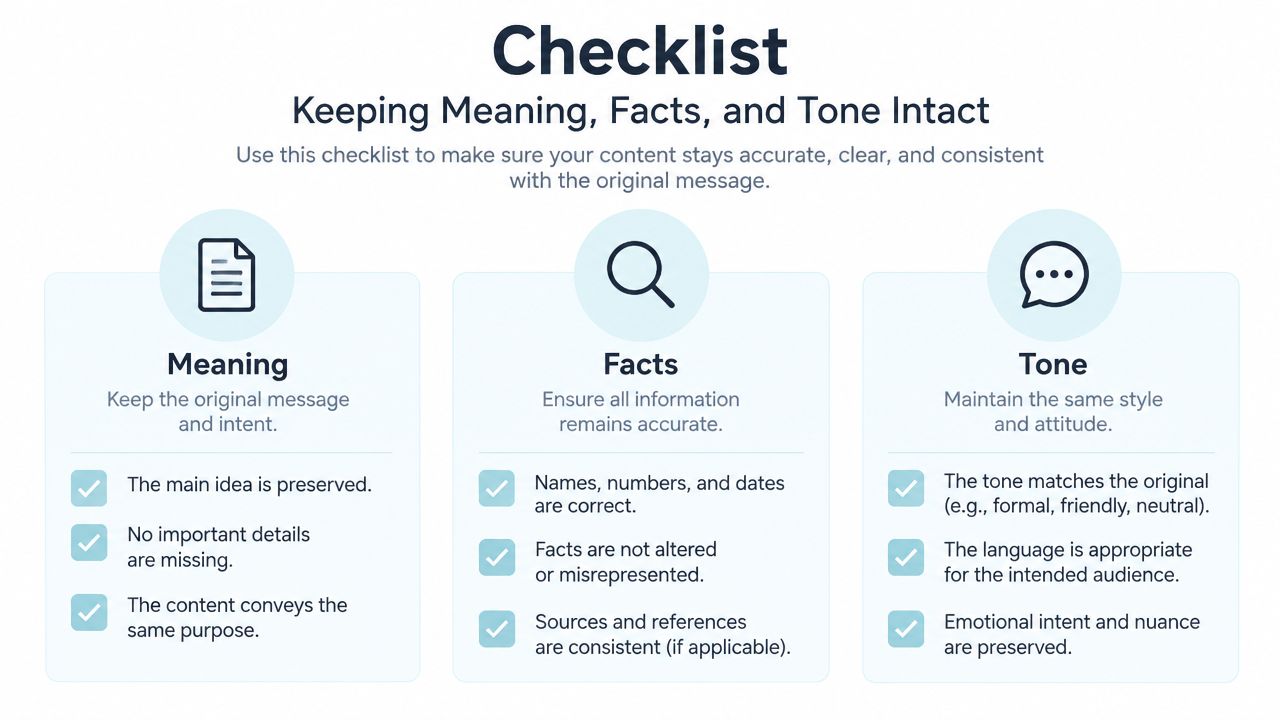
A clean detector result is worthless if the text no longer says what the source said. Watermark cleanup should be treated as a controlled editorial pass, not an invitation to let a tool improvise.
Before running the rewrite, mark the elements that must survive exactly:
- Proper nouns: Keep people, organisations, products, places, and named systems unchanged unless the source itself contains an error you're authorised to correct.
- Numbers and dates: Compare every figure and date against the original source after cleaning. A changed number is a red flag, especially in technical, financial, academic, or legal material.
- URLs and citations: Preserve links, references, identifiers, and citation text. Don't let a stylistic rewrite turn a precise reference into a vague summary.
- Direct quotations: Keep quoted language verbatim when quotation accuracy matters. Rewritten wording isn't a quotation anymore.
- Tone and reading level: Match the original audience. Tone comes from sentence length, vocabulary, formality, and rhythm, not from forcing casual words into professional copy.
Use the comparison view as an audit tool
Keep the original and cleaned versions side by side. Read for omissions first, then additions, then changed implications. If a sentence now makes a stronger claim, sounds more certain, or assigns responsibility differently, revert it or rewrite it manually.
Don't waste limited credits on trivial fragments that a human can edit safely. Longer passages benefit more from a coherent pass, but process them in manageable sections when the input exceeds the tool's supported limit. If a result reads awkwardly, adjust the intensity rather than stacking random paraphrases.
Editorial rule: If a fact changed, the cleanup failed, regardless of how natural the paragraph sounds.
For client work, save the original, the cleaned version, and your final human-edited copy. That record protects the content process and makes later fact checking possible.
What Detectors Can and Cannot Catch
AI detectors don't deliver certainty. They score patterns and estimate whether a passage resembles a watermarked or machine-generated distribution. Entropy-aware methods give more weight to informative token choices, while longer passages provide more material for a statistical pattern to emerge.
Short fragments often produce unclear results because there isn't enough text to establish confidence. A long passage with only light edits can retain enough of the original token bias to produce a positive reading. The reverse is also true: a rewritten passage may avoid a particular detector's threshold without proving that no watermark remains.
This is why detector output should be treated as one signal, not a verdict. A positive result doesn't prove authorship, and a clean result doesn't certify human authorship or guarantee that another detector will agree.
Use detection as a review signal
Run checks only after the text has been fact checked and manually reviewed. If the result is unclear, inspect the passage for repetitive syntax, formulaic transitions, and low-information phrasing before making another rewrite. If it's flagged, rewrite the structure rather than inserting invisible characters or swapping isolated synonyms.
The distinction between a watermark and a detector is important. A watermark is a generation-time statistical pattern. A detector is an inference system that tries to recognise patterns, and its reliability depends on text length, editing, token alignment, entropy, and the method used. This comparison of AI watermarks and AI detectors explains why the two concepts shouldn't be treated as interchangeable.
Your publishing decision should also account for disclosure rules, platform policies, academic requirements, licensing, and the actual origin of the draft. Reducing a signal doesn't remove those responsibilities.
Practical Checklist Before You Publish Cleaned Text
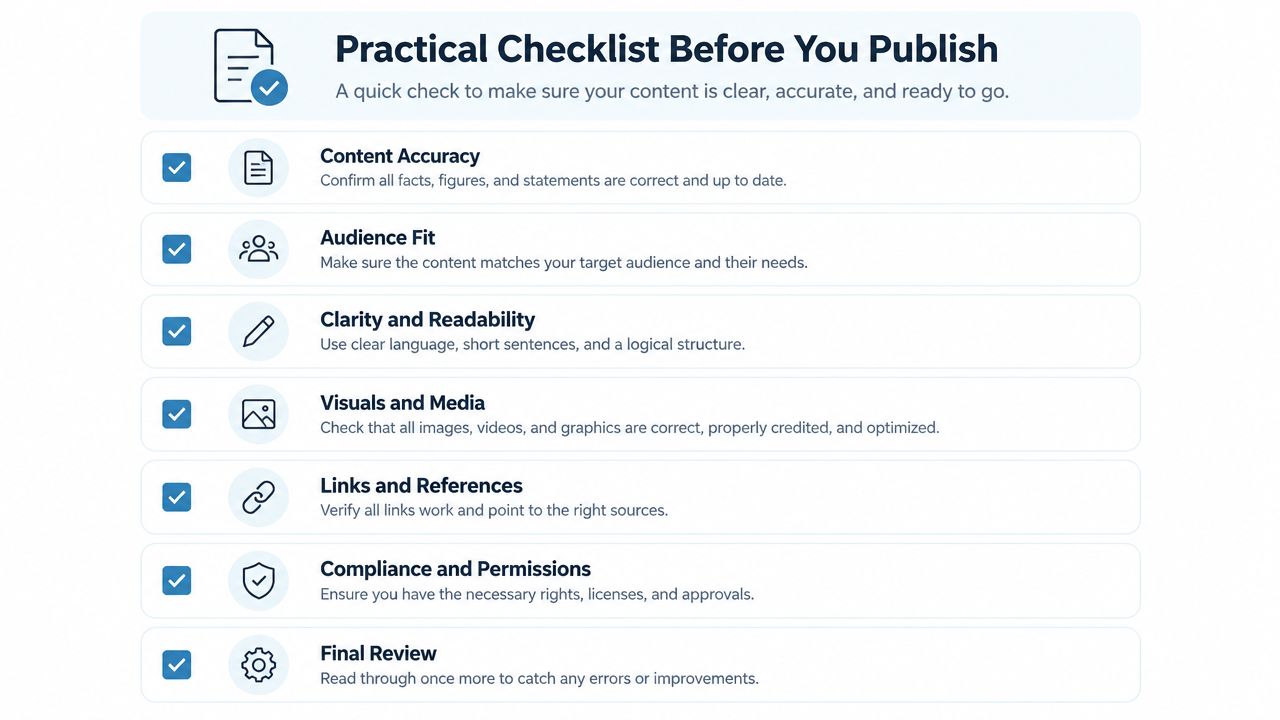
Before publishing cleaned text, review it as an editor, not as someone chasing a detector score. Use this checklist:
Read it aloud. Listen for stiff transitions, repeated sentence patterns, missing context, and sudden tone changes. Awkward rewrites are easier to hear than spot on screen.
Verify claims against source material. Confirm every factual statement against the original documents, references, product documentation, or approved brief. Cleaning text must not change what the source supports.
Check numbers and names character by character where accuracy matters. Compare dates, measurements, statistics, organisation and product names, URLs, and quoted language.
Treat detector flags as review prompts. If a passage is flagged, identify the structural problem before running another paraphrasing pass. Rewriting blindly to improve a score usually damages clarity and meaning.
Check the word allowance. Confirm that the passage fits the cleaner's request size and that another run will not use credits needed for the rest of the document. Simple Unmark processes up to 5,000 words per request, rounds usage to the next 100 words, and charges 0.1 credit per started 100 words. Review Its credit and word-count guidance before submitting a large document.
Save both versions. Keep the source draft beside the cleaned output. For client, academic, compliance, and legal work, preserve the review trail.
Publish only after a final human check. A reduced probabilistic signal does not guarantee a zero score across detectors. Accuracy, natural wording, licensing, attribution, and disclosure obligations still belong to the publisher.
Simple Unmark provides paste, rewrite, comparison, and copy functions for removing hidden Unicode artifacts and reducing probabilistic watermark signals in AI-generated text. Visit Simple Unmark to clean an authorised draft, compare the changes, and publish only after confirming that its facts and meaning remain intact.
- how to use watermark
- watermark removal
- AI text cleaner
- SynthID
- Simple Unmark
More posts
Invisible Numbers Explained and How to Remove Them
Learn what invisible numbers and hidden Unicode characters are, how they watermark text, and how to detect and remove invisible numbers safely.
AI Text Humanizer Explained and How to Use It Right
Learn what an AI text humanizer does, how rewriting and Unicode cleanup reduce watermark signals, and how to humanize AI text without losing meaning.
Word Count Limit Rules at Simple Unmark
Simple Unmark word count limit rules explained. Up to 5,000 words per clean, 0.1 credit per started 100 words, rounded to the next 100.