
Content Credentials Explained: What They Prove and Don't
Content Credentials explained: how C2PA provenance records are signed, why edits can strip them, and how to verify them before you trust a file.
If a photo carries a verified badge, does that mean the photo is true? That question points to the most common misunderstanding around Content Credentials. A credential can show a record hasn't been changed since signing, and it can name the signer behind that record. It can't judge whether the scene, caption, or claim inside the file is accurate.
Table of Contents
- What Content Credentials Are and Where They Came From
- The Parts of a Content Credential and What Each One Proves
- Why Credentials Survive Some Edits and Lose Others
- Reading a Credential Without Over-Trusting It
- Content Credentials and Text Watermarks Are Different Signals
- Where Content Credentials Appear and Who Adopts Them
- Set a Publishing Rule for Files With and Without Credentials
What Content Credentials Are and Where They Came From
A Content Credential is a signed record attached to a digital file that states where the file came from and how it was edited, so a viewer can check that record instead of guessing. It's best understood as provenance, meaning a documented history, rather than a guarantee about quality or truth. Readers, editors, and platforms still need to assess the content itself.
The Seal Analogy
A useful comparison is a tamper-evident seal on a parcel. An intact seal suggests the box wasn't opened unseen after packing, and the label can show who sent it. The seal doesn't confirm the items inside match the description, work properly, or were described accurately.
Core distinction: Content Credentials document who or what made changes and whether that record has been altered, while leaving the audience to judge the content itself.
That limit isn't a flaw. It's the design. Newsrooms, creators, and compliance teams need a shared way to describe origin and edits without turning a technical check into an automatic truth verdict.
How the Standard Began
The C2PA announcement of its 1.0 specification traces the Coalition for Content Provenance and Authenticity (C2PA) to a launch in February 2021 by six founding members, Adobe, Arm, the BBC, Intel, Microsoft, and Truepic. A draft specification followed in September 2021, and version 1.0 was released on January 26, 2022. The framework covers images, video, audio, and documents.
The founding group mattered because it spanned software, semiconductors, broadcasting, and major technology infrastructure. Provenance wouldn't help much if only one photo app understood it. Files move between cameras, editors, content systems, messaging apps, and social platforms, so the record needs a format other tools can read.
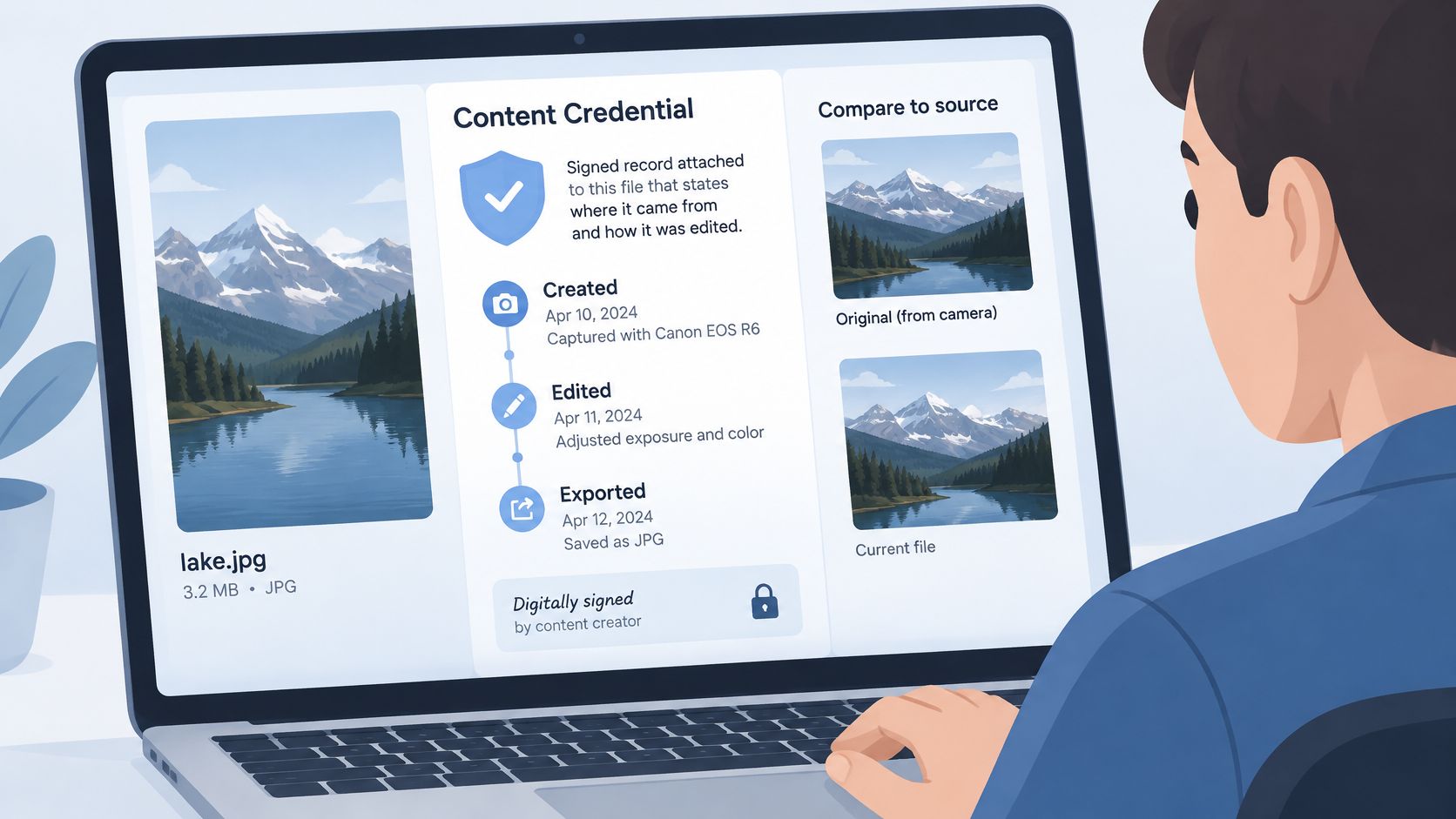
Before this approach, teams often relied on isolated platform labels, visible marks, or ordinary metadata that another service could delete without warning. Content Credentials aim for interoperable provenance that can travel with a file and be displayed consistently. The evidence is the recorded history, and the reader remains responsible for deciding what that history means.
The Parts of a Content Credential and What Each One Proves
| Component | What it holds | What it proves |
|---|---|---|
| Assertions | Facts about creation, editing actions, tools, capture details and AI involvement | What the signer states happened to the asset |
| Claim | Hashes of the assertions and the name of the claim generator | That the assertions are grouped and bound to one record |
| Claim signature | Signature made with the signer's credential | Who signed the record and that it has not been altered since |
| Content binding | Link between the record and the asset | That the asset matches the record |
| Manifest Store | Manifests from source files plus the final asset | The ingredient history behind the final asset |
The C2PA technical specification for Content Credentials calls this cryptographically bound structure a C2PA Manifest. Its parts answer different questions, and confusion starts when readers treat them as one general stamp of approval. Each part should be read on its own terms.
Assertions, Claim, and Signature
Assertions are the individual statements inside the record. One might identify the capture device, another might list a crop, another might record the editing tool, and another might state that AI was involved. Assertions describe what a participating system says happened.
The claim groups those assertions, hashes them, and identifies the claim generator. Hashing creates a compact fingerprint of data, so later changes produce a different result. The claim signature then signs that grouped record with a credential controlled by a person, organisation, or device.
A valid signature supplies integrity and attribution for the record. It shows the signed material hasn't changed and connects the record to a signer. It doesn't independently check every real world assertion, so the signer's identity, certificate chain, and trust model still matter.
Content Binding and Manifest Store
The content binding links the manifest to the exact asset. Standard manifests include one or more content binding assertions, preventing a reader from pairing a genuine record with a different file. If the file changes after signing, verification should expose that mismatch.
The Manifest Store handles ingredients. Say a camera records an original photo, a photo app adjusts exposure, and a newsroom system exports the final image. Each participating tool can add a signed event, and manifests from source files can travel with the final asset instead of collapsing into one vague edited label.
Readers can apply a simple exercise to any credential they encounter. List the assertions, identify the signer, confirm the binding, and check whether ingredient manifests are present or missing. A missing component doesn't always mean deception, but it defines the limit of what can be checked.
Why Credentials Survive Some Edits and Lose Others
| Transformation | Hard binding | Soft binding | Practical result |
|---|---|---|---|
| Recompression | Breaks | May survive | Rediscovery through the soft binding may recover the credential |
| Resizing or cropping | Breaks | May survive | Rediscovery may recover the credential, but the asset is changed |
| Format conversion | Breaks | May survive | Recovery requires the new format to keep the manifest or soft binding |
| Metadata removal | Manifest lost | May survive | Recovery requires the soft binding and a lookup mechanism |
| Copying into email or office software | May be stripped | May survive when preserved by the system | Treat the file as unverified until the credential is found |
A hard binding usually uses cryptographic hashing to tie a manifest tightly to a file. That strength makes it brittle by design, because changing the file changes its hash. A durable credential pairs it with a soft binding, such as an invisible watermark, fingerprint, or repository lookup, that may locate the record after ordinary transformations.
The C2PA explainer on Content Credentials describes a foundation of hashes, Merkle trees, and digital signatures, with structures such as COSE_Sign1 and certificates used for signed claims. It also links soft bindings to recovery after recompression, resizing, format conversion, or metadata removal. Recovery isn't the same as proving the changed file is unchanged, because the edit itself still needs a new signed event.
Where Ordinary Systems Break the Chain
Document management, email, and collaboration tools may strip or ignore provenance metadata while copying files. A credential can disappear during a routine upload, export, screenshot workflow, or conversion, leaving no obvious gap in the filename. For video teams, it's useful to compare descriptive and technical video metadata because descriptive fields, technical fields, and signed provenance serve different purposes and don't survive every system equally.
Ingredient records create another edge case. A primary asset may confirm ingredients were checked when used, yet full verification of each ingredient requires access to the underlying data. Without that data, a reader can confirm prior validation but not inspect the complete chain.
Editors dealing with copied text face a related discipline, even though the mechanism differs. The plain text converter illustrates a formatting cleanup step, while credential handling requires systems to preserve manifests at every editing stage. After material edits, the practical rule is to re-export with a new signed manifest rather than expecting the old record to describe the new file.
Reading a Credential Without Over-Trusting It
Verification works best as a sequence, not a glance at a badge. Each step narrows a different uncertainty, and skipping the signer check is the fastest route to over-trust. A guide comparing AI watermarks and AI detectors reinforces the broader habit of naming the signal before interpreting it.
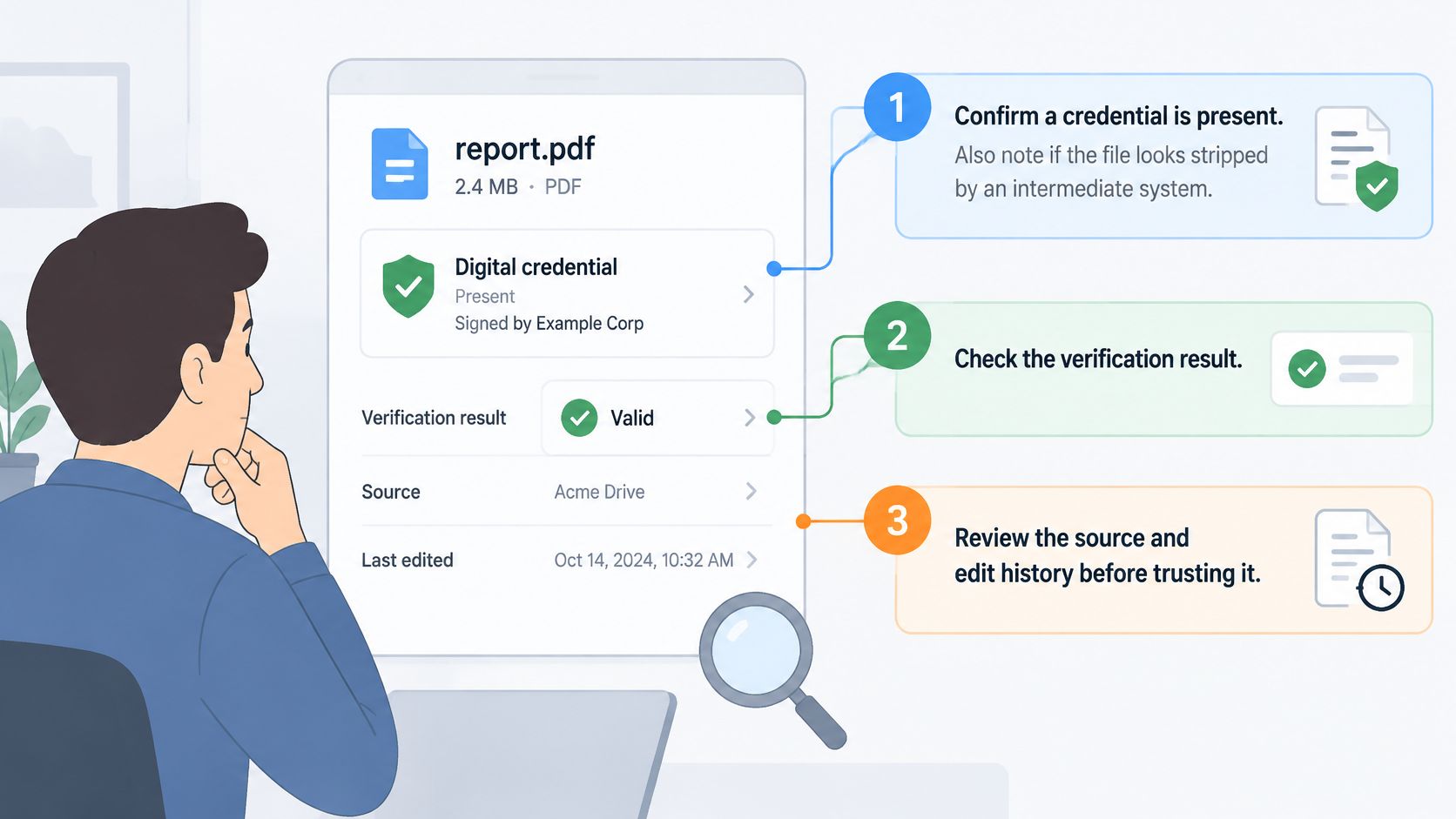
- Confirm presence: Check that a credential exists, and note whether an intermediate system may have stripped it.
- Run verification: Use a C2PA compatible verification tool and record the status it reports, because a valid signature is the first gate.
- Match the binding: Confirm the content binding applies to the exact file being reviewed, not an earlier export.
- Read the signer: Inspect the signer and certificate chain, then decide whether that signer is trusted for this kind of asset.
- Review assertions: Look for creation details, edit actions, tools, and any statement about AI involvement.
- Check ingredients: Treat missing ingredient records as an unfinished history, not as proof that no source files existed.
- Decide in context: Combine the technical result with sourcing, captions, rights information, and the publication risk.
A Wire Photo Example
Say a newsroom receives a wire photo with a valid credential from a known agency. Verification passes, the binding matches, the agency is the expected signer, and the assertions show original capture followed by a crop from a desk editing tool. That is a useful result because the record is intact and the crop is disclosed.
The photo still needs editorial checks. The caption might misidentify the location, an older image might be paired with a current event, or important context may sit outside the crop. The credential supports the recorded chain, while reporting must establish what the image shows.
Two reminders prevent the most common errors. A missing credential doesn't show human authorship, because many legitimate tools and delivery systems don't create or preserve one. A present credential doesn't prove every claim is accurate, because the signature authenticates the record and its signer, not the truth of each assertion.
Content Credentials and Text Watermarks Are Different Signals
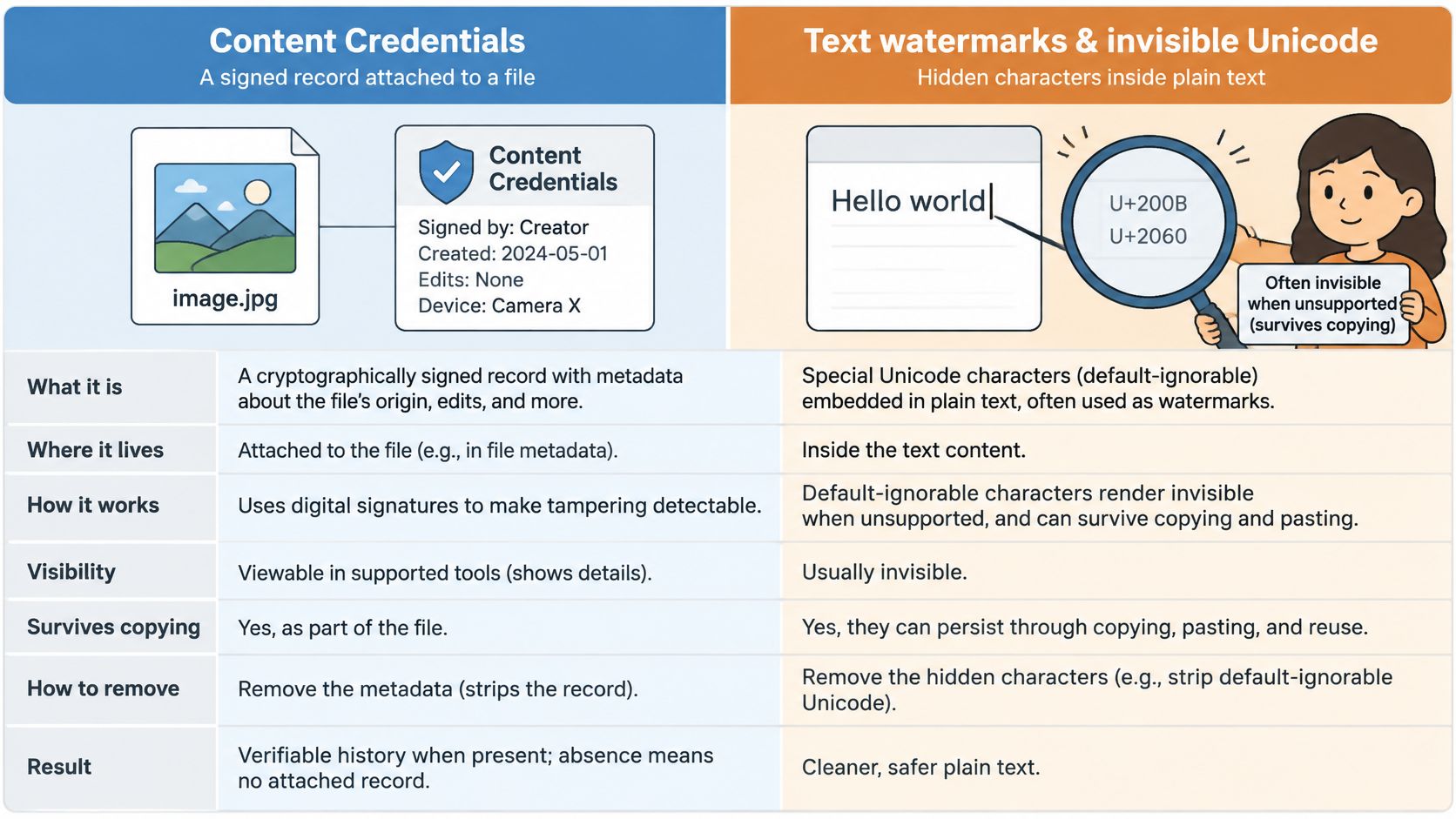
A content credential works like a signed luggage tag on a suitcase. It names who attached the record and whether that tag is still intact. A statistical text watermark is closer to a dye in the fabric: a pattern in how words were chosen. Hidden Unicode characters are a third thing, stray marks on the letters themselves.
| Signal | What it is | What it can show | What it cannot show |
|---|---|---|---|
| Content Credential | Signed manifest attached to or linked from the file | Who signed the record and whether it is intact | That every claim is true or that content is human-made |
| Statistical text watermark | Hidden pattern in token choices during generation | A statistical signal in the wording | Authorship on its own, or that plain-text conversion removed it |
| Hidden Unicode characters | Zero-width or direction-control code points | Formatting artifacts that need cleanup | Authorship; their presence is not evidence of AI writing |
| Plain-text conversion or line-break cleanup | Formatting edits to text | Cleaner, copy-safe text | Removal of a statistical watermark |
The common mistake is treating every invisible signal as the same kind of evidence. Unicode cleanup, standard Unicode normalization, and statistical watermark rewriting operate on different layers of text. Fixing one layer does not automatically change the others.
The Unicode FAQ on unsupported characters states that default-ignorable characters should render completely invisible and non-advancing when unsupported. Such characters can survive copying, disturb search or processing, and leave the visible words apparently unchanged. Removing them can produce safer plain text, but it does not alter ordinary word choice or token selection statistics.
Why Plain Text Isn't a Watermark Test
A statistical watermark shapes generation choices through a hidden pattern in token selection. Converting text to plain text, removing line breaks, or deleting zero-width characters cannot by itself establish that the statistical pattern is gone. Those actions change characters and layout, not necessarily the sequence of words carrying the pattern.
Say a paragraph pasted from a chatbot contains zero-width spaces between words. Those spaces justify cleanup because they can break copying, indexing, or downstream processing. They do not prove AI authorship, since hidden characters can arrive through browsers, documents, templates, and other copy and paste paths.
Simple Unmark is a text-only option in that narrower cleanup context. Its free browser-local tools, including the invisible character remover, line-break remover, and plain text converter, require no signup, credits, or upload. Those utilities do not rewrite wording or verify that a statistical watermark is gone. Rewriting through the AI watermark remover aims to keep the original meaning, facts, names, and tone, without promising an undetectable result or a detector verdict. Image, video, and audio credential checks still require a C2PA compatible verifier because Simple Unmark does not clean media or verify C2PA manifests.
Where Content Credentials Appear and Who Adopts Them
Adoption became harder to ignore during 2024. The University of Washington analysis of provenance and synthetic media records that in early February 2024, OpenAI adopted C2PA for images generated by its DALL-E 3 model, while Meta announced plans to use the standard for images on Facebook, Instagram, and Threads. Two days later, Google joined the C2PA steering committee and indicated plans to integrate the approach into its products.
Those moves connected the standard to large consumer distribution systems and a widely used image generator. Scale increased further by 2026. Coverage citing TikTok in an overview of provenance standards in production states that TikTok had labeled more than 3 billion videos using Content Credentials alongside its own labels and watermarks.
The C2PA news page reported in 2026 that more than 6,000 members and affiliates had live applications of Content Credentials. That number signals production use, not universal coverage. Plenty of publishing surfaces still strip, ignore, or fail to display provenance.
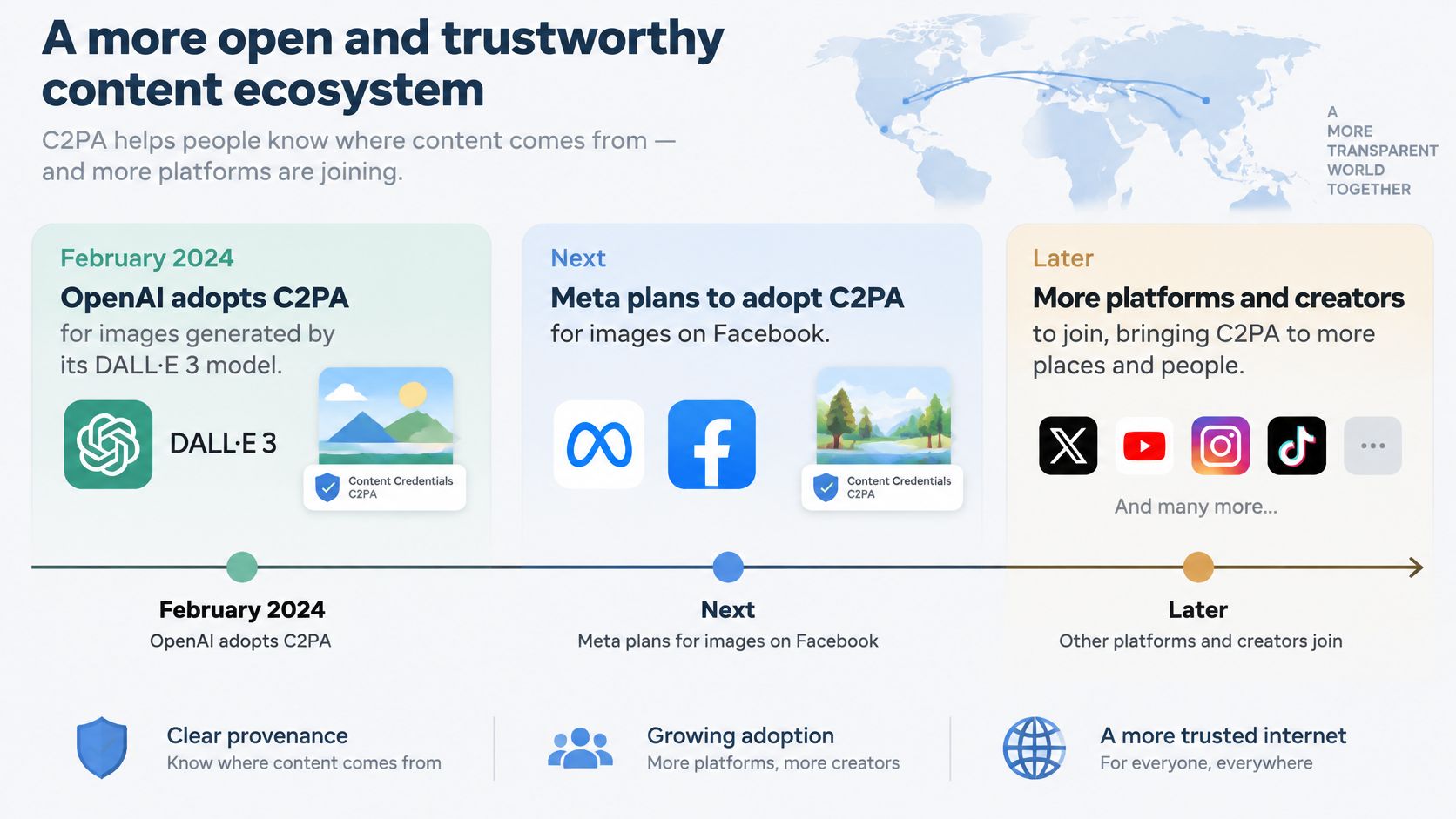
In practice, credentials appear where origin affects a decision. Newsrooms check wire photos before publication, brands confirm campaign assets, platforms display verification status, and compliance teams review AI assisted material. Marketing teams that build creator-style ads with AI also need clear records of generated and edited assets, especially when several tools touch one campaign file.
Incomplete adoption changes interpretation. A missing credential from a source that normally supplies one deserves a question, while absence from an older camera or office workflow may mean nothing more than an unsupported path. Publishers should inventory the surfaces they use, note which ones display credentials, and identify the handoffs that remove them.
Set a Publishing Rule for Files With and Without Credentials
A team policy removes guesswork at deadline. It should define the default treatment for verified, partially documented, and unverified files before a disputed asset arrives.
- Valid credential: Treat it as evidence of integrity and attribution for the record, not proof that the content is true.
- Trusted signer: Require a signer the team already trusts for that file type, after checking identity and certificate chain.
- Editing chain: Keep the manifest through every stage, and re-export with a new signed record after material edits, including work such as changing scenes without altering products, where the final image differs materially from the source.
- No credential: Label the file unverified rather than human-made, and state the basis for any published origin claim.
- Text drafts: Run a hidden character check before publishing, since invisible characters are a formatting issue and cleanup doesn't remove a statistical watermark.
For step 5, Simple Unmark offers three free browser local utilities at its tools page, the Invisible character remover, Remove line breaks, and Plain text converter. They require no signup, credits, or content upload, and they don't rewrite wording or verify statistical watermark removal. Its methodology page explains how claims are sourced, what gets tested, and what the service refuses to claim.
The remaining decision is operational. Teams should name which file types require a credential check before publication and which may proceed with a clear unverified label and normal editorial sourcing.
Writers and editors who need to separate hidden character cleanup from statistical watermark questions can use the free local text tools and meaning preserving rewrites described by Simple Unmark. The service is text only, requires human review of rewrites, and doesn't promise a detector outcome, making it a bounded cleanup step rather than a substitute for C2PA verification.
- content credentials
- C2PA
- digital provenance
- AI content authenticity
- provenance metadata
Related articles
AI Generated Text Explained: Signals, Detection and Limits
Learn what AI generated text is, how watermarks and detectors read it, why results stay uncertain, and how to clean hidden characters safely.
Free AI Text Checkers: 10 Options and Review Limits
Compare free AI text checkers by current allowances, account needs and reporting. Treat scores as screening signals alongside source evidence.
AI Essay Checkers: 10 Tools and Their Limits
Compare essay checkers by review workflow, reporting and privacy. Separate AI-writing estimates, plagiarism checks and text cleanup.