AI Writing for Students: A Responsible Workflow Guide
Master AI writing for students with practical steps for drafting, cleaning text, citation, and avoiding plagiarism while preserving academic integrity.
95% of students now use AI in at least one way, and 12% include AI-generated text directly in assessed work. The question isn't whether AI writing is part of student life anymore, but whether you'll use it without surrendering your judgment, authorship, or academic standing.
You're probably dealing with a half-finished assignment, a blank document, or an AI draft that sounds polished until you read it aloud. The sentences are smooth, but the argument feels borrowed. Some phrases may contain invisible formatting artifacts, and the sources may be unreliable. That's where students get into trouble, not because every use of AI is automatically dishonest, but because they submit machine output before doing the work of becoming its author.
AI writing for students needs a workflow, not a panic response. Use AI to get unstuck, then take control of the ideas, evidence, wording, citations, and final explanation.
Table of Contents
- The New Normal for Student Writing
- Building a Responsible Drafting Workflow
- Understanding Watermarks and Detection Limits
- Knowing the Line Between Assistance and Ghostwriting
- Pre-Submission Verification Checklist
- Final Thoughts on Academic Integrity
The New Normal for Student Writing
A student asks AI for possible angles, accepts its outline, and pastes a paragraph into an assignment. Another uses AI to clarify a difficult concept, then writes the response independently. Both used AI, but their academic situations are not equivalent. The difference is who did the thinking and who can defend the final work.
The scale of adoption makes “just avoid AI” unrealistic advice. A 2025 HEPI/Kortext survey of 1,041 full-time undergraduates found that 92% used AI in some form, up from 66% in 2024. 88% used generative AI to help with assessments, up from 53% the previous year, and 18% included AI-generated text directly in their work. Inside Higher Ed's coverage of the HEPI findings reports that by 2026, 95% used AI in at least one way, 94% used generative AI to help with assessed work, and 12% directly included AI-generated text in assessed work. Read as a trend, adoption rose while direct inclusion fell.
AI is no longer a novelty limited to university essays. High school students already use it for early writing tasks. A 2025 College Board research brief reported that generative AI use for schoolwork rose from 79% in January 2025 to 84% in May 2025, with half of students using it to brainstorm, revise essays, or research sources. UCLA's summary of student AI perspectives also notes that 69% identified ChatGPT as their preferred generative AI tool.
Detection is not a substitute for judgment
Fear of detection misses the practical risk. Detection systems can produce unreliable results, and a false accusation can harm a student who wrote the work independently. Your strongest protection is a process you can explain, supported by drafts, notes, sources, and genuine understanding.
Oxford guidance says available tools cannot reliably determine whether AI was used or serve as the basis for academic decisions. OpenAI's educator guidance likewise describes detector limitations, including false flags for human writing and possible effects on ESL students and writers with concise or formulaic styles. The practical rule is straightforward: a detector score is not proof of authorship.
Do not submit untouched AI text. Review it for unsupported claims, borrowed phrasing, weak citations, and hidden Unicode or probabilistic watermark artifacts. A post-generation cleanup step, using a tool such as Simple Unmark where appropriate, helps remove machine residue before you format and submit legitimate work. It does not turn ghostwritten text into your own.
For field-specific research, a curated resource such as an overview of AI tools for academic writing can help you compare use cases. Choose tools for a defined task, then follow your course policy and take responsibility for every sentence.
Building a Responsible Drafting Workflow
The safest workflow starts with your thinking, not with a request for a finished essay. Treat AI as a limited assistant that can help you generate possibilities, identify gaps, and improve clarity. It shouldn't become the hidden author of your assignment.
Start with ownership
Write your working thesis, key claims, and evidence in your own words before opening an AI tool. If you can't state the argument yourself, you aren't ready to ask a chatbot to expand it. AI can make a weak idea sound confident, which is exactly how students end up submitting fluent nonsense.
Use prompts that keep the intellectual work visible:
- Brainstorm: Ask for competing angles, questions, or counterarguments. Don't ask for a finished introduction.
- Clarify: Ask the tool to explain a concept at a different level, then check the explanation against your course materials.
- Plan: Request an outline based on your thesis and sources. Reject any section that doesn't serve your argument.
- Draft selectively: Write the core paragraphs yourself. If you use generated wording, mark it clearly for later review.
- Verify: Check every factual statement, quotation, citation, and reference independently.
For research-heavy assignments, Model Diplomat's research playbook offers useful context on using AI during research without treating its output as evidence. The rule is simple: an AI answer can point you toward a source, but only the source can support your claim.
Add a cleanup pass
Raw AI text often carries odd spacing, hidden Unicode characters, direction controls, or repetitive wording. These artifacts don't prove misconduct, but they can make pasted text look careless and machine-produced. A cleanup pass also gives you a forced pause before submission, which is valuable because most weak AI-assisted assignments fail through passive copying.
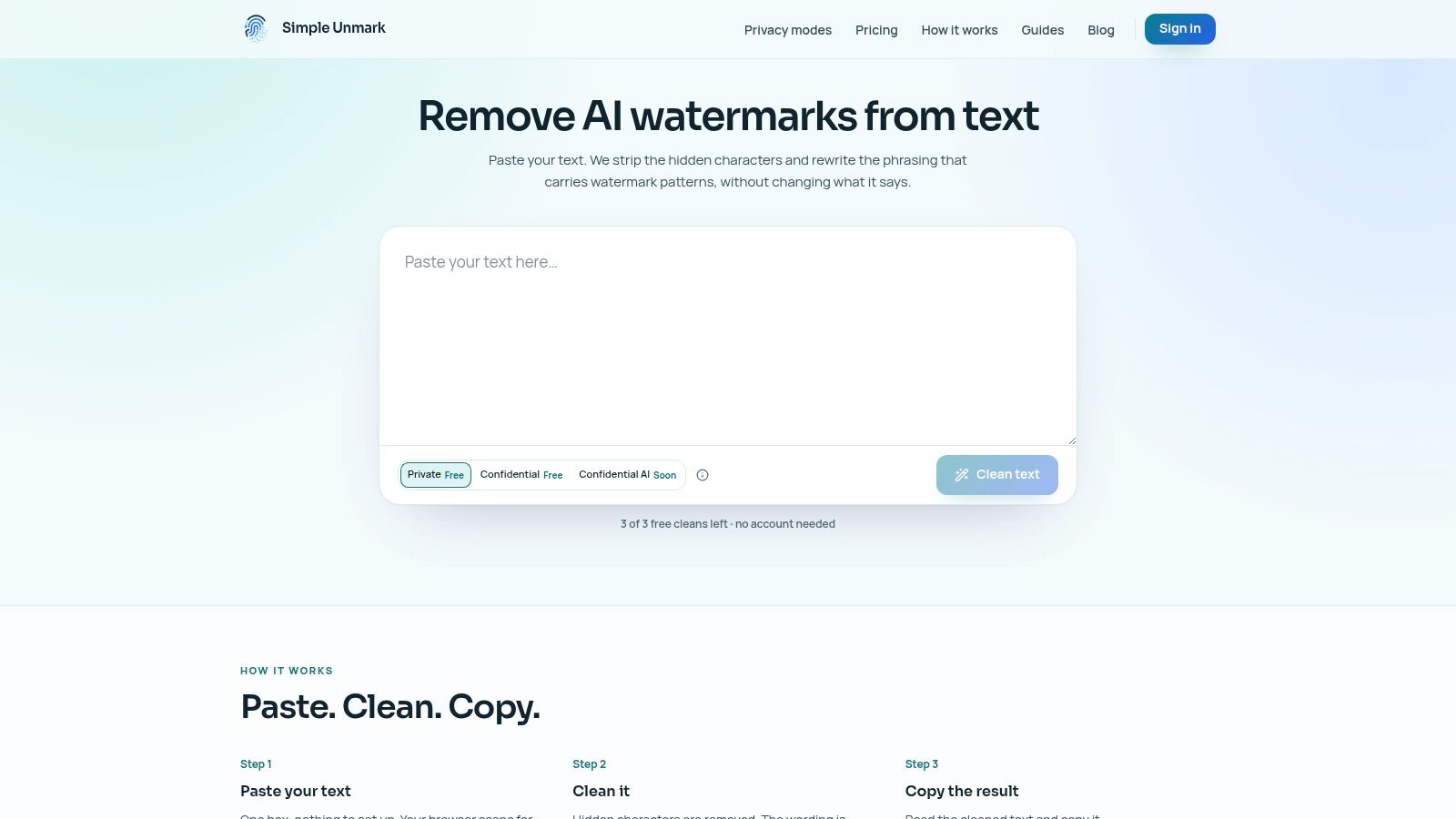
A paste, clean, copy loop works like this:
- Paste the draft: Put the text into a cleaning tool and inspect what it identifies.
- Strip hidden artifacts: Remove zero-width marks, unusual spaces, and formatting controls.
- Rewrite cautiously: Rephrase generic or statistically predictable wording while preserving facts, numbers, proper nouns, tone, and intent.
- Copy the result: Move the cleaned text into your document, then edit it yourself.
- Read it again: Cleaning isn't authorship. Restore your examples, qualifications, and natural phrasing.
Simple Unmark is one option for this specific pass. It removes hidden Unicode characters and rewrites passages to reduce probabilistic watermark signals, including SynthID-style patterns, while aiming to preserve the text's meaning and factual details. Its public explanation of how AI text watermarks work is useful if you want to understand the difference between invisible characters and statistical signals.
Practical rule: Never use cleanup to disguise an essay you didn't write. Use it to remove formatting debris, expose weak phrasing, and create a clean draft you can genuinely explain.
The final responsibility stays with you. If a cleaned paragraph contains an argument you wouldn't have made, delete it. If it includes a citation you haven't opened, remove or verify it. A cleaner surface can't rescue borrowed reasoning.
Understanding Watermarks and Detection Limits
A student submits a polished essay, then gets questioned because a detector assigns it a high AI score. That score does not establish authorship. Students need to separate two different risks before reacting.
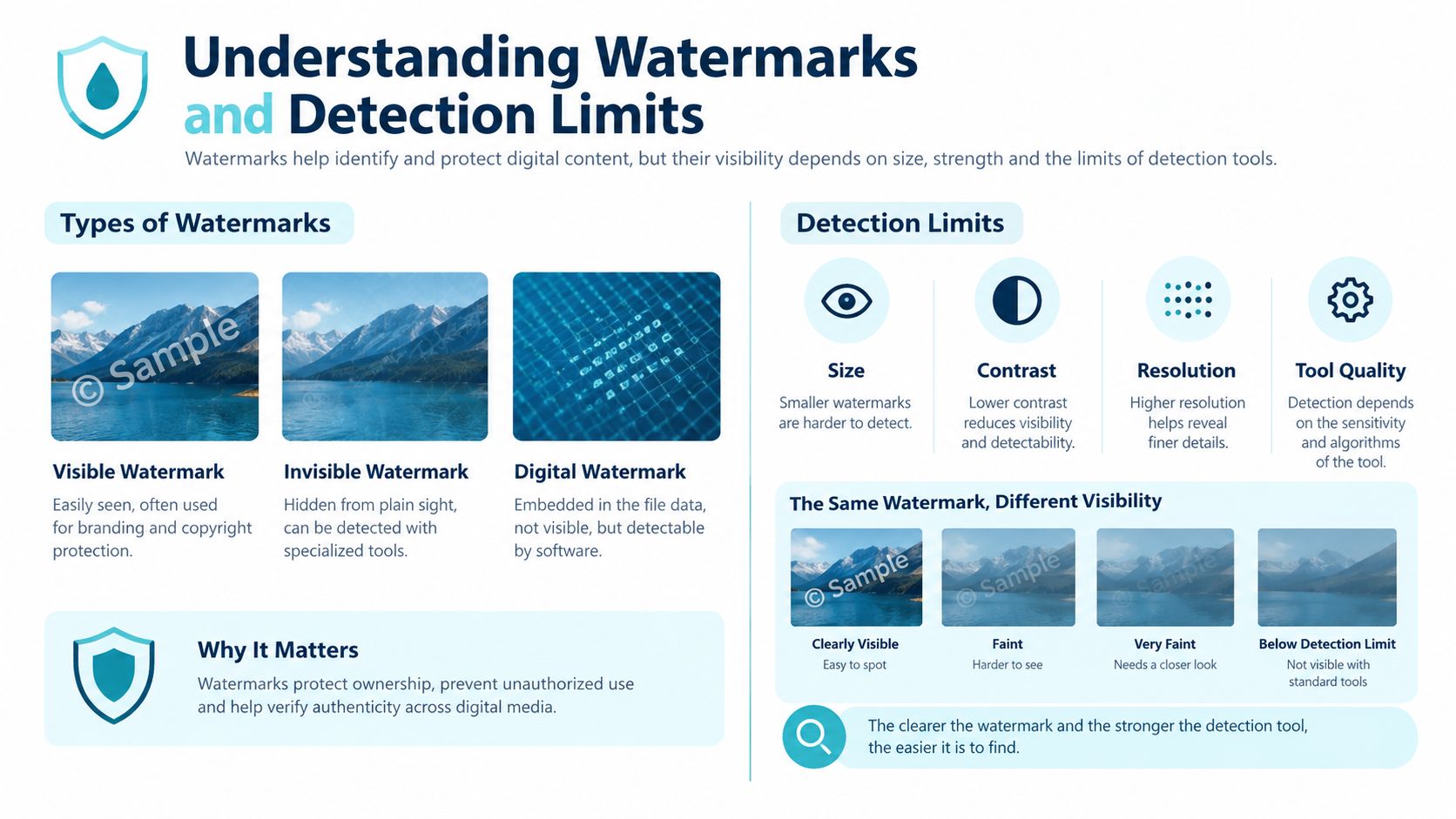
A hidden Unicode artifact is an invisible character or formatting control that can survive copying and pasting. Zero-width characters and unusual spacing belong in this category. A statistical watermark works differently. It uses patterns in token selection, so ordinary-looking wording may still contain a probabilistic signal.
Methods associated with Gemini and SynthID are discussed as producing statistical traces, but those traces are not permanent proof. Rewriting changes token choices. Human editing, translation, formulaic prose, and short samples can also influence a detector's result. Treat the output as limited evidence, never as a verdict. For a practical explanation of AI watermarks versus AI detectors, separate invisible formatting from statistical signals before deciding what to clean.
Why detector scores don't settle authorship
Available detection tools cannot reliably establish whether a person or an AI system produced a text. CASRAI likewise states that no field-wide numeric threshold definitively proves AI authorship. A university cutoff reflects institutional policy, not a scientific finding. The Oxford AI Centre discussion explains why uncertain scores should not become automatic academic judgments.
OpenAI's own testing showed its detector flagging human writing as AI-generated, and independent evaluations have found short, formulaic samples especially prone to false positives. A student facing such a result may need to contest it in an academic hearing by presenting drafts, revision history, source notes, and a clear explanation of the argument. Formal phrasing or predictable structure alone should not carry the burden of proof.
Cornell recommends process-based checks rather than dependence on detector scores. Instructors can ask students to verify citations, explain their methods, and discuss their work verbally when necessary. These checks test whether the student understands the submission instead of pretending software can identify intent. Cornell's academic-integrity guidance offers a more defensible standard.
Keep your process traceable, your sources accurate, and your ideas explainable. Cleanup tools can remove artifacts, but they cannot prove that borrowed reasoning belongs to you.
Knowing the Line Between Assistance and Ghostwriting
The ethical line isn't “AI used” versus “AI not used.” The stronger distinction is support versus substitution.
Support helps you perform your own intellectual work. Substitution hands that work to a system and leaves you with a document bearing your name. Grammar feedback, translation support, brainstorming, and requests for counterarguments can sit on the assistance side, depending on your instructor's rules. Asking a chatbot to generate the entire essay, invent the evidence, or write in your voice crosses toward ghostwriting.
Student attitudes reflect that difference. In a survey of 2,555 students, 70.4% opposed using tools such as ChatGPT to write a whole essay, while 54.1% supported or somewhat supported tools such as Grammarly for revision. Another study found that 64.2% had used LLMs in some way for a writing assignment in 2024, up from 31.2% a year earlier. The Springer study on student writing and generative AI shows both rapid adoption and a persistent boundary around full-draft generation.
A practical comparison
| Use | What you contribute | Risk level |
|---|---|---|
| Brainstorming questions | You select the issue and develop the argument | Usually lower, subject to policy |
| Explaining a difficult concept | You verify the explanation and apply it yourself | Usually lower |
| Grammar or clarity feedback | You wrote the substance and accept or reject edits | Often acceptable when permitted |
| Generating a complete essay | The system supplies the structure, reasoning, and prose | High, often misconduct |
| Fabricating references or quotations | The system replaces research altogether | Unacceptable |
A large U.S. university survey of 277 students found that 52% used AI at least weekly for paraphrasing, summarizing, or translating writing, 50% used it weekly for feedback on academic writing, and 42% used it weekly to complete writing assignments. The study also found that ethical beliefs were the strongest predictor of whether students viewed AI-assisted writing as misconduct, while policy awareness had little or no significant effect on behavior or judgments. Duke's summary of the student writing survey supports a blunt conclusion: knowing a rule matters, but your decisions still depend on whether you understand why authorship matters.
Policies differ sharply. UC Santa Barbara says AI writing tools aren't allowed in student work unless an instructor or supervisor specifically permits them, placing that rule under its Student Conduct Code and academic-integrity policy. UCSB's guidance on AI writing tools should remind you to check the syllabus before you experiment.
Before using a tool, ask yourself: Could I explain the argument, source every claim, reproduce the reasoning, and describe exactly how AI helped? If the answer is no, you haven't assisted your writing. You've outsourced it. For related technical background, this guide to hidden Unicode and statistical watermarks can clarify text artifacts, but technical cleanup never changes the authorship rule.
Pre-Submission Verification Checklist
Your document is not ready because the prose sounds polished. It's ready when every important part survives scrutiny from you, your instructor, and the sources you cite.
Check the evidence first
Open every reference. Search the title, author, publication, and relevant passage in Google Scholar or your library database. AI tools can produce plausible-looking citations that point to the wrong article, merge several sources, or invent a reference entirely.
Use this quick audit:
- Citations: Does every in-text citation support the exact claim beside it?
- Quotations: Did the author write those words, in that context?
- References: Can another reader locate each source?
- Numbers: Did you copy every figure accurately and explain what it measures?
- Examples: Are they yours, documented, and relevant?
A practical reference correctly guide can help if your citation habits are weak. Don't treat formatting as decoration. Accurate attribution shows where your thinking ends and another person's work begins.
Listen for the student who wrote it
Read the assignment aloud. Stiff transitions, repeated sentence shapes, inflated vocabulary, and paragraphs that all sound equally polished are signs that you need to revise. Watch for generic AI-isms such as “delve,” “tapestry,” and “key,” especially when they don't sound like words you'd normally use.
Then compare the paper with your notes and earlier drafts. Your final version should contain your examples, your qualifications, and your actual level of understanding. Cleaning software may remove invisible characters or alter predictable wording, but it won't add intellectual ownership.
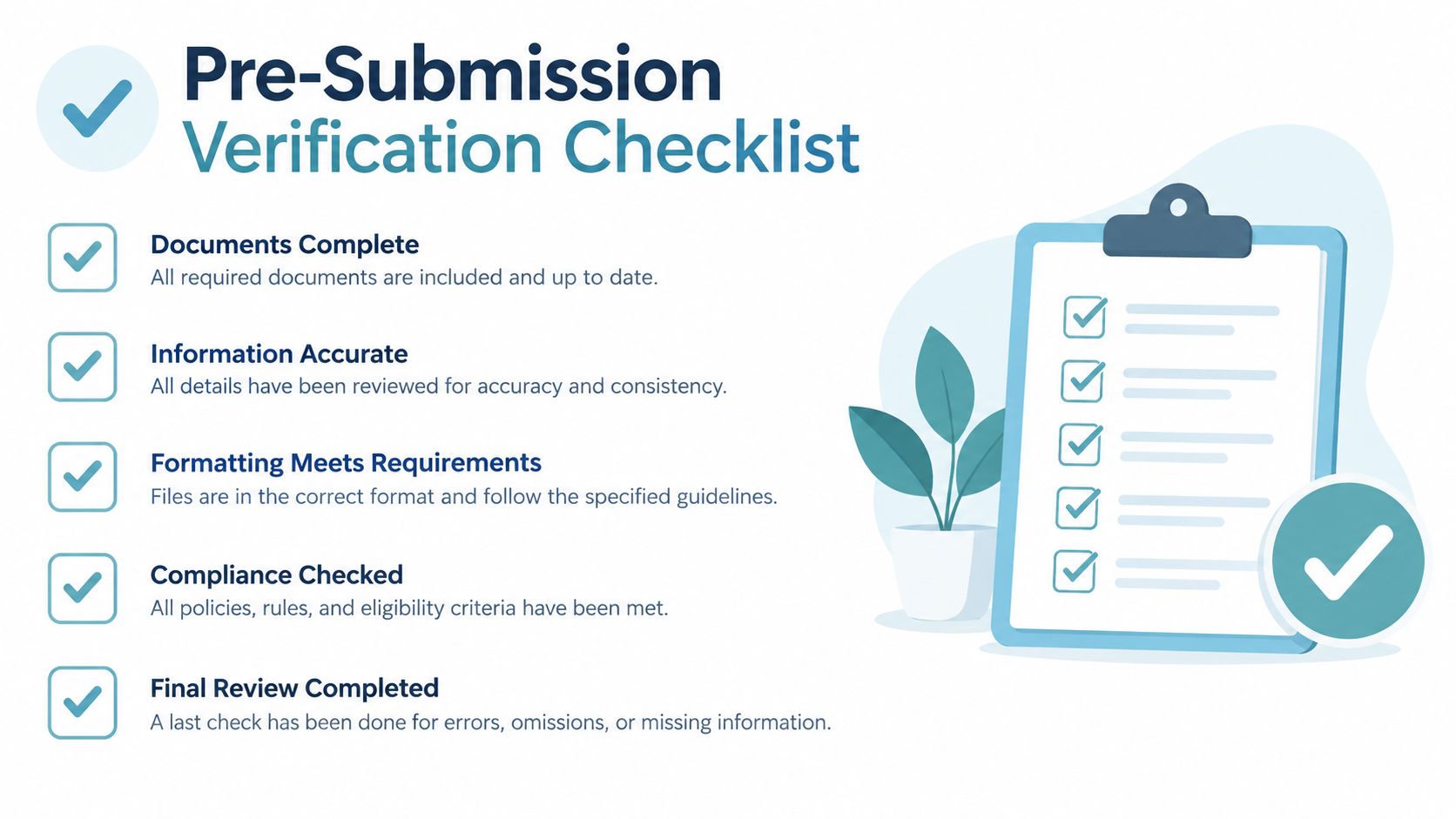
Final test: Explain every paragraph without opening the document. If your professor asks why you chose a source, made a claim, or arranged the argument that way, you should have an answer.
Finally, check the course policy one more time. If disclosure is required, disclose the tool and the type of assistance. If AI use is prohibited, don't try to make prohibited work look acceptable through rewriting. Submit work you produced within the rules.
Final Thoughts on Academic Integrity
AI can help students work faster, but speed isn't the same as learning. A chatbot can suggest a clean paragraph in seconds. It can't take responsibility for a false citation, defend your interpretation in a seminar, or explain why your conclusion follows from the evidence.
Responsible AI writing for students has four parts: start with your own ideas, use AI for permitted support, clean and revise the output, and verify everything before submission. The cleanup step matters because pasted text can contain hidden artifacts and generic phrasing. The verification step matters more because no rewrite can turn an invented source into a real one.
Students also need to understand why institutions are cautious. A 2025 study found that 71.7% of learners never reviewed AI-assisted work for plagiarism, while many were only somewhat concerned about plagiarism. The study on learner practices and plagiarism concerns points to a practical weakness in current advice: students need clear disclosure rules and revision habits, not only warnings about detection.
Use AI as a tool you can question, reject, and correct. Keep the thesis yours. Keep the evidence real. Keep enough drafts and notes to show how the work developed. Your goal isn't to make machine text look human. Your goal is to submit work that reflects a human student who did the thinking.
Simple Unmark offers a paste, clean, and copy workflow that removes hidden Unicode artifacts and rewrites wording to reduce probabilistic watermark signals while preserving meaning, facts, numbers, proper nouns, tone, and intent. Visit Simple Unmark to clean an AI-assisted draft before you review it yourself, verify its sources, and submit only work you can fully defend.
- ai writing
- students
- plagiarism
- academic integrity
- writing tools
More posts
Text Watermark Remover: How It Works in 2026
Find a text watermark remover that actually works in 2026. Learn how hidden watermarks are detected and what rewriting-based cleanup really delivers.
How to Remove Watermarks from AI Text in 2026
Learn how to remove watermarks from AI text honestly. Covers SynthID, hidden Unicode, and practical rewriting methods with clear limits and verification steps.
Watermark Remover Online: What Works and What Doesn't
Compare watermark remover online options for AI text. See how rephrasing, Unicode cleanup, and token edits differ, plus where Simple Unmark fits.