
AI Rewriting Tool: What It Does and How It Works
Learn how an ai rewriting tool works, where it helps, the watermarking risks involved, and how to fit one into a clean editing workflow.
The most popular advice about AI rewriting tools is also the least useful: keep rewriting until a detector says the text looks human. That's not an editing standard. It's a score-chasing exercise that can leave you with weaker prose, altered facts, and no credible evidence of who wrote what.
Use an AI rewriting tool to improve a draft, not to manufacture an authorship claim. The useful work is concrete: cleaner wording, controlled changes to sentence structure, and removal of inappropriate hidden characters.
Table of Contents
- The Honest Truth About AI Rewriting Tools
- What an AI Rewriting Tool Actually Is
- How Watermarks Get Embedded in AI Text
- Why Rewriting Changes the Signal
- Where an AI Rewriting Tool Fits in a Real Workflow
- What a Clean Detector Score Does Not Prove
- A Practical Editing Workflow With an AI Rewriting Tool
The Honest Truth About AI Rewriting Tools
A rewrite doesn't guarantee natural prose. It can replace stiff wording with different stiff wording, flatten a distinctive voice, or turn a carefully qualified statement into an unsupported certainty. Judge the result as an editor, not as someone watching a progress bar.
People arrive at these tools with different motives. Some want detector bypass, some want plagiarism insurance, and some want to publish AI-assisted text without disclosure. No rewrite guarantees any of those outcomes. Changing language doesn't establish originality, and it doesn't override a client's contract, a publisher's rules, or an academic policy.

Set the right objective
An AI rewriting tool can produce alternative phrasing, change token sequences, and make awkward material easier to edit. Whether those changes help depends on the assignment. A concise support response needs different treatment from a research summary or a first-person essay.
- Clarity: Remove repetition, tangled syntax, and unnecessary setup.
- Consistency: Bring a mixed-source draft closer to a defined editorial voice.
- Signal reduction: Treat changes to statistical patterns as a technical outcome, not a certificate of human authorship.
- Accountability: Keep responsibility for claims, attribution, and disclosure with the writer or editor.
Research on cooperative watermarking describes a basic boundary: detectors looking for a compatible watermark cannot cover text from systems that never implemented it, and editing can degrade that signature. That's a limitation of the mechanism, not proof that the resulting text is human-written. See the research synthesis on watermarking scope and robustness.
Editorial rule: Accept a rewrite because it improves the document. Reject it if it makes the document less accurate, even when the detector score looks better.
What an AI Rewriting Tool Actually Is
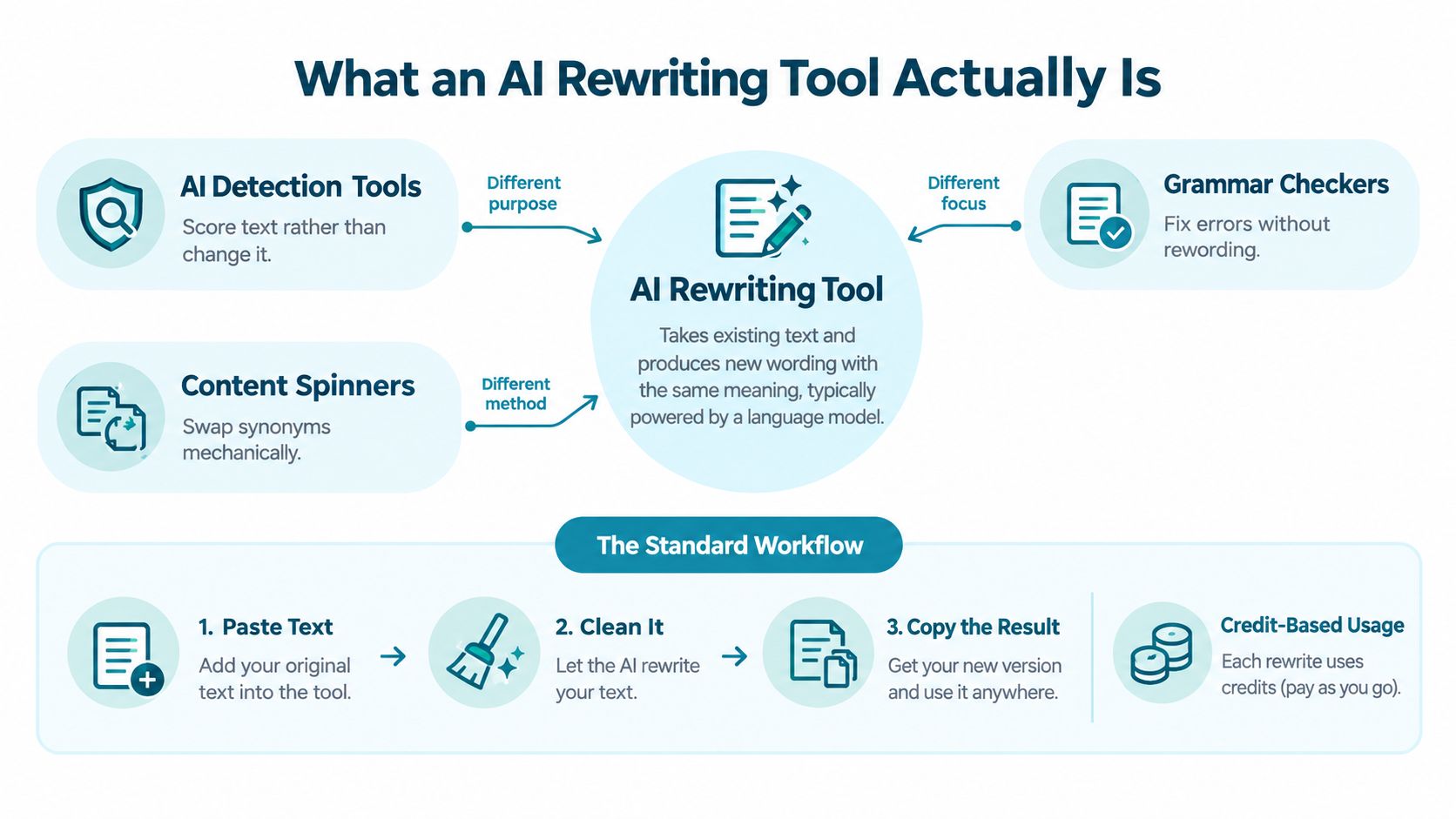
An AI rewriting tool takes an existing passage and produces new wording intended to preserve its meaning, typically through a language model. Unlike generation from a blank prompt, rewriting starts with material that already contains claims, structure, and an intended message.
That distinction matters. If you need ideas for a new social post, iHatePosting can help you generate TikTok captions easily. If you already have a caption and need tighter wording without changing its message, you're asking for rewriting rather than fresh generation.
Know which job you're buying
| Category | Primary job | What to inspect |
|---|---|---|
| AI rewriting tool | Reword an existing passage | Meaning, factual fidelity, voice |
| AI detection tool | Evaluate text rather than change it | Scope, thresholds, uncertainty |
| Grammar checker | Correct language errors | Whether corrections alter meaning |
| Content spinner | Substitute words mechanically | Awkward phrasing and lost nuance |
These are useful distinctions between functions, not rigid product boundaries. A single application may combine several of them. Don't assume a detection feature makes its rewriting feature reliable, or that a grammar correction is harmless in technical prose.
Understand the paste-clean-copy loop
The basic workflow is straightforward: paste the draft, inspect the input, run a clean or rewrite, review the output, and copy the accepted version. Local scan feedback can flag hidden-character issues as text is entered. It shouldn't be confused with an authorship verdict.
A pass is a processing run. A clean may combine character cleanup and wording changes. A credit is a billing unit, not a measure of editorial quality.
Keep signal and watermark separate, too. Signal describes evidence a detector evaluates; a watermark is a deliberately embedded pattern. A product that changes wording may affect that evidence, but the interface alone tells you nothing about whether the final passage is accurate or suitable for publication.
How Watermarks Get Embedded in AI Text
A statistical text watermark isn't a hidden stamp attached to a paragraph. It's a pattern created while the system chooses tokens during generation. Looking for a suspicious word or deleting an invisible character won't locate that pattern.
Google's SynthID Text modifies the probability distribution used to select the next token. A detector later compares the resulting choices with expected watermarked and unwatermarked patterns, as described in the report on Google's release of text-watermarking technology.
Think about patterns, not labels
Consider a sequence of cards in which one suit appears slightly more often than you'd expect by chance. No individual card announces that the sequence was manipulated. The evidence comes from the distribution across the sequence.
The analogy isn't exact, but it explains why length matters. A short sequence offers little evidence. A longer sequence gives the evaluator more observations, although the evaluation conditions still matter.
Technical summaries report that SynthID-Text can exceed 95% detection at below 1% false positives on sufficiently long Gemini outputs of 200 or more tokens. Those are conditional results, not a promise for every document, according to the technical discussion of SynthID-Text detection and length.
Separate the mechanism from the interface
The paste-clean-copy interface shown above is what the user sees. Token sampling is what creates the watermark in the first place. Don't confuse a convenient workflow with evidence about the underlying detection mechanism.
For a more focused explanation, the guide to how AI text watermarks work covers the distinction between generated token patterns and visible text.
The practical conclusion is narrow: an AI rewriting tool changes an existing sequence. It doesn't reach back into the original generation process, identify a removable stamp, or reveal the author's identity.
Why Rewriting Changes the Signal
Deleting punctuation and rebuilding a sentence are different operations. They may both make a passage look different, but they don't necessarily change the underlying token sequence to the same extent.
Technical descriptions of SynthID explain that candidate-token scoring depends on generation context and a private watermarking key. The published configuration described in the SynthID technical overview uses a four-token context window with Bernoulli-distributed scoring values. Context, not just individual vocabulary, matters.
Compare the depth of the edit
| Edit type | What changes | Main limitation |
|---|---|---|
| Surface edit | Capitalization, punctuation, isolated terms | Much of the original sequence remains |
| Synonym substitution | Selected vocabulary | Sentence structure may remain awkward or unchanged |
| Substantive rewrite | Syntax, clause order, phrasing, local context | Greater opportunity to alter meaning accidentally |
Synonym substitution isn't irrelevant. A peer-reviewed review reports that paraphrasing weakened detection, while a separate synonym-replacement tokenization technique recovered approximately 30 percentage points of detection performance. The review of paraphrasing and detection preprocessing shows why the result depends on both the edit and the detector's processing method.
Preserve the parts that shouldn't move
The editorial risk increases when a tool treats every word as replaceable. Names, quantities, technical terms, quotations, and qualifying language need explicit protection. Changing “may” to “will” isn't polishing. It changes the claim.
- Protect meaning: Keep causation, conditions, exceptions, and uncertainty intact.
- Allow structural changes: Let the tool improve clause order and sentence construction where those changes help readability.
- Reject decorative churn: Different vocabulary isn't useful if it introduces ambiguity.
More changed words don't automatically mean a better rewrite. Structural improvement matters, but factual fidelity comes first.
Hidden-character cleanup is a separate operation. The guide to hidden Unicode versus statistical watermarks distinguishes string cleanup from changes to generated wording. Don't treat either operation as a substitute for reviewing the other.
Where an AI Rewriting Tool Fits in a Real Workflow
Consider a freelance writer preparing a Gemini-assisted draft for a client. The useful assignment is to tighten transitions, remove repetitive phrasing, and match the commissioned voice. The writer should retain the original prompt, source material, and accepted edits, rather than ask the tool to make the draft appear unaided.
A blog editor has a different problem: a manuscript assembled from interviews, contributor copy, and AI-assisted notes. Rewrite only the passages that need standardization. Protect interview quotations and distinctive observations instead of smoothing the entire article into the same bland register.
Match the intervention to the document
- Freelance delivery: Use rewriting for readability and tone. Keep the client's disclosure requirements alongside the draft, and don't interpret a cleaner passage as permission to ignore them.
- Blog editing: Maintain a house-style sheet and an edit log. Preserve source boundaries so an editor can still distinguish reported material from connective prose.
- Academic preparation: A student revising an AI-assisted research summary should keep quotations intact, check claims against the cited works, and follow the institution's permitted-use rules.
- Compliance review: Audit both the text and its provenance. Ask for the source draft, supporting citations, and the disclosure decision before approving publication.
These are editorial scenarios, not claims about measured results. Their value is in assigning responsibility correctly: the tool changes text; the person reviewing it decides whether the changes are acceptable.
Know when to leave the draft alone
Rewriting is a waste of credits when the paragraph is already clear and the only objective is a more reassuring score. It's also a liability when nobody can verify the subject matter.
For technical, legal, or research material, send uncertain passages to someone who understands the claims. If the original source is missing, recover it before polishing the prose. A smoother sentence can make an unsupported statement harder to notice, not easier to defend.
What a Clean Detector Score Does Not Prove
A clean score means the detector didn't return the evidence needed for its chosen result. It doesn't establish who wrote the passage, whether the writer used AI elsewhere, or whether the text was edited after generation.
Watermark detection and authorship verification are different tasks. SynthID targets a supported watermark pattern, not an identity record. Thorough rewriting or translation can weaken confidence, but a lower result doesn't reconstruct the document's history.
Understand what a miss looks like
A false negative occurs when a detector misses a watermark that is present. A false positive occurs when it flags material that shouldn't receive that classification. Neither outcome supports treating the interface as an infallible judge.
A resilience assessment reported that meaning-preserving paraphrasing removed detection in 100% of initially detected KGW and Unigram texts and 98.3% of initially detected SynthID texts. In its tested SynthID setting, it also reported an 80% false-negative rate, a 5.4% false-positive rate on paraphrased human-written controls, and 80% of pristine outputs classified as uncertain. These are results from the specific watermark robustness assessment, not universal detector performance figures.
Keep the conclusion narrower than the test
Those findings don't mean every rewrite defeats every detector. They show why an absent detection result can coexist with known AI-generated provenance.
The distinction between AI watermarks and AI detectors matters when an editor or reviewer interprets a score. Ask what the detector measures before accepting any claim based on it.
For reviewers: A detection result is an observation under test conditions. A provenance record is evidence about the production process.
For short or tightly constrained passages, be especially cautious about sweeping conclusions. Don't accuse a writer or certify human authorship from the score alone. Use the retained drafts, source checks, and documented edits to evaluate the work.
A Practical Editing Workflow With an AI Rewriting Tool
Start with the text itself, not the rewrite button. Unicode identifies default-ignorable characters, including the zero-width space U+200B, which can be invisible on screen yet affect string processing, search, and tokenization. Use the Unicode cleanup and security discussion to guide a scan before rewriting, and record which characters you remove.
Keep that scan selective. Some format characters serve legitimate linguistic or typographic purposes. Check direction controls and unusual spacing against the document's language before deleting anything.
Run a controlled editing pass
- Scan the input: Inspect hidden characters before changing wording. Record relevant cleanup instead of trusting what appears on screen.
- Set a pass budget: Decide how many rounds of reprocessing you will allow. Stop when the passage meets its editorial purpose, not when a detector score improves.
- State preservation rules: Tell the tool to retain facts, numbers, proper nouns, quotations, tone, and intent.
- Verify the output: Compare the accepted rewrite with the source. Check qualifiers, attribution, citations, and formatting as separate items.
- Record provenance: Keep a short account of the source prompt, generating system, human edits, supporting citations, and disclosure decision.
Use the VeloCMS AI-assisted editing guide as a companion to human review. Give the rewriting tool a narrow assignment, then make the editorial decisions yourself.
Choose features that support inspection
Simple Unmark is one option. It combines rewriting intended to reduce statistical watermark signals with automatic hidden-Unicode cleanup, and uses credit-based access without a required subscription.
Compare tools by transparent word counts, stated processing limits, preservation controls, and whether they let you inspect the cleaned text. Prefer a visible post-clean scan over an unexplained success message. Check how submitted text is handled before entering confidential material.
Keep the original draft beside the accepted version. Then check whether the document communicates its intended meaning accurately, with sources and production history accounted for. A lower detector score can show a changed signal. It does not establish who wrote the text.
Simple Unmark offers hidden-character cleanup and meaning-preserving rewriting for AI-assisted drafts. Use it to clean a passage, compare the result with the original, and keep only edits that improve the document.
- ai rewriting tool
- ai text rewriter
- paraphrasing tool
- AI watermarking
- content cleanup
More posts
10 AI Essay Checker Tools for Detection and Cleanup
Compare 10 AI essay checker tools for detecting AI-generated text, reviewing flagged passages, cleaning watermarks, and managing false positives.
Unicode Text Converter: What It Does and Why It Matters
Learn what a unicode text converter actually does, why pasted AI text behaves strangely, and how to remove invisible characters without breaking real content.

Undetectable AI Content Without the False Promises
Undetectable AI Content. Learn how to reduce AI-detection signals in text through rewriting, Unicode cleanup, quality checks, and honest limits—without